
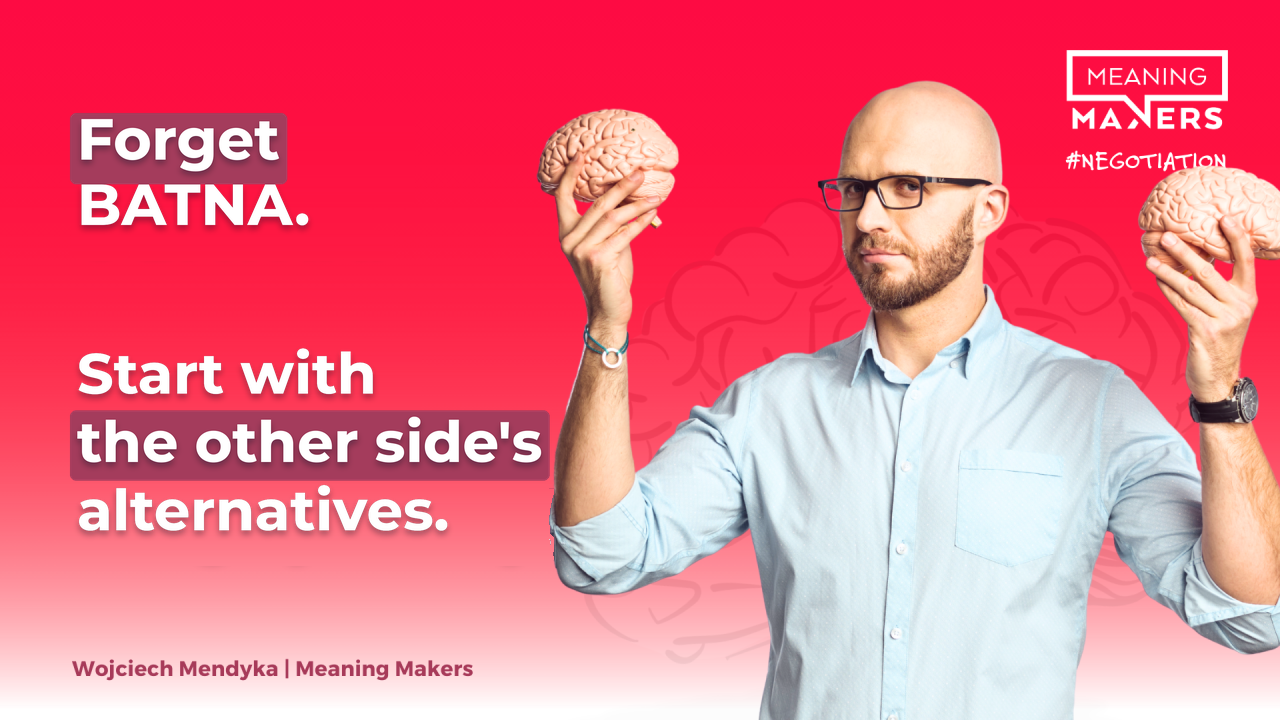
In negotiations, there is something that is talked about over and over again, and something that almost no one talks about. The first, you know all too well. BATNA. The second influences the outcome just as strongly, but rarely appears in preparations. It is how the other party perceives their alternatives.
Most people prepare only halfway. They analyze their exits. They think about their risks. They plan their variants. But they rarely ask the question: what do the alternatives on the other side of the table look like? What do they see? What can they do? What do they consider real, and what is just their posturing?
And this is where the real problem begins.
(seriously though, don't forget about BATNA, but remember it's only one element of negotiation success )
The problem that nobody names
In most conversations, we have a tendency to assume that the other side has more alternatives than we do. That they can go elsewhere. That they will easily give up. That they have the upper hand. And we do this before we even ask what they can actually do.
It's a classic asymmetry. We see our own limitations, and we imagine them as strong and independent. And this imagined strength of the other party influences behavior much more than the real one.
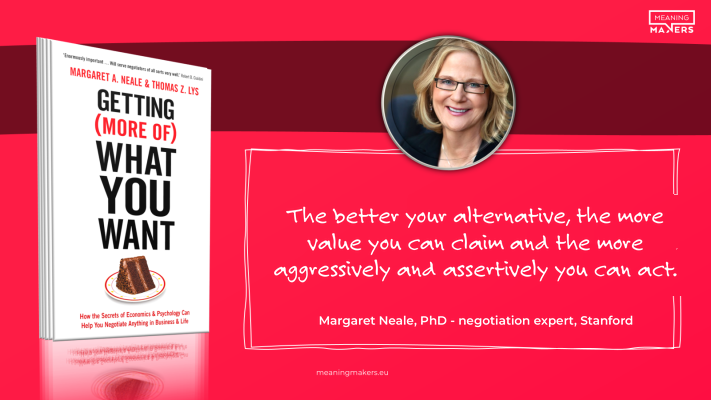
The whole trouble lies in the fact that we only look at our side. Yet the power of a conversation stems from two sets of alternatives. Yours and theirs. And often what happens on their side of the table has a greater impact on the result than what you have on yours.
This is the core of everything you will read below.
Why we so often see only our piece of the puzzle
When I ask teams if they try to find out what alternatives the other side has, most avoid this topic in conversations with clients or partners. Interesting, isn't it? They don't know how to do it. They fear it will sound too direct. Sometimes they don't even think to ask. People are not in the habit of asking:
– “What else are you considering?” – “What does the other path look like?” – “What will you do if we don't reach an agreement today?”
And if we don't do this, we assume the other side has more alternatives than they do in reality. And that they are better than ours. And that we must yield. Often too early.
This is not a technique but the psychology of data lack.
The shortcut trap: why BATNA won, but isn't enough
For years, I've been asking training participants: Hey, what is the one thing you associate with good negotiating...? Half of the people answer... BATNA! One acronym, one concept, one task: “strengthen your position.” The BATNA phenomenon is simple, and that's why it's memorable.
The problem is that when people think about alternatives, they think only about themselves. BATNA taught them one thing: have a way out. But it didn't teach the other half: understand what ways out the other side sees.
It's no wonder that in many conversations, both sides sit at the table feeling they are in a weaker position. And both are convinced that it is the other side that can walk away.
A classic example of this are the opinions I've heard from many procurement department representatives who openly admitted they "needed" a given supplier. And you won't guess what the supplier's salesperson was thinking at the time? They thought they had zero leverage .
Where the negotiation is really decided
When you don't understand and work with the other side's alternatives, their brain sees you as one of several similar options. And when you are one of several similar options, the conversation turns toward any kind of differentiator: price, cost, small differences.
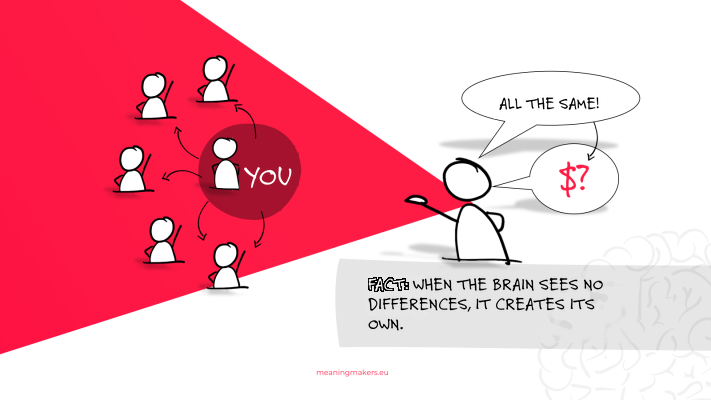
This is why so many salespeople, leaders, and negotiators "fall into the race to the bottom."
Seth Godin* — author, marketer, and blogger — has been writing about this for years: if the other side sees too many similar options, they start looking for price differences. And if price becomes the only category of choice, everyone loses. After all, how much can you lower the price?
Your arguments don't always matter if the other side sees wide and convenient alternatives.
(*Seth Godin is an author who had a monumental impact on my development, my thinking about business, messaging, and marketing.)
Lack of work and lack of alternatives
When I returned from Dublin almost 20 years ago, I was in a very unique place in my life. I had fulfilled my goal. What was it, you ask? A company? A career? Far from it... I just wanted to save some cash and have everyone leave me alone for a while. Do you ever feel that way too?
And I did save up. Quite a lot for that moment. For the first time in my adult life, I could take a break and nothing was chasing me. I went to job interviews, but I didn't need anything.
And it was a huge contrast to how I felt a few years earlier. Back then, I worked as if I had no choice. After Dublin, for the first time, I saw how behavior changes when alternatives are real, not just imagined. When you don't have to.
In interviews, I was calm, without pressure. Unfortunately, I also had heavily inflated expectations after working with Graham, a super manager from Ireland. So I couldn't fit into any interview or company.
And when after a few months I saw my savings melting away, my behavior started changing on its own. More tension. Less peace. Less autonomy. My father asking me every day if I had found a job yet didn't help either ( Dad).
The pressure was growing, and my reactions changed along with it. In the end, it turned out well. I crossed paths with Dirk, whom you know from this article. The rest is history.
But exactly the same thing happens at the negotiation table. Alternatives are not just a tool. They are a state of mind.
How the brain really sees alternatives
In my Dublin example, specific brain mechanisms are operating underneath. They show why behavior changes so quickly when we lose options or when we regain them:
1. Lack of alternatives triggers survival mode
It's the limbic system, meaning tension and alertness. Interpreting neutral signals as threats. Example: This is exactly what was happening when my savings started to drop. Every phone call was stressful, every question from my dad sounded like pressure, every rejection hurt more than it should have.
2. Visible alternatives activate the prefrontal cortex
Logic returns. Analysis appears. The ability to listen appears. Example: After Dublin, I had a choice. I could walk away from the conversation. I could wait. I could take another offer. I had a sense that I was in control of the situation, and that changed my tone of voice, the way I looked, and my readiness to reject bad proposals.
3. The brain reacts mainly to losses
The brain is sensitive to losses and asks itself one question: what will I lose if I choose wrong. That is why time pressure changes behavior so significantly. Example: When the cash started melting away, my brain wasn't thinking about what I could gain. It was thinking about how I could lose my security. And in this state, a person starts agreeing to things they would normally never accept.
Business case: when price disappears as an alternative
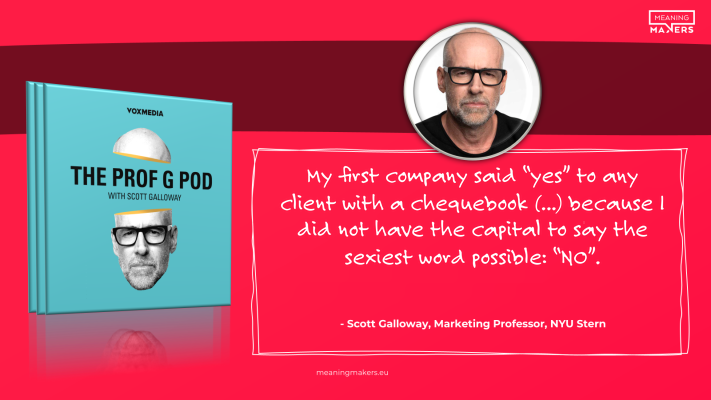
You see this the same way in business. Recently, I saw a case of a company that did something completely opposite to everyone else. They copied a competitor's price list 1 to 1. Not cheaper. Not more expensive. As they put it themselves in an interview I recently saw – "they ripped the price list from their website."
What did the customers do? Deprived of a natural dimension to differentiate the offer... they stopped analyzing the price. Price stopped being the alternative. They had to look for differences in work style, approach, and the quality of the conversation. And that was the conversation that the salespeople of the company in question wanted to have.
One decision changed how the customer's brain evaluated the options.
How to strengthen your alternatives
The alternatives you have in your head change the way you speak, listen, and react. The better the alternatives, the less pressure and the better the quality of the decisions. You know this already, but do you know these techniques?
1. Three "what if" scenarios
Write down a good, average, and difficult variant. Why it works: the brain stops seeing only one possible future.
Example: Before a talk about a raise, you prepare three versions: – I get the full amount, – I get a portion and we revisit the topic next quarter, – I don't get it and I stay with my current scope. Thanks to this, you don't go "all-in." You have three ways out, so the pressure drops.
2. Three paths "A, B, and C"
Naming the options calms the brain and restores a sense of control. Why it works: the brain hates black holes.
Example: Before negotiating with a client, you establish three paths: A – we close the full project, B – we start with a smaller scope, C – we plan a pilot. Thanks to this, you don't stick rigidly to one solution. The key is to name and write them down. The brain reacts to concretes, not to abstract, ephemeral options.
3. Lower-variant plan
Think about what you will do if things go worse. Why it works: it doesn't attract losses. It takes away their power.
Example: You know that if the client doesn't accept the terms, you can direct the offer to two other companies you've had preliminary talks with. It's a simple plan B. And the mere fact that it exists changes the way you speak, react, and hold the line.
There is always a plan B. Think you must have this demanding client? Or maybe you'll dedicate that time to acquiring two others who are easier to manage?
4. Time as an alternative
A salesperson behaves completely differently at the beginning and at the end of the quarter. Many clients take advantage of this.
Space is one of the strongest psychological alternatives. Why it works: when you have time, you react more logically.
Example: If you give yourself even one day of breathing room before a difficult conversation (no meetings, no running from call to call), your decisions are calmer.
5. Sparring with artificial intelligence
Ask AI for three difficult questions and practice the conversation. Why it works: simulation lowers the arousal of the limbic system.
Example: Before a salary negotiation, you type into the AI: "Ask me the three toughest questions my boss might ask." You go through them out loud. Thanks to this, nothing surprises you in the real conversation, and you react more calmly. Sales teams do the same before big meetings – and you can see immediately that they enter the conversation with a different energy.
How to diminish the other party's alternatives
It's not about taking away someone's options. It's about making the other side see more clearly why working with you is logical, safe, and convenient.
1. Questions revealing their options
Ask: "What else are you considering?" "What does the alternative look like?" "What would happen if you went a different way?"
Why it works: People rarely talk about their alternatives spontaneously. But when they say it out loud, they start to see the real differences between the options. They often discover that "those other options" are weaker than they thought.
Example: A client says: "the other company is cheaper, but they won't handle the implementation." They hear for themselves that it is no longer an equal alternative.
2. Changing the frame of the conversation
The frame decides what is being compared. Price? The lowest will win. Value? The best logic will win.
Why it works: The brain doesn't evaluate "everything at once." It always chooses one category of comparison. If you set up the conversation in the wrong category, you will lose, even with the best product.
Example: Instead of comparing "how much it costs," give them a comparison - "what will happen if they choose wrong and what the consequences will be"
3. Showing things only you can do
When the other party sees an element they won't get anywhere else, their alternatives automatically narrow.
Why it works: Perception of differences = sense of security. If they see a unique way of thinking, a unique analysis, a unique logic – the alternative ceases to be "interchangeable."
Example: When the competition relies on stock slides, and you are working on their specific case.
Example from yesterday - a client noticed that the entire Meaning Makers presentation was in their brand's color theme. A coincidence? I think not.
4. Building relational alternatives
A relationship is also an alternative.
Why it works: The brain chooses what is easier, clearer, and safer. Good cooperation in itself narrows the other party's alternatives because the sense of risk decreases.
Example: The way a conversation is conducted, the clarity of communication, and the speed of response make someone think: “It will simply be easier with them.” And the competition drops out of the game, even if it objectively exists.
Finally - alternatives at home and “me time”
It works similarly in private life. It's not about money here, but about time and space. Each of us has something that is their own “alternative” – a moment to breathe, one's own rhythm, a moment of silence.
For me, it’s simple. At home, everyone knows that I need my “me time.” Half an hour to go out alone, take a walk, go for a run, sort things out in my head. And when I have that, everything works. I come back calmer, more present, more logical.
And when I don't have that – when everything happens at once, when there is no space to even for a moment step off the track – I start reacting exactly like a person without alternatives at the negotiating table. I feel pressure. I feel overwhelmed. The brain defends its influence because it feels like there is no other option.
And I know that many of you have it this way too. It's no wonder. It's simply the same mechanism that works everywhere – at work, in conversations, in decisions, and at home.
Space is also an alternative. And alternatives are the way the brain regains its peace.
Summary
Most people think about BATNA and stop there. And the truth is simple. Negotiations go in the direction that the alternatives go – yours and theirs. They are what set the tone of the conversation, the pressure, the pace, and who at any given moment has peace, and who has tension.
Before your next conversation, ask yourself two quick questions. What alternatives do you have. And what alternatives does the other side really have. This often changes more than a whole list of techniques.