
Have you ever seen a hotel that looked great in the photos… and then the reality was a bit less Instagrammable?
What you see in a hotel photo is very often not a lie. It is just a fragment of reality.
The best angle. The best light. The best moment. You see a beautiful sunset over the pool, an atmospheric balcony, and a perfectly prepared room. You don't see the parking lot behind the building, the road renovation next door, or the windowless room hidden a floor below.
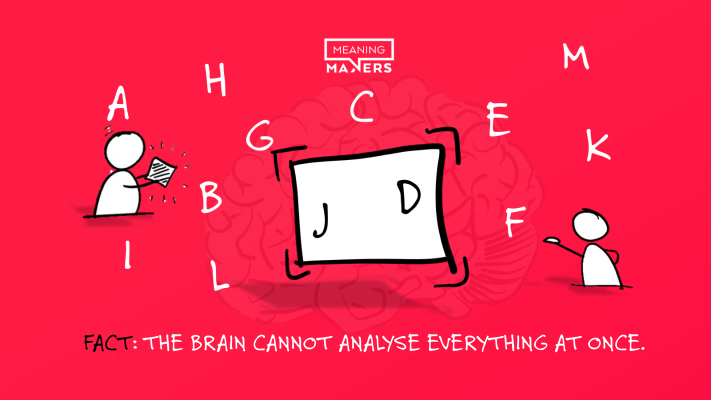
The human brain practically never analyzes the whole of reality simultaneously. That would be too energetically costly. Instead, it selects a fragment, simplifies the situation, and builds meaning. It looks for a quick answer to the question: "How should I interpret this?"
In negotiations, exactly the same mechanism works.
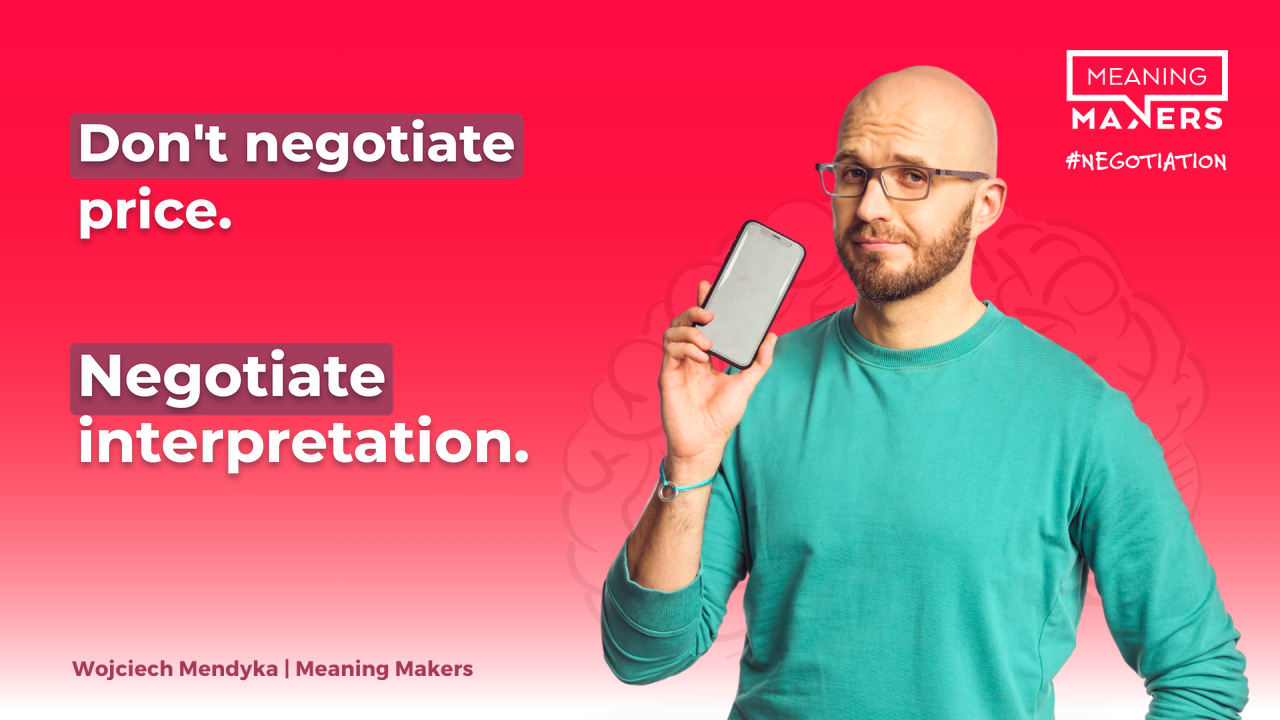
You are never negotiating solely on price, scope, or contract terms. You are negotiating the way the other party interprets the situation.
The same offer will be an "expensive option" for one person. For someone else, it will become a "safe choice." One client will see an unnecessary cost. The other, risk mitigation. One company will see a high expense. The other, an investment that will avoid much larger losses in a year or two.
It is not the product that changes. It is the frame through which the other side looks that changes.
That is why experienced negotiators understand one thing very well:
In negotiations, the better argument wins much less often. The better interpretation of reality wins much more frequently.
If you are interested in the mechanisms of communication, sales, and human decisions, you can subscribe to the Meaning-Making newsletter here on LinkedIn: LINK
Negotiations start earlier than the arguments
Imagine negotiations during a car sale.
What will the seller say? He says: "The car is in great condition. Serviced. It has low mileage. It never let me down..."
A few minutes later, the buyer is already walking around the car and doing exactly the opposite.
He looks at the scratches. He looks for signs of corrosion. He asks about knocks in the suspension. He points out the smallest flaws that probably no one would have even noticed before.
Interestingly, both parties are looking at the exact same car. And yet they see something completely different.
What are you looking at? An attempt to set the frame for the upcoming negotiations. One side is trying to build a value frame. The other is trying to build a devaluation frame.
Most people imagine negotiations as an exchange of arguments. One side talks about price. The other responds with value. Someone pushes, someone defends. Everything looks like a duel of logic.
In practice, a much more important thing happens earlier. Even before the other side begins to analyze the arguments, their brain is trying to answer one question:
“What is this really about?” That is when the negotiation frame is created.
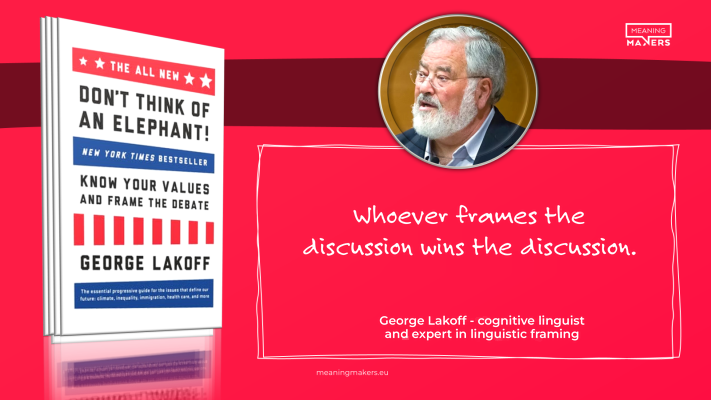
A frame is a way of interpreting a situation. The direction in which the other side begins to look at the problem, offer, or decision.
For example, if your client only hears: “this costs more,” their brain builds a price frame. If they hear: “about mitigating risk over the next two years,” the entire situation begins to look different.
The offer doesn't change. The meaning assigned to that offer changes.
This is exactly why people try to lower the value of things they want to buy. They point out defects in an apartment. They pull out the weaker elements of a project. They emphasize risks and problems. At the same time, the other side tries to build a story around security, quality, advantage, or the future consequences of the decision.
Every negotiation is, to a large extent, a struggle for the interpretation of reality.
But why does this actually work?
The brain needs simplifications
You probably take a lot of photos, but have you ever wondered about the significance of the frame itself? About what is shown—and what consciously or accidentally disappears outside the image?
You see, a photo never shows the whole world. It shows a selected fragment. A frame. A perspective. A focus point. It shows what looks good or what we want to remember from a given situation.
When you return to a photo after a few months or years, all the rest of reality practically ceases to exist. Only the fragment that was captured remains.
If I take a photo of my daughter just as she is pulling herself up by an armchair for the first time and laughing at her own success, that is what I see years later. I don't see the toys scattered on the floor. I don't see the plates left after dinner. I no longer remember that I had a hard day then and was completely exhausted.
I only see the emotion from that one moment.
Negotiations work very similarly.
A strong negotiation frame is about directing the other party's attention to a specific element of reality. To something that begins to dominate the way the entire situation is perceived.
For one person, the decision's security will become paramount. For another, it might be risk mitigation or avoiding the costs of delay. Sometimes the conversation will revolve around a lost opportunity, stability, or competitive advantage.
It's not because other elements cease to exist. It's simply that the brain is unable to analyze everything simultaneously. It needs simplification. It needs a central meaning.
This is exactly why a restaurant doesn't sell a "meat sandwich," but rather "slow-roasted beef." An apartment isn't "small," it's "intimate." And a hotel doesn't showcase the parking lot, but the sunset over the pool.
The frame influences perception. And perception influences the decision.
The biggest mistake? Too many arguments
Many people believe that effective negotiation requires a vast number of arguments.
The more reasons you provide, the greater the chance the other side will be convinced. Sounds logical?
Except psychology shows the opposite. You can say too much.
There is a phenomenon called argument dilution. This refers to a situation where weaker arguments begin to undermine the strongest ones.
It's a bit like an 80-slide presentation. After a while, the brain stops distinguishing between key points and entirely secondary ones. Everything starts to blur into a single mass of information. The exact same thing happens in negotiations.
For example, perhaps we can convince a supervisor that we need a new laptop?
So, you try to convince your supervisor that you need new equipment. You say the computer runs slowly, it freezes, the battery is practically non-existent, it doesn't support the new operating system, and it hinders daily work.
On top of that, you throw in: "And it only has one USB port."
And this is where your negotiation ends. This final argument might suddenly hijack the entire focus of the conversation.
The supervisor (if they know what they're doing) will respond: "But surely you've managed just fine with one USB port until now?"
In an instant, the conversation veers into a completely irrelevant detail. Instead of talking about work efficiency or real hardware limitations, you start an argument about a USB port.
That's how the brain works. Very often, it doesn't analyze arguments separately. It evaluates the entire construct as a single story. If it finds something weaker within it, it starts to question the credibility of the whole.
That is exactly why experienced negotiators do not try to throw everything into the conversation at once. Instead, they build a single strong interpretation of the situation and take great care not to dilute it with accidental arguments.
If these mechanisms are interesting to you, you can subscribe to the Meaning Makers newsletter. Every week, one article appears there about the psychology of decisions, communication, and influence in business.
You can find all the articles from this series here: LINK
A strong frame returns throughout the entire conversation
If you listened to the radio in the 80s, there is a good chance that every dozen or so minutes, a Phil Collins or Genesis song was playing.
“In the Air Tonight”. “Another Day in Paradise”. “Invisible Touch”.
It didn't matter whether you liked them or not. By the end of the day, those melodies were stuck in your head. And that is exactly where the power of a repeating motif lies.
The brain really likes things that keep coming back.
The most effective negotiations work similarly. They do not rely on dozens of different arguments. Most often, they orbit around two or three elements that thread through the entire conversation and begin to build one dominant association.
A bit like a chorus. You don't remember the whole song, after all. You remember the main motif. That is what stays in your head and gives meaning to the whole.
In negotiations, it is exactly the same.
The other side very rarely remembers all the arguments, numbers, or details of a presentation after the meeting. Most often, they are left with a general feeling of: “what was this all about.”
That is why a strong frame must return throughout the entire conversation.
If your axis is the security of the decision, then this thought should appear in examples, questions, stories, and summaries. If you are talking about the risk of the status quo, this motif should tie the different parts of the negotiation together into one story. It is about a consistent direction of interpretation.
This is exactly why brands build positioning, politicians create slogans, and the media very often tries to reduce complicated situations to one dominant message.
The brain seeks a simple explanation of reality. If, after the meeting, the other side cannot say in one sentence “what this was all about,” the frame has probably not been built.
"You're too expensive" x 10
Back when I was still working in a large organization as a sales trainer, I very quickly started to notice a certain pattern.
It usually appeared toward the end of the week. Around Friday, the salespeople would head back to the office to process emails, send out proposals, update CRMs, and catch their breath after a whole week of client meetings.
And that’s when exactly the same thing would very often start happening.
"Everything would be fine, if we were cheaper." "Clients keep saying that we are too expensive." "We have a great solution, but the price is killing us."
After a while, I noticed something very interesting. The more often someone heard such a message from clients, the more they started to believe it themselves.
Clients know this. That is why "you're too expensive" is one of the most dangerous sentences in negotiations. This sentence creates a very specific frame.
The brain starts to treat "expensive" as an objective fact rather than an interpretation of the situation. The problem is that "expensive" practically never exists in a vacuum.
Expensive compared to what? More expensive today may mean a much cheaper solution over the next two years. A higher price can mitigate a much larger risk. Sometimes the cost of a decision is significantly lower than the cost of no decision.
Heads up, this might be shocking: the best negotiators don't try to obsessively defend the price. Lowering the price until we "meet in the middle" isn't even negotiation. Anyone can do that.
The best change the way the situation is viewed. Instead of centering the conversation exclusively around the cost, they start talking about the consequences of delay, the risk of sticking with the current solution, or how much the organization might lose if nothing changes. Because the status quo has its own price, too. Often, it is exactly that which should become the main axis of negotiations.
If all week long you hear nothing but "you're too expensive" from clients and you don't try to build your own frame for the conversation, then at some point you start negotiating against yourself.
You stop talking about value. You stop talking about risk, consequences, or the impact of the decision on the future. You start defending the price even before the other party truly attacks you.
How to build a strong negotiation frame
In theory, it all sounds simple. Talk about value, don't let yourself get boxed in by the price, and keep an eye on the direction of the conversation.
Except that in practice, most negotiations start to fall apart very quickly. Too many arguments appear, too many threads, and too many reactions to what the other side says. And when the conversation loses its main axis, the brain naturally starts to simplify the situation.
That is why, if you want to build a strong negotiation frame, it is worth remembering a few simple rules that help keep the meaning of the conversation under control.
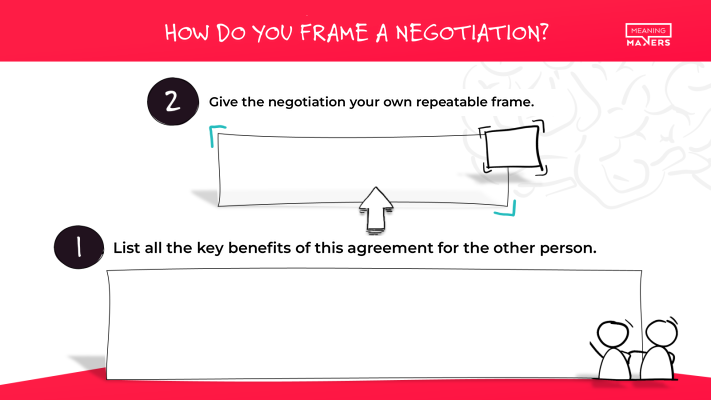
1. Choose two or three key elements
How many arguments does the other side actually remember?
Most people in negotiations try to say too much. More arguments, more examples, more reasons.
The problem is that the brain does not remember everything. It looks for one main story.
That is why it is better to build a conversation around two or three strong axes than to throw in ten different arguments at once. If issues regarding the risk of delay, the cost of the current situation, or the impact of the decision on the future keep returning throughout the conversation, the other side starts looking through exactly that filter.
And if you don't do this? The conversation gets diluted. Everyone remembers something different. And very often, the whole thing ends up reducing the negotiation solely to price.
2. Build the conversation around what matters to the recipient
Why do people often not react to our arguments? Because very often they are important mainly to us.
The recipient's brain focuses primarily on their own risk, their own goals, and their own problems. Therefore, a client reacts much more strongly to the possibility of losing time, chaos, the risk of error, or loss of control than to a simple list of features or benefits.
Instead of saying: "our solution has great features," it is much more effective to show: "if nothing changes, this problem will keep coming back every month."
If the recipient does not see their own problem in the conversation, it will be very difficult for them to feel the need to make a decision.
3. Return to the same axis of conversation
Why do some conversations stay in the head while others disappear after an hour? Because the brain likes recurring meaning.
It works a bit like a chorus in a song. You don't remember everything. You remember the motif that returned several times.
It is the same in negotiations. If your axis is, for example, the risk of the status quo, this thought should return at different moments of the conversation. In questions. In examples. In the summary. It is not about copying the same sentences, but about a consistent direction of thinking.
Without this, the conversation starts jumping between topics. And when there is no single clear axis, the brain simplifies the situation itself. Most often down to the price.
4. Don't let yourself be trapped in someone else's frame
Think about it—who really controls the negotiation? Very often, it is the one who defines the meaning of the situation.
If the client says, "you are too expensive," and you immediately start explaining the price, you are accepting their frame. From that moment on, the conversation revolves mainly around cost.
It is much better to try to change the perspective. For example: "And what will be the cost of staying with your current solution?" Suddenly, the conversation stops being solely about price. The topics of risk, losses, or the consequences of indecision appear.
If you don't guard the frame of the conversation, it's very easy to fall into a simple comparison war. And there, the advantage very quickly boils down to a discount.
Frame or be framed
A frame is always created. Whether you want it or not. With your involvement or without it.
The choice of words alone affects the interpretation of the situation. "Cost" sounds different than "investment." "Problem" different than "risk." "Expense" different than "security."
There is no communication that is completely devoid of interpretation. Every word directs attention in some direction. Every question sets the context. And yes—every example suggests to the brain: "pay attention to this."
That is why a simple rule very often applies in negotiations: Frame or be framed.
If you don't give meaning to the situation, the other side will do it for you. If you don't build your own interpretation of value, risk, or the consequences of a decision, you can very quickly be locked into someone else's frame: "too expensive," "this is unnecessary," "everyone does the same thing," "we can wait."
And then you stop leading the negotiation. You merely start reacting to the interpretation created by the other side.
That is exactly why the best negotiators are very rarely recognized by the fact that they talk the most.
Much more often, it's by the fact that they can give the conversation a meaning that stays in the head long after the meeting has ended.
And now look at your last negotiations
What frame were you building?
Did the other party remember, above all, after the conversation: price, discount, comparison of offers…
Or maybe risk, consequences, value, or the cost of no decision?
Because perhaps the biggest problem in your negotiations is not that your arguments are too weak.
Maybe the problem is that the other side is looking at the entire situation through a frame that you never consciously tried to change.