


Do you remember what it's like to be truly hungry? Not in the "I'll eat something soon" sense, but in that state where you start looking for solutions. You change the plan, you get creative, you don't procrastinate. Hunger triggers action.
In negotiations, exactly the same mechanism works. It's simple. If you don't have a hunger for the result and a hunger for value, you very quickly accept the "enough" level. Not because the other side outplayed you, but because you created a comfort zone for yourself. Low expectations provide peace of mind, but they take away the energy to fight for more. Aspirations play the role of hunger here—they are what push you to act when tension arises.
It is only when you have clearly defined aspirations that another important mechanism kicks in. The brain starts picking up on moments where you act inconsistently with what you set for yourself. Exactly like with food. If you know your goal is a specific number of calories per day, reaching for a random candy bar doesn't pass neutrally. A slight, unpleasant sting appears. Not because the candy bar is "bad," but because it moves you further away from your goal.
It's the same in negotiations. When you have aspirations, you feel the moment you start going too low. When you don't have them—nothing alerts you. And that is exactly why it's so easy to settle for something that is "okay" instead of fighting for what truly has value.
The same mechanism, different contexts
This pattern is visible in many areas of life. In sports athletes who have "already won their share" still play correctly, but without the intensity they had before. Skills remain, determination weakens. In business companies that achieve a leadership position often start focusing on protecting the status quo instead of further development. And almost always, a smaller, hungrier player appears and begins to shift the market.

The same thing happens in professional careers. At the beginning, the stakes are high and resources are limited, so a natural hunger appears. You push, you fight, you don't let go. Over time, it gets safer and more comfortable. And that drive doesn't return on its own. It needs to be rebuilt consciously, through more ambitious goals and higher aspirations.
The problem is that high aspirations go against evolution. From a survival standpoint, once you've reached a point of comfort—"the goal has been achieved." You will survive. You will manage. Why want more? When you had nothing, hunger was natural. Today you have what you need, so the fight stops being obvious. And without the fight, there is no growth.
Where negotiation problems really begin
Many people assume that poor negotiation results stem from a lack of arguments, a difficult client, or market constraints. In practice, the problem starts earlier. At the moment when we lower our own expectations before the other party even has a chance to say anything.
I often say that we negotiate inside our own heads . While still in the elevator. On the way to the meeting. You wonder whether you should really say that amount. Whether you should really propose that scope. You already see the other party's reaction in your mind—annoyance, rejection, the risk of damaging the relationship. And before you reach the top floor, you change the offer. A different amount. A different scope. Different expectations.
Congratulations. The other party never experienced real negotiations from your side. The point from which you start the conversation will become their new reference point. And all the negotiations that took place in your head have zero impact on their perception of value.
Negotiation is an experience. Emotions. Tension. Dynamics. If you deprive the other party of this experience, you rob yourself of one of the strongest sources of influence.
Why aspirations work before the numbers are even spoken
Aspirations affect negotiations on several levels simultaneously .
First—they change behavior. People with high aspirations defend their position longer, withdraw less often at the first sign of resistance, and more actively seek out arguments. Our brain very quickly detects moments when we start to drift away from our own goals—exactly the same way as when we have a set number of calories and reach for something that makes no sense from the perspective of that goal. This generates discomfort, which, paradoxically, acts as a mobilizer. Tension arises, pushing us to continue acting instead of giving immediate consent.
Second—aspirations communicate value . We evaluate offers not only through the prism of arguments but by what they signal. If something is clearly cheap or "easy to agree on," suspicion arises. A low price very often strips away value. And this is not irrational. Premium brands have been building their positions for years precisely on unavailability and a high barrier to entry. Price does not just reflect value—it co-creates it.
That is why certain things are desirable precisely because they are not available to everyone. If everyone got the keys to a Porsche 911 for their eighteenth birthday, it would cease to be an object of desire. Aspirations work exactly the same way—they build a frame in which the other party starts thinking differently about value.
Thirdly - aspirations affect the behavior of the other side. At workshops, there is almost always a pair where one person, upon hearing a high offer, starts to question their own preparation. They pay more than they planned. They exceed their maximum. Not because the arguments were better, but simply because the other side's aspiration shifted their sense of a "reasonable range."
This isn't theory. It happens every time.
I have seen this mechanism at negotiation workshops for years. Participants receive the same case, the same information, and the same constraints. And yet, the results can differ dramatically. One person "sells" a solution for 1,900, another for 12,750 .
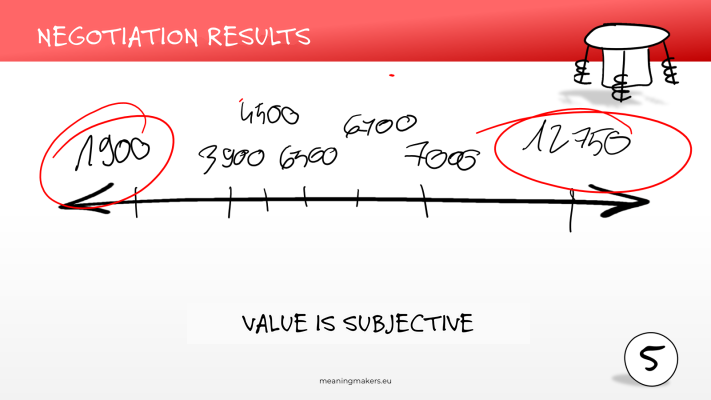
Interestingly, both sides often leave with the feeling that "it went well" - right up until the moment we compare results. The difference almost never lies in cleverness or techniques. It lies in the reference point. Everything in life is judged by comparison. Without a reference point, we are satisfied. Once it appears - we start to react. This is exactly what we see today in discussions about pay transparency. Regardless of opinion, one thing is certain - the comparisons are only just beginning.
Aspiration, satisfaction, limit - order instead of chaos
Negotiations are about pushing boundaries. However, to truly participate in them, you must first set those boundaries for yourself. Otherwise, you aren't negotiating - you are only reacting. You are responding to the other side's moves instead of co-creating the negotiation space.
That is precisely why we organize this topic very meticulously during workshops. Before negotiating, everyone sets three levels: aspiration, satisfaction and limit. Aspiration is what you really want. Satisfaction is the "okay" level. The limit is the moment you know you are walking away from the table.
The problem is that most people communicate satisfaction instead of aspiration. The effect is predictable. A ceiling set low works perfectly - you reach exactly that. Of course, aspirations must take into account market realities, competition, and context. But even then, the starting point matters immensely. Those who want more, statistically, get further.
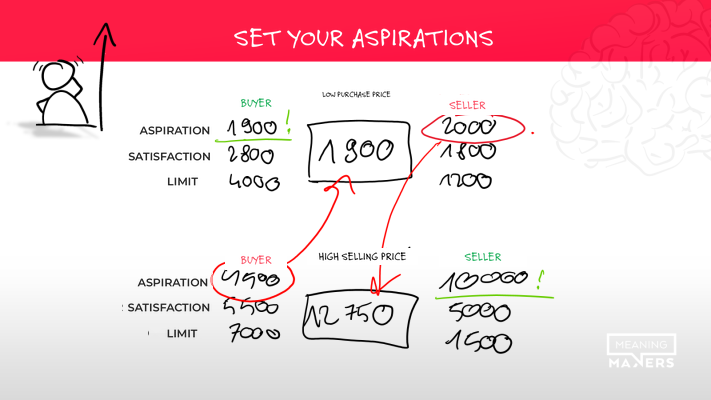
If you don't have a clearly defined boundary, every proposal from the other side starts to move you. Step by step. Without a moment where you can say "stop." That's when it becomes very easy to mistake flexibility for drifting.
A clearly set boundary doesn't block negotiations - it gives you a point of leverage. You know where you can make concessions and where the conversation loses its meaning. Only when you have this boundary does aspiration start to work realistically: not as a loose hope for a better result, but as a direction that guides your decisions during the conversation.
It's not just money. Very often, it's about the scope.
In project negotiations, the problem is rarely the price itself. Much more often, it is a too narrowly defined scope. Out of fear of rejection, we simplify the solution even before the client sees its full value. As a result, we sell less, even if the conditions would have allowed for more.
Importantly, aspirations aren't always about "adding." Sometimes it's about "subtracting" - limiting the scope on the client's side, shortening the expected time, reducing the number of iterations, or clarifying responsibility. High aspirations can be about the project being smarter and realistic to deliver, rather than just bigger or more expensive.
That is why thinking about aspirations solely in the context of money is misleading. Most negotiations have many areas. In a job interview, finances are just one of them. Alongside, you have contract terms, benefits, flexibility, development, scope of responsibility, and notice period. If you anchor high at the right moment and show a broader aspiration, you create space for an exchange. You can concede in two areas to deliver a result in a third - the one that truly matters to you.
A lesson from my work in the corporate world
When I worked in a corporation, I realized quite quickly that training and development was an area where I wanted to go further than the standard path provided. And I communicated this directly. My aspirations were clearly linked to the roles, projects, and level of responsibility I wanted to be admitted to.
This generated tension. Comments, jokes, and attempts to "bring me back to earth" appeared. At one point, I even got the semi-jocular nickname "young wolf". It seemed like a joke, but in such environments, comparisons work like in negotiations - someone who communicates higher aspirations automatically becomes a point of reference for others. And not everyone feels comfortable with that.

The facts, however, were clear. I was the one sent to the toughest projects. I was the one who got access to the best certifications. I was the one who ended up where the stakes were highest. In the long run, this led me to international projects, working in dozens of countries, and finally to building what I do today.
I'm not saying this is the path for everyone. But in hindsight, I know one thing—communicating aspirations, even if it generates tension and temporary discomfort, realistically opens doors. And I wouldn't trade that for peace and quiet.
Four practical rules for working with aspirations
If aspirations are to realistically impact the outcome of negotiations, they must be more than just "wishful thinking." These are four rules that regularly come back in the work of Meaning Makers—and which are visible in results, not in declarations.
1. Always start with aspiration, never with satisfaction
What you start the conversation with very quickly becomes the reference point for both parties. If you communicate satisfaction at the start, you set a low ceiling for yourself and it’s hard to pretend later that you want more. Write your limit on a piece of paper, put it in an envelope, and tuck it in your pocket. Write your aspiration on your hand with a marker—it is meant to lead the conversation, not your fear of tension.
Example from salary negotiations: people who start the conversation with "I would be happy with X" very often end up exactly at X or even lower. Participants who communicate an aspiration clearly above their satisfaction level, even if they don't get the full amount, end the conversation with a better result. The difference doesn't come from techniques, but from the starting point.
2. Assume that your aspiration will be questioned
High expectations almost always meet with resistance. And not because they are unreasonable, but because the other side has to test them. This moment is not a signal of failure, but the beginning of the actual negotiations. The problem starts when you treat resistance as something you need to retreat from immediately.
Example from B2B negotiations: the phrase "it's too expensive" very rarely means the end of the conversation. Most often it is a test—checking whether the other side can defend the value, or if they will back down at the first sign of tension. I see this clearly: people who have arguments prepared for their aspiration maintain it significantly longer. Those who are not prepared lower their expectations almost automatically.
3. Show the full vision first, only then limit it
Negotiation is a conversation about choices, but you cannot choose from something you cannot see. If you show the minimum version right away, you rob yourself of the space to talk about value. A full vision is not a promise—it is a reference point from which the exchange only begins.
Example from project negotiations: teams that start a conversation with the minimum scope very quickly close off their space for negotiation. Those who show the full vision of the solution, and only then scale down the scope in exchange for specific concessions, end up with higher project value. Even if the final scope is smaller, the reference point was set higher.
4. Treat tension as the cost of a better outcome, not as a mistake
If you want more, tension is part of the process. Attempting to defuse it immediately often looks like good cooperation, but in practice, it means a quick concession. What is unpleasant during the conversation very often determines the quality of the result after it ends.
Example from partnership negotiations: many people lower their expectations just to quickly defuse tension and "get it over with." In the short term, this provides relief. In the long term—a worse result that stays for years. My experience clearly shows that the best results appear where the participants are able to endure the tension for a few rounds longer.
Conclusion
Not everyone will achieve exactly what they set out to do. But people with higher aspirations consistently get further. Not because they always win, but because they have an internal reference point that keeps them in the game.
Our brain detects moments very quickly when we act contrary to our own goals. When you have a clearly set aspiration, every decision that moves you away from it causes a slight, unpleasant sting. Exactly like with calories. If you know that your goal is 2500 kcal a day and you have that consciously set, then reaching for a pointless candy bar does not pass neutrally. Something doesn't add up. You feel it. And it is precisely this mechanism that makes you stick to the framework more often, even if you sometimes fall out of it.
Without aspiration, this doesn't exist. There is only reacting to the situation, momentary decisions, and "it'll be fine somehow." With aspiration, a hunger for direction appears. Not perfection, not one hundred percent consistency, just on average better decisions made more often than by chance.
In negotiations, we rarely lose to the market. Much more often, we lose to our own satiety. To the moment where we stop feeling discomfort, because we stopped wanting more a long time ago. And yes, I know – there are exceptions, but that doesn't change this general rule.
Final question : where have you recently lowered your aspirations before anyone even said "no"? And more importantly – what for?