
You know the feeling: two people look at the same thing – and see something completely different. In negotiations, that’s the norm. For one side, something is too costly; for the other, it’s worth every effort. The same object, a different value. Because value doesn’t reside in the thing. Value lives in the mind.
And that is exactly why negotiations so often end in frustration. One side walks away feeling they’ve lost, the other thinking "we pulled it off" – even though both were talking about the same thing. The problem rarely lies in the numbers. It lies in the fact that each side was operating in a different world of meaning.
Value is subjective
I have good news and bad news for you... which would you like first? Relax – behavioural economics says you’ll want the bad news first.
So here’s the bad news – nothing is certain; you have to make the effort, explain, show and persuade. The good news? That’s precisely what makes the world work. If value were objective, we wouldn’t need salespeople, negotiators, advisers or managers. There would be no discussion of terms, no exchange – just a price list. And if everything could be read off a table, there would be no need for people in the process at all. The subjectivity of value is the very reason entire professions – and human relationships – exist.
In practice, you see this every day. The same project is "too expensive" for one client and "suspiciously cheap" for another. The same candidate hears "not within budget" at one company and "a perfect fit" at another. The thing hasn’t changed. The perception of value has.
Felt that pleasant warmth just now? That feeling is "job security". Put simply: as long as you create value, you have a job. Right, let’s carry on.
The brain constantly assesses value
Our brains are constantly calculating. With every message, proposal or person, it fires off a question: is this worth it, should I accept this, can I trust them? It’s not intellect – it’s an evolutionary warning system designed to protect us from loss. Everyone remembers the moment they felt they’d overpaid, and that other moment – when they landed an exceptional bargain. Both tap into the same basic reward-and-loss system. That’s when the brain says: you’ve won a small evolutionary lottery… or you’ve lost.
Interestingly, the brain reacts far more strongly to the possibility of loss than to a potential gain. That’s why in negotiations we so often guard against "overpaying", instead of calmly considering what we actually stand to gain.
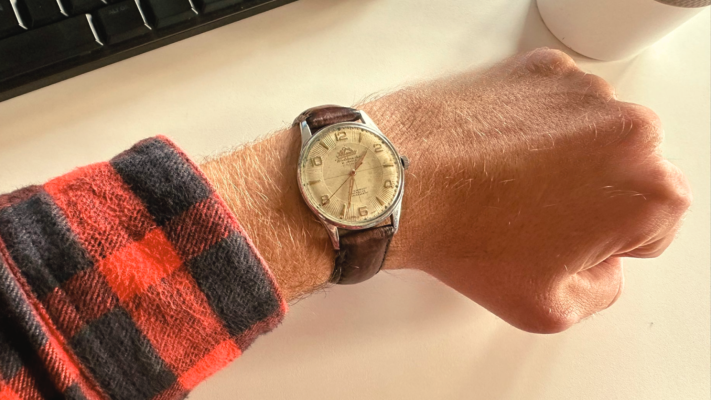
Grandfather’s watch
Many years ago, after my grandfather passed away, I inherited his watch – an Atlantic Worldmaster 21 Jewels Prima, a classic Swiss model from the 1950s. For many Poles at the time, it was a status symbol, as it was one of the few items to reach the country through Baltona and Pewex. For my grandfather, it was something more – he bought it just as he was starting out in adult life, and it accompanied him at work, on his travels and at meetings. When I wear it today, people see an "old watch". I see a story. Because its value lies neither in the movement nor the brand.
If I put it up for auction today, the market would price it within a specific range. But no price could capture what this watch means to me. And value in negotiations works in exactly the same way.
Value doesn’t just appear. Value is shaped
During negotiation workshops, people often ask about techniques: what should I say to get the other side to agree? Unfortunately, there are no cheap tricks here. There are only well-prepared negotiators. Negotiation is not a moment in a conversation. It is the result of preparation. How the other side perceives value begins to take shape much earlier – in what they know about you, how you present your intentions and how you build context.
For over a dozen years, I’ve opened every negotiation training session with a short exercise. Participants receive the same data, the same negotiation case and identical conditions. After twenty minutes, the results differ dramatically – from 5,000 to 15,000, for example. A threefold spread, despite an identical starting point. Why? Because during the conversation, some participants managed to shape the value, while others let the other side do it for them. Value does not lie in the numbers. It is created in the conversation.
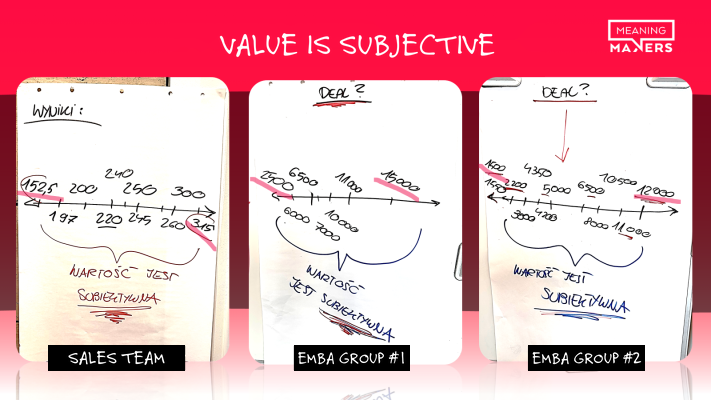
Importantly – even when we strip out the extremes and look only at the middle of the range, the differences remain significant. 7,500 versus 10,000. That’s no coincidence, no luck and no "better day". It’s the result of how well participants were – or weren’t – able to shape value in the conversation.
Looking at these results side by side, it’s hard to find more tangible proof of just how subjective value is. The same data, the same case, identical conditions – yet the difference in outcomes runs to several hundred per cent. And that’s regardless of the participants’ industry, role or experience. In some groups, logic wins; in others, emotion or narrative. And in the real world? Of course, the market, the product and the numbers all influence the outcome. But you can’t ignore the fact that what also matters is how you shape perceived value during the conversation.
Value is not a state – it is a stream
Value is not something fixed. It is a stream that flows and changes direction with context, emotions and information. You can leave it to its own devices, or consciously shape its course. When you hear "it’s not worth it", that’s not a verdict. It’s a sign that the stream of value is flowing in another direction. Your job is to gently redirect it – not through manipulation, but by reframing what it means. Value is not an argument. It is the way the other person interprets reality.
That’s why 80% of success in negotiations happens before the conversation itself. It’s not about 20 hours of analysis, but about 20 minutes of focus – on what truly matters to the other side. Because only then can you influence how they see the value of your proposal.
That’s why good negotiators rarely ask: "which argument should I use?" – and far more often ask: "what story is the other side telling themselves right now?"
Why value is subjective
Value never exists in a vacuum. It always belongs to someone. It depends on who the other person is, the situation they’re in and what they truly need at that moment. That’s why "one good argument" so rarely works in negotiations – and why the advantage so often goes to the person who can make the meaning relevant to the other side.
Here are four facts about subjective value (and how to use them):
1. Everyone sees value differently
People judge things through the lens of their experiences, emotions and goals. What is a problem for one person may be a solution for another. If you want the other side to see value, don’t start by persuading – start by understanding what makes sense to them.
Example: In a conversation about changing a process, one person sees extra effort, while another sees a chance for greater autonomy and influence.
2. Value depends on the situation
The same argument can land or fall completely flat – it all depends on the context. Timing, pressure, emotions or the point in the work cycle can completely change how a proposal is received.
Example: A project deadline "in two weeks" sounds reasonable in January, but in December – when the team is overloaded – it may come across as detached from reality.
3. There is no universal measure of value
There is no single, universal measure of value that works for everyone. Numbers matter, but they’re rarely enough. People make decisions based on how a given proposal genuinely changes their day-to-day reality.
Example: Hearing that an idea "cuts costs by 5%" sounds fine. Only when you show that it "frees up two days of work a week" does the value become tangible.
4. It makes exchange possible
In negotiations, we often talk about win-win as if it were an ideal state to be achieved. The paradox is that win-win is possible precisely because value is subjective. Each side can gain something different – and both can leave the conversation feeling it made sense.
Example: One side gains stability and a long-term partnership, the other – flexibility and a sense of security. Different needs, one shared decision.
In summary
Value isn’t something that simply is. It’s something that comes into being – in our heads, our emotions and our experiences. Sometimes it’s like my grandfather’s old watch – priceless to one person, just an old watch to another. Sometimes it’s like a stream that flows wherever you allow it to flow.
If you don’t shape the value, someone else will – and the stream will flow elsewhere. Then the conversation stops being a negotiation and becomes a defence. Because in life – and in negotiations – the foundation is not control, but agency. You decide what meaning to give to what you bring to the conversation.
And that is precisely why shaping value is not just a business skill. It is a daily practice of protecting your own sense of influence and mental well-being. Because when you know you can shape the value of what you do, you stop feeling that the world is shaping you.
Now it’s your turn
The higher you are in an organisation and the bigger the decisions you make, the less often you negotiate numbers – and the more often you negotiate meaning.
We all know that feeling when, after a conversation, you think: "I could have shown that better, framed it differently, prepared better." Or perhaps you’ve had a moment when the other side suddenly saw the value – and everything changed?