
Why is it so much easier to eat sensibly… after a workout than before one?
And what does this have to do with your change or transformation in your organisation?
Perhaps you’re familiar with this. I know it from my own experience. Once you start exercising, you begin to watch your diet, sleep and daily choices. These decisions are no longer random. They align in a single direction and start to support each other. When there’s no workout, this system quickly falls apart, and everything goes back to “on-the-fly” mode. So that “extra cookie” is OK, right?
This phenomenon is rather difficult to explain by motivation or discipline alone. It’s more accurate to look at how the continuity of decisions works. The first action sets up a way of thinking about yourself, and subsequent choices try to align with it. At a certain point, it’s no longer about individual decisions, but about maintaining the direction that has been started.
A beautiful thing, if applied to maintaining a healthy lifestyle.
However, the same mechanism also works outside of sports. At work, in projects, in teams. People stick to solutions they know, even if they have stopped working. They continue a way of operating that once made sense because it was repeatedly confirmed in practice.
In an organisation that is “in transformation”, this mechanism ceases to help. It starts to work against change. The more things that worked before, the more reasons there are not to touch them.
If you want to introduce a change, you are not just up against a process or a tool. You are up against something deeper. A mechanism that keeps people clinging to what they already know – even when it stops working.
This is why many changes stall at the level of understanding. The new approach is logical, well-explained and accepted on a declarative level. The problem begins when it comes to translating this into action.
What makes some changes actually happen, while others end up as slides in a PowerPoint presentation?
To understand this, you have to go one level deeper than behaviour. To where decisions are no longer just logical.
Change hits something more important than comfort
It hits who you are. An exaggeration? Not necessarily.
In conversations about change, arguments related to convenience, habits or resistance often come up. All of this matters, but there is another level at play underneath.
Every decision you make begins to build a story about how you operate. Over time, this story ceases to be just a collection of actions. It starts to be something you refer to when making subsequent choices. It starts to become a little bit… you.
This is very evident in daily work. If you have used one method for preparing materials, running meetings or building presentations for years, it is no longer just a technique. It is your way of operating. Your modus operandi.
I recently caught myself doing this with something very simple. A change in PowerPoint (thank you, Microsoft – your constant changes and “updates” provide me with a wealth of stories for my training sessions) took away my ability to prepare one of the elements in the exact same way I had for years. It’s just some feature in an app, right?
Wrong. I was proud of it. Years ago, I found a trick that allowed me to create something no one else was doing (confirmed many times by clients).
My reaction to this feature change in PowerPoint was immediate. Frustration, an attempt to find a workaround, a focus on preserving my existing way of working.
Only after a moment did the reflection come that perhaps this method wasn’t the only possible solution. This thought didn’t appear immediately, because the first reaction was the need to maintain what had already been working. And no – I still don’t forgive Microsoft.
This shows well how consistency works. When we do something for a long time, the brain treats it as a safe course of action and tries to maintain it. Above all, however, in many cases it begins to treat it as who we are. Even if it is only a small part of your “person”.
And trying to change who you are can create resistance, can’t it?
Why a small “yes” leads to big decisions
Do you think safe driving in the city is important? Probably so. Most people would say yes. It’s a simple declaration that’s hard to disagree with.
OK, so logically, would you therefore agree to a huge “Drive Safely” banner in front of your house?
That’s probably a harder sell, isn’t it?
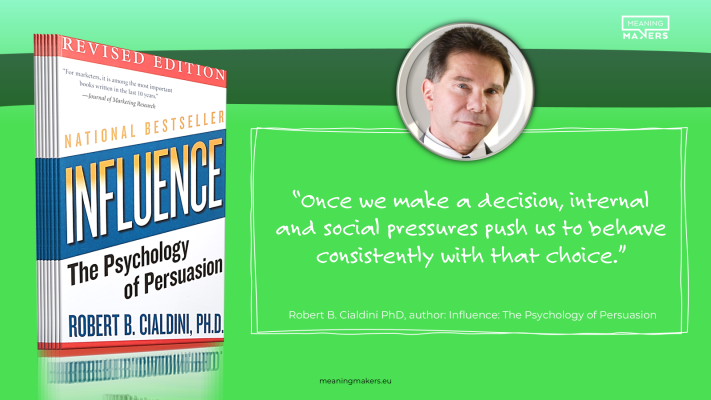
In one of the studies described by Robert Cialdini in his classic book Influence, people were asked to do exactly that. One group was asked to place a large “Drive Safely” banner in front of their house. Most refused. Such a step was too big and too visible.
In the second group, they started with a small action. A small sticker with the same slogan. It was a minor thing that didn’t require much commitment. Many people agreed. After some time, they were approached again with the request for the banner. What do you think happened this time? This time, the number of agreements was significantly higher. The increase was several hundred per cent.
The idea didn’t change. What changed was that people had already taken the first step. They began to see themselves as people who support this cause. Consistency is built through small actions. Big decisions are often their consequence.
People don’t react to goals. They react to a start.
This mechanism is visible everywhere. We just usually don’t notice it. Loyalty programmes are one of the clearest examples because they show it in a very simple way.
Loyalty programmes are my “behavioural hobby horse”. This also baffles my family and friends. Why? Because I consciously avoid points cards and stickers, collecting stamps, and other such inventions.
When someone at the till in Żabka asks if I have their loyalty card, I say no. Not because I don’t see the benefits. It’s because I see very clearly what happens next.
I have a strong need for autonomy and a distinct dislike for situations where someone tries to draw me into a process without my full participation. I know that every stamp, every card scan is not an innocent extra. It’s the beginning of a story I’m meant to enter and will later want to complete.
Every such action builds commitment. At first, it looks like a minor task. Over time, a mechanism kicks in that shifts the focus from the value of the reward to the need to finish what has been started.
This effect was shown very well in another of Cialdini’s studies – concerning car washes. Two groups of customers took part in the experiment. Each group had 150 people. The first group was given loyalty cards with eight empty boxes. After eight washes, the customer received a free service.
The second group was given very similar cards. The difference was that the card had ten boxes, two of which were already stamped at the start. Formally, the conditions were identical. In both cases, the customer had to get eight washes to receive the reward.
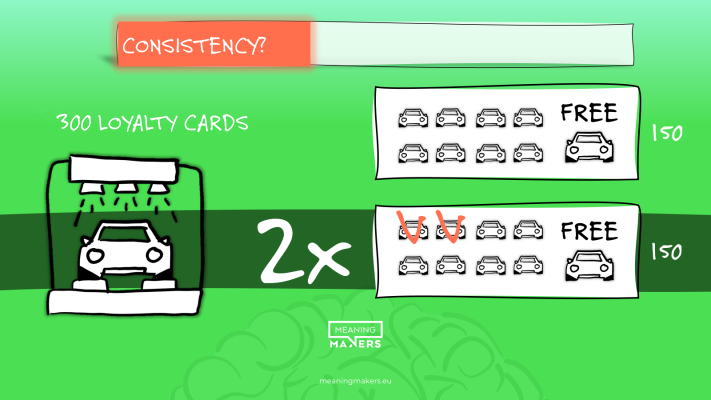
The effect was clear. In the second group, more than twice as many people completed the programme. The effort didn’t change, the reward didn’t change, the conditions didn’t change. The only thing that changed was that people felt they were already underway.
People rarely react to the goal itself. They react to whether they feel they have already begun.
So, the next time a barista gives you two stamps on a new coffee shop card, you can smile at them and whisper, “I know what you’re doing...”
I’m joking, don’t tell them that.
The hardest moment is the switch
The greatest cost of change appears at the very beginning.
In many situations, the challenge is not the effort, but the moment of starting. This transition from inaction to action requires the most cognitive energy. At Meaning Makers, we often call this “the Switch”. Getting on the right track determines what happens next and which way subsequent decisions will go.
This is clearly visible with exercise. You know how it is. The hardest part is leaving the house and starting the first exercise. Resistance, excuses and procrastination appear. Once you’re there and start moving, your body gets into a rhythm, and your head stops negotiating every next step. That’s why I’ve been telling everyone for years that the biggest predictor of success in getting on the path to fitness is the distance you have to travel to get to the gym.
It’s similar with children and tidying up (a hot topic at my house right now). A request to clean the whole room sounds like a huge task and provokes resistance. A request to put one thing away is specific and doable. In many cases, after this first action, others follow without additional pressure.
Preparing a presentation works in a similar way. An open, blank slide can stop you in your tracks for a long time. It’s hard to decide where to start and how to structure it. But all it takes is writing the first sentence, adding one chart, or sketching out a structure. Suddenly, a point of reference appears, and the rest starts to fall into place. How many presentations have I started and finished this way? I can’t count.
This moment of switching changes your mindset. Instead of wondering whether to start, a natural desire to continue what has already been started emerges.
The more you’ve put in, the harder it is to back out
Consistency is linked to a mechanism that in psychology we call the sunk cost fallacy. Every decision you invest time, energy and attention into starts to have more significance for you than is warranted by the outcome of that decision alone.
From the brain’s point of view, this is logical. Every investment leaves a mark. The time spent, the effort, the emotional commitment. Giving up would mean admitting that these resources did not bring what you expected. This creates a tension that the brain tries to reduce.
A large role here is played by the mechanism of loss aversion. A loss hurts more than a gain of the same value feels good. In practice, this means that you feel the thought of “wasted time” much more strongly than the potential benefit of making a better decision now. The brain prefers to maintain the current course rather than face that loss.
Added to this is the aforementioned need for consistency. If you have acted in a certain way for a long time, you start to build a belief that it was the right decision. Each subsequent step reinforces this story. At a certain point, you are no longer defending the action itself. You are defending the sense of your earlier choices.
This is why we finish books that don’t grip us, watch films to the end, and drag out projects that have long since lost their justification. In each of these situations, the same pattern is at work. Continuation is psychologically easier than stopping and changing direction.
In organisations, this effect grows with scale. The longer a project lasts, the more people are involved, and the more resources have already been used, the harder it is to say “let’s stop”. Additional justifications, reports, and arguments appear. The story of the decision begins to close in on itself and reinforce its own meaning.
This mechanism can also be seen in purchasing processes... The moment you start configuring a product, selecting options, and customising details, something more than just analysis is triggered. You create a mental sense of ownership.
The product ceases to be one of many options. It starts to be “your version”. You see it in a specific context, you imagine how you will use it. At this point, the decision becomes linked to how you see yourself in the future. All of this makes it harder to back out, even if better alternatives appear.
I had a similar experience recently when I was buying a car. I took it for a test drive, took some photos. I thought about it a lot. I looked at the pictures... and suddenly, as if out of nowhere, I started to feel like the car was already a little bit mine. In the end, I didn’t buy it – and it’s a good thing I didn’t, as a few issues came to light. But I certainly had to control my instinct, which was built entirely on consistency and sunk costs.
You can consciously use all of this in conversations about change. If someone starts to invest their attention, make initial decisions, and see themselves in a new way of working, the chance that they will want to maintain that direction grows.
Cognitive dissonance – the key to shifting thinking
At this point, you can see why many change initiatives end at the level of declarations. The attempt to introduce a new solution often ignores the fact that people already have their own history of decisions, experiences and beliefs.
A change that focuses solely on the future overlooks what has already been built. As a result, it is perceived as something alien, rather than a natural continuation. If someone has been making decisions in a certain way for years, then for them, a change is not just a new instruction. It’s a proposal to rewrite part of their life story to date.
One way to work with this mechanism is to show the inconsistency between declarations and actions. We call this cognitive dissonance.
Imagine a team that says the most important thing is the quality of customer service. In conversation, everyone agrees with this. But when you look at the data, it turns out that most support tickets are closed as quickly as possible, without actually solving the problem. Instead of judging this, you can ask one question: how does what we do today support the quality we talk about? At this moment, a tension appears that is hard to ignore.
A second example concerns project work. The team declares that they value collaboration and information flow. In practice, most decisions are made within a small circle, and the rest find out about them after the fact. It’s enough to show a specific situation from the last project and ask, to what extent was this consistent with what we consider important? You don’t need to add anything else. The difference becomes visible on its own.
When someone sees that their current behaviour doesn’t match what they consider important, cognitive tension arises. This triggers a need to resolve it. Some people change their way of thinking, others change their actions. In the context of working with a client or a team, this is the moment when you can open up a space for a conversation about change.
The key, however, is not to start with confrontation, but with building awareness.
But that’s not the only way. You’ll get the biggest return on your influence for change not by fighting for new habits, but by linking them to what people are already doing...
How to use consistency in your change
Change rarely fails because it’s illogical. It fails because it’s detached from what people have already done and what they have already bought into. If you want someone to change their way of working, you can’t start from scratch. You have to work with what already exists.

People want to be consistent with their decisions and actions. If you take this into account, you stop trying to convince them and start guiding them through a process that feels natural to them.
This approach consists of four elements that you can apply in practice.
1. Start with what they already consider important
What do people in this area already consider important today? Instead of starting with a presentation of the solution, start with a conversation. Let people name what matters to them. It could be the quality of work, response time, level of customer service, or team results. When they say it out loud, they create their own point of reference.
In an organisation, this could look like a workshop or a meeting where the team itself defines what it wants to improve. Such a declaration is not yet a change, but it becomes the foundation for the next steps.
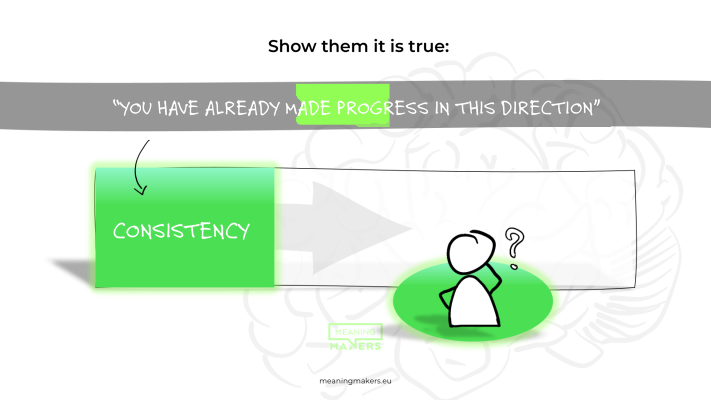
2. Show them they are already in motion
Where has this change already happened, even on a small scale? People rarely start from zero. In most teams, there are already individual actions that are heading in the right direction. The problem is that no one names them or connects them into a bigger picture.
In practice, you can show specific situations where someone is already acting in line with the new approach. An example from a project, a snippet of a conversation with a client, a decision made differently than usual. This changes the perspective. Instead of “we have to start”, it becomes “we are already doing this”.
3. Reinforce what is already working
What has already been done that is worth maintaining and developing? Most communication about change focuses on what is not yet there. This naturally lowers energy. A different approach is to notice and reinforce what is already working.
In an organisation, this can mean regularly returning to specific examples of progress. Short summaries, case studies from the team, naming it in a public forum. This builds a sense that the change is not a distant goal, but a process that is already underway.
4. Design the first, small step
What is the simplest move someone can make right away? Big changes are blocking because they are hard to grasp. Small actions trigger movement because they are concrete and doable. The key is for this first step to be clear and possible to take without additional resources.
In practice, this could be one change in the way a meeting is run, one question asked of a client, one element of a report prepared differently. This move sets the direction and makes it so that subsequent actions start to appear naturally.
Change begins at the point where someone sees continuity, not a break. If you show people they are already on the way, you don’t have to push them forward. You just need to help them take the next step that will feel natural to them.
A gym at home
In a gym workout, the hardest moment is not the set of exercises or the last repetition. It’s the moment you put on your shoes and walk out the door.
I know this from my own experience, and I 100% believe in what you have read in this article. That’s exactly why I built a gym at home.
Because the hardest part is the moment you switch from thinking to doing. Once you are in motion, subsequent decisions begin to align. Food, sleep, recovery. Everything starts to move in one direction because the first step has been taken.
Exactly the same pattern can be seen at work.
If you prepare presentations in one way for years, you build your own shortcuts, habits and a sense of control. Changing a tool or a way of working is not just a technical change. It’s a moment when you have to let go of something you’ve already invested time and attention in. Resistance appears, even if the new solution makes sense.
On the other hand, all it takes is one move in a new direction. One slide prepared differently, one decision made according to a new model, one meeting run in a different way. This begins to build a new story. From that moment on, subsequent actions have something to refer to.
Change rarely starts with a big decision. It starts from the moment someone takes the first step and begins to see themselves differently. From that point on, subsequent actions cease to be an isolated effort. They begin to form a direction that one wants to maintain.
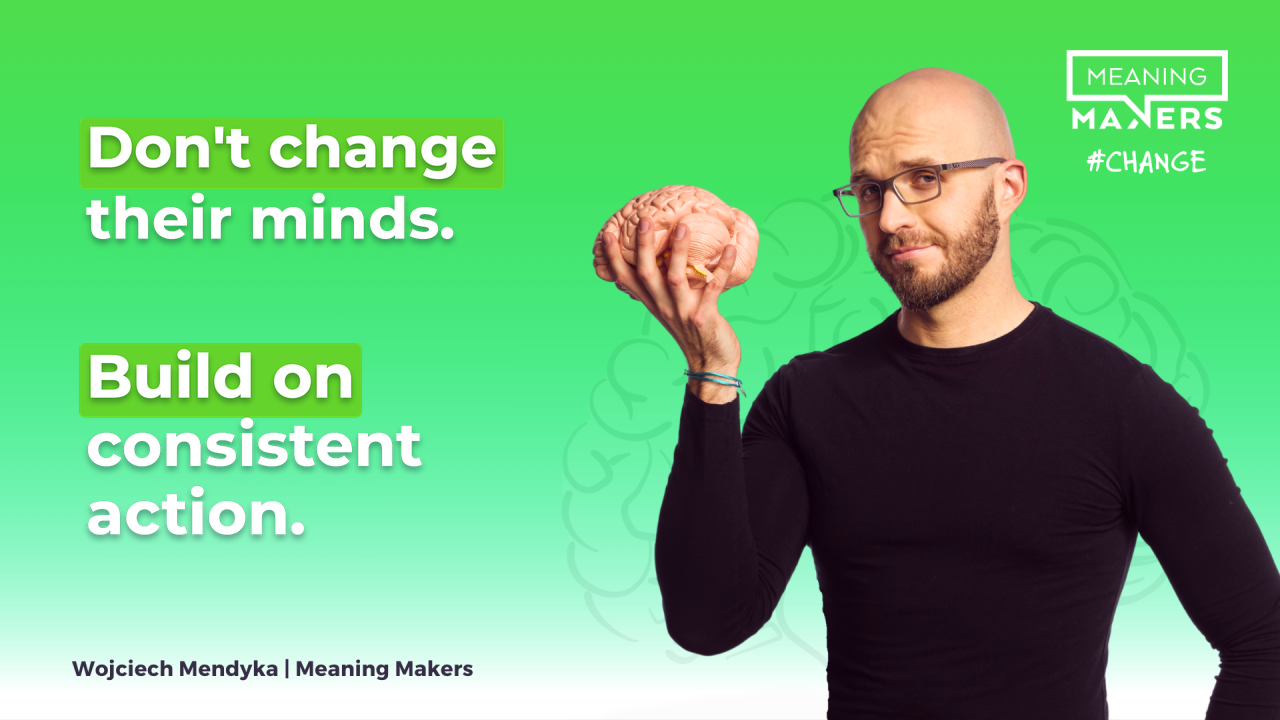
That's why working with people is less about changing their minds. It's more about creating a situation where someone starts to act in a new way and has a reason to continue.
Now, over to you
The question that remains is simple.
Where are you currently trying to convince people to change, instead of helping them take the first step that will set them on a new course?