

For over a decade, the internet has been conditioning us to obsessively focus on one word.
LIKE.
Facebook turned it into a button. Instagram, a measure of popularity. LinkedIn can make you check your post every so often just to see if the number has jumped. Of course, I’ve heard other people do that. Never me.
We wonder how many people have liked our post, photo, comment, or video. We far less frequently ask ourselves about the older meaning of the word.
What actually causes someone to like us?
For them to simply like us.
This question sounds a bit like a topic for a networking workshop or a guide on how to be a more likeable person. In reality, it's much more interesting. Likability plays a significant role in who we give the benefit of the doubt, who we listen to a little longer, who we forgive a slip-up more easily, and whose suggestion we're willing to at least consider.
You can have a great argument. You can be prepared. You can know more than everyone else at the table.
If the other person doesn't like you, part of that advantage has just disappeared.
Friendly neighbourhood Spider-Man
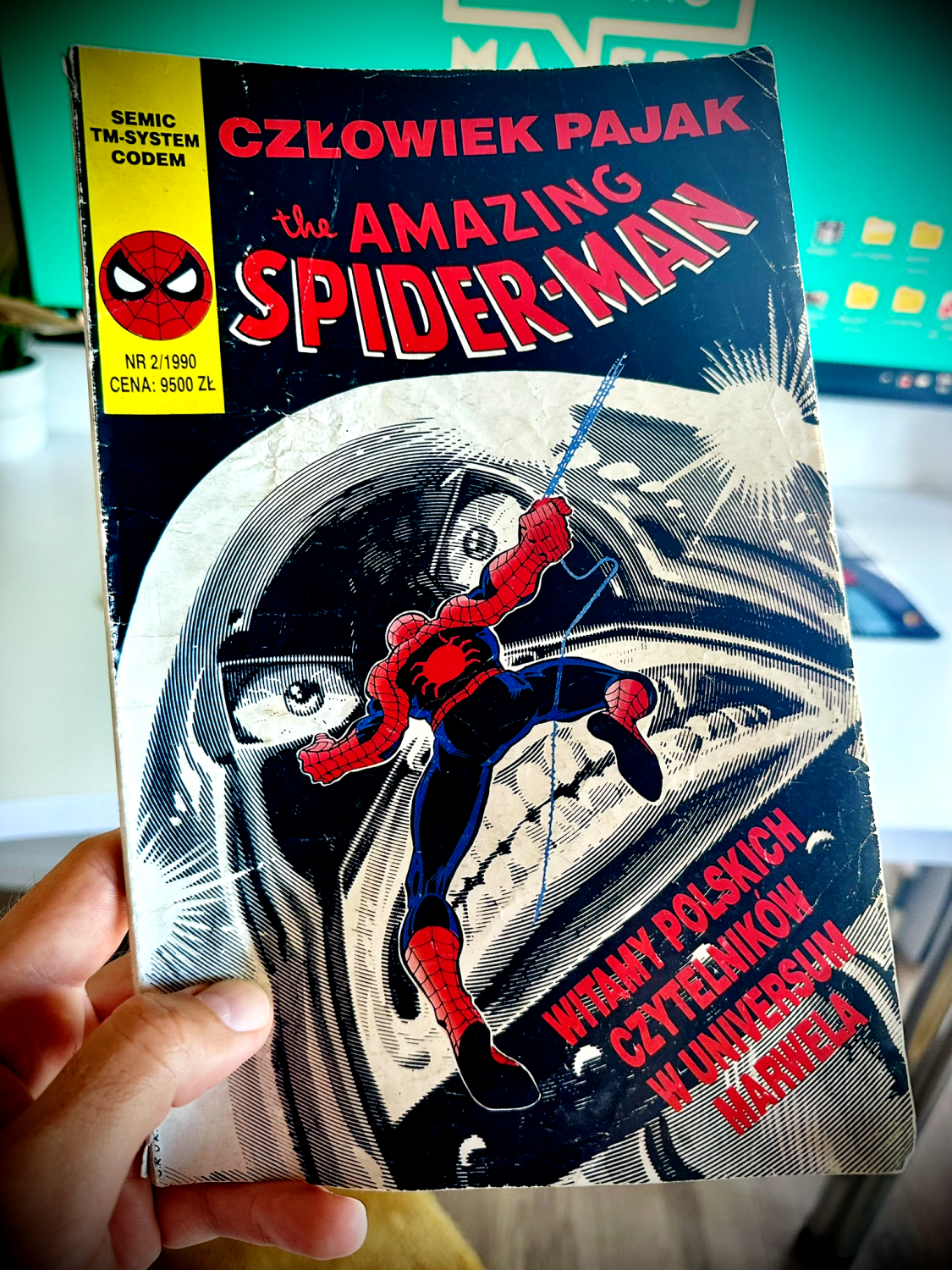
Spider-Man was one of my favourite heroes back when you bought comics at a newsagent, not in an app. To this day, I still have a few old issues, including one from the early 90s. Now my kids watch him, so it seems Peter Parker has handled the generational shift quite well.
For years, I've been amused by one of his most famous descriptions:
Your friendly neighbourhood Spider-Man.
The longer I work with people and influence, the more I like this phrase.
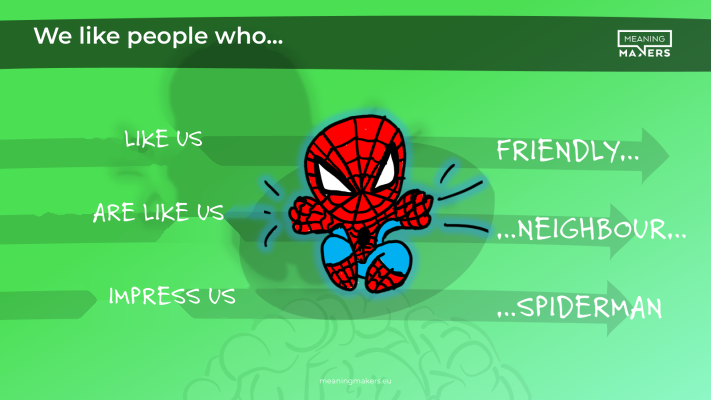
Neighbourhood. Someone from the local area. A guy with normal problems. School, work, relationships, no money, an aunt, bills, his own screw-ups. For most of his history, Peter Parker doesn't act like someone standing several floors above ordinary people. He's one of them.
Friendly. We know whose side he's on. We can assume good intentions. There's no need to be particularly defensive around him.
And then there's Spider-Man.
The guy walks on walls, swings between buildings, and generally can do things that most of us can't quite grasp.
It's an interesting combination. Someone who is close enough for us to identify with, yet unique enough to impress us.
Perhaps that's why Spider-Man has remained one of the most-liked superheroes for decades. Not because he has the best costume or the most impressive powers. Under the superhero cape... alright, Spider-Man doesn't have a cape. All the better. Underneath the costume, there’s still someone who seems familiar.
Likability matters more than we want to admit
Robert Cialdini included likability among the classic principles of influence. When you first read about it, it's easy to just take it in your stride.
Alright. People are more willing to say “yes” to people they like.
Thank you, Captain Obvious.
It only gets interesting when we start breaking this “liking” down.
Cialdini wrote about similarity, compliments, attractiveness, contact, and positive associations, among other things. All these elements help explain why we feel at ease with some people very quickly, while with others we remain a bit more cautious from the very first minute.
Over the years, I've simplified this topic for myself down to three things I regularly see at work.
We like people who are similar to us. We like people when we feel that they like us. And we often like people who impress us with something.
- We like people who are similar to us.
- We like people when we feel that they like us.
- And we often like people who impress us with something.
Of course, social life is more complicated than three sentences on a slide. But as a map, it works surprisingly well.
Think for a moment about a few people you genuinely like. Not just family or your closest friends. Also people from work, authors you read, public figures you enjoy listening to.
There's a good chance you'll find at least some of these elements there.
We like people in whom we see a piece of ourselves
Similarity gives the brain something very convenient: predictability.
When someone speaks a similar language, has similar experiences, a similar sense of humour, interests or problems, we begin to understand their behaviour more quickly. We don't have to constantly wonder what world they come from and what to expect from them.
That's why during the first few minutes of a conversation, people so often look for common ground.
“Do you have kids too?”
“Did you also use to work at that company?”
“Do you game too?”
“Do you hate Teams too?”
The last point, of course, unites humanity beyond all divisions.
Similarity doesn't require identity. We don't have to vote the same way, have the same career, or a similar character. Sometimes, one small element is enough to make us think: I know this world.
This is precisely why we sometimes shoot ourselves in the foot in professional communication by trying too hard to appear professional.
We remove everything personal. What's left is the role, the position, the responsibility, the competence, and five correct sentences on an “About me” slide.
The thing is, people rarely build a relationship with a scope of responsibilities.
They build it with a person.
We like people who make us feel that they like us
This is probably the simplest piece of the whole puzzle, and at the same time, one of the most frequently overlooked.
We can feel very quickly whether the other person is genuinely interested in us.
It's visible in the little things. Whether they listen to the answer to a question they themselves asked. Whether they remember something you said earlier. Whether they react to your example or are just waiting for a moment to return to their own.
A compliment is one way to trigger this mechanism, but it doesn't have to mean telling someone they have a perfectly matching shirt (I know, but thanks anyway!)
Small signs of recognition can be much more powerful.
“That was a good question.” “I hadn't thought about it that way.” “What you said earlier about the client explains this problem well.” Such a message says more than just its content. It shows: I noticed you.
- “That was a good question.”
- “I hadn't thought about it that way.”
- “What you said earlier about the client explains this problem well.”
- Such a message says more than just its content. It shows: I noticed you.
And when we feel noticed, the quality of the relationship changes.
Impressing people works. Provided you're not building a monument to yourself
This is where it gets a bit more complicated.
We also like people we admire. Who know something we don't. Who can do something. Who have achieved something that seems difficult. Who have experience we can benefit from.
Competence gives a reason to listen. But competence alone can create considerable distance.
If someone spends the first fifteen minutes talking only about their achievements, we quickly understand that they are very good. After another five, we start wondering when we can go and get a coffee.
That's why the combination of competence and similarity is so interesting.
You want to feel that this person knows more than you in a given area. At the same time, it's good when they don't make you feel that this makes them a better class of human.
This brings us to a man who looks a bit like my future.
Scott Galloway, or me in about 15-20 years
I've enjoyed listening to Scott Galloway for years. I don't agree with him on everything. In fact, I've been disagreeing more and more often lately, which I think is healthy.
But I still like him.
When I show his picture during workshops, I usually joke that a very sophisticated mechanism of similarity is probably at play here too.
Bald. Glasses. A short grey beard.
- Bald.
- Glasses.
- A short grey beard.
Well...
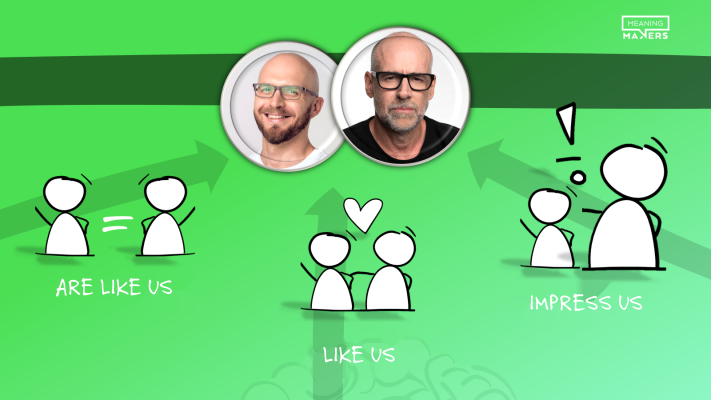
Scott looks a bit like my future self. Unfortunately, that future self is about 15-20 years older, but oh well.
Of course, the visual similarity is a joke here. I'm more interested in his communication style. Galloway can talk about great success, business, and money, and a moment later tell a story about his own failure, a problem with his kids, or a stupid decision. The competence doesn't disappear. Some of the distance does.
This makes it easier to listen to a man whom you can both admire and recognise something familiar in.
This is one of the most interesting things about likability. You don't need complete agreement to like someone.
Sometimes, likability even allows you to listen to an opinion with which you initially disagree.
After more than a decade in the training room, I noticed something about myself
When I look at the way I run workshops today, I see that for years, completely unconsciously, I have been trying to hit precisely these three areas.
I've never liked putting myself on a pedestal.
In the training room, I tell people about my mistakes, my first job in Dublin, my kids, games, failed conversations, Microsoft driving me crazy, and many other things that don't build a particularly majestic image of an expert.
Some participants have similar problems. Some have similar experiences. Someone else has small children. Someone used to play Warcraft. Someone has also felt like throwing their laptop out of the window after a Windows update.
The distance closes very quickly.
At the same time, I know that people need a reason to listen to me for the next few hours. Experience from hundreds of projects, working in different countries, MBA lectures, clients, and over a decade of doing the same thing in new contexts helps.
I don't need to talk about it for half the day. It's enough that this information exists somewhere.
But the third element is probably the most important.
On a daily basis, I'm quite an introvert and I'm really comfortable on my own. But in the training room, something switches in my head. I walk in with the assumption that these people have come for something for themselves, and that I have something valuable to give them. There’s also a bit of gratitude in it, that in a moment they will give me a few hours of their attention - even if they don't know it yet at the beginning. After so many years in this job, I also know that most people genuinely want something meaningful for themselves, their team, or their company. They want this time to make sense. That's why, from the first few minutes, I don't treat them as “a group to be handled”, but as people I want to give something to. I have the impression that this is felt more quickly than any compliment.
I think people feel it.
Perhaps for years, I have been unconsciously trying to achieve the same balance that Marvel captured in a single phrase.
Close enough that you can have a normal chat with me. Competent enough that it's worth staying in the room.
Friendly neighbourhood... trainer unfortunately sounds much worse.
Likability changes how we interpret people
This is where likability starts to do very specific work.
Think about someone you really like and trust. If they say something a little imprecisely, you usually cut them some slack. You more or less know what they meant. You assume good intent.
Now, imagine the same words from a person you feel distant from. Suddenly, you start analysing their tone, choice of words, possible intentions. “What's he trying to get out of this?”
The words might be very similar. Their reception is not.
With the first person, we more often interpret ambiguity in their favour. “He probably just said it wrong.” “I know what he meant.” “I'll try to understand.”
With the second, suspicion arises more easily.
“Why did he say that?”, “What's he getting at?”, “What is he trying to gain?”
The content hasn't changed. The filter has.
In sales, it matters when a client is trying to understand your recommendation. In negotiations, when the other side has to interpret your move. In leadership, when you're communicating a difficult decision. In organisational change, when you ask people to get on board with something they don't yet fully know.
Likability won't deliver a good argument, strategy, or competence for you.
But it can decide the intention with which they are read.
And you'd probably agree that's already a lot.
Four things that close the distance
If likability changes how we perceive people and their messages, it's worth moving from theory to what you can actually do in a conversation, at a meeting, or during a presentation. This isn't about “techniques for being liked”, but about a few behaviours that help close the distance, show good intent, and make it easier for the other person to see a human being in you, not just a role.
1. Show the person before you show the CV
The first practical point is simple. If a real similarity exists, let the other person see it.
I don't mean artificially looking for a common hobby five minutes before a client meeting.
“I see on LinkedIn that you like skiing. Me too. Now, will you buy an ERP system from me?”
No. It's more about not cutting out everything from your communication that reveals the person behind the professional role.
A short story. A personal experience. A mistake. A specific situation.
Something that allows the other person to say to themselves: I know that feeling.
2. Compliment specifically or not at all
A compliment can build likability very quickly. It can kill it just as quickly if it sounds artificial.
“Great presentation” costs almost nothing, but it also doesn't give much.
“I liked how you boiled that problem down to a single decision in three minutes” says something completely different.
A specific compliment shows that you really paid attention.
The same applies to feedback, sales, or a simple conversation. People recognise automated pleasantries very quickly. Noticing something specific requires a little genuine interest.
3. A first impression works longer than the first meeting lasts
The halo effect is one of the mechanisms that influences how we judge others. One positive trait can colour our assessment of subsequent ones, and a first impression often influences the interpretation of what we see later.
Someone is prepared, so we start attributing greater competence to them in other areas as well. Someone speaks calmly and to the point, so we are quicker to see confidence in them. Someone shows up late, is chaotic, and spends the first ten minutes fighting with the HDMI cable...
Well. Good luck rebuilding the image of an expert after that.
That's why the first few minutes of a meeting matter more than the content of the first slide. During this time, the audience is forming an answer to the question of who they are actually dealing with.
4. Tell stories, because that's how people talk
I have one more observation of my own, which I don't consider another of Cialdini's principles.
When a relationship is purely transactional, we exchange information.
Price. Deadline. Scope. Decision. Next step.
When we start to like someone, stories appear.
“I had a similar situation once...” “You know what, that reminds me...” “Something like that happened at our place...”
- “I had a similar situation once...”
- “You know what, that reminds me...”
- “Something like that happened at our place...”
I'm not talking about grand storytelling, the hero's journey, and dramatic plot twists. I mean simple human storytelling.
Stories reveal a little more of the person. They show experience, emotion, a way of thinking. They give the other person anchor points that pure information doesn't provide.
Perhaps that's why, with people we like, we rarely talk exclusively in bullet points.
So don't talk in bullet points.
Tell them something.
Is this manipulation?
Of course, one could ask an uncomfortable question now.
If I know what causes likability, can I consciously use it?
Of course. In fact, you already are.
You choose how to introduce yourself. You decide whether to tell a story. You show or hide your experience. You react to the other person. You choose your tone.
Influence occurs regardless of whether you want to name it.
That's not the problem. The problem is with feigned similarity, artificial interest, compliments used as a sales technique, and building an image of competence that doesn't actually exist.
A few issues ago, I wrote in this newsletter about manipulation and responsibility for influence. The mechanism here is similar. Awareness doesn't have to lead to cynicism. It can just as well lead you to more consciously build relationships that are genuine.
Because likability works best when it doesn't need to be manufactured.
Friendly. Neighbourhood. Spider-Man.
Friendly, because you sense good intent.
Neighbourhood, because he's close enough to your world for you to identify with him.
Spider-Man, because he still does something that you can't.
I don't know if Stan Lee designed this name by analysing the psychology of influence. I highly doubt it.
But he did a pretty good job.
In business, we sometimes focus too much on the last part. We want to show competence, experience, results, our advantage. To prove that we're good enough for someone to listen to us.
And at the same time, the audience is making a much simpler decision.
Do I even like this person enough to let them influence my thinking and my decisions?