
Have you ever been in prison?
I’ll answer for you – you have. Don’t worry, I’ll explain in a moment.
There’s one thing that comes up in Meaning Makers training sessions, regardless of the topic. It’s almost become an internal meme for me.
I mean, how else can you explain it? I work with leaders responsible for their organisation’s direction. I work with salespeople trying to persuade clients to change their supplier or way of working. I work with experts who want to introduce a new approach within their team.
Almost every time, the conversation comes down to the same phenomenon.
Even if I haven’t planned it on the agenda, even if it wasn’t in the training plan, this theme still appears. Out of nowhere, it creeps into conversations or the debriefing of workshop exercises. I’m even starting to laugh about it.
What is this phenomenon? You see, the industry changes, the decision-making level changes, the scale of responsibility changes. The mechanism remains identical. Someone sees the need for change. Someone else defends the current state of affairs. From the outside, it looks like resistance to logic. On the inside, it’s often an attempt to protect one’s own position.
What am I talking about?
The status quo, of course – our irrational tendency to stick to the current situation, even in the face of sensible arguments.
That’s why I often start with the question: have you ever been in prison? And the answer, in a sense, is yes. We’ve all been there – and in many respects, we are still prisoners of the present.
So are your clients, your employees, and sometimes even your board.
Thinking outside of work, my passive resistance to Microsoft wanting to force me to switch to Windows 11 immediately comes to mind, and I didn’t want to (perhaps you’ve had a similar experience?).
This game of cat and mouse went on for months. Notifications, emails, messages when I turned on the computer, and so on. Was it because I loved Windows 10 so much? No. I was simply used to it. I had my things set up, my shortcuts, my habits. The change involved minimal discomfort, but it was still a change.
It’s the same at work. We have newer management models, better suited to modern realities, yet teams still stick to what they know. We present a client with a better solution, and they stick with the old one, even though it’s logically clear that yours is more beneficial. Or perhaps you’re an expert proposing a new approach or a specific change, and people react with resistance, often passive resistance.
People rarely stick with something because it works perfectly. They stick with it because they know the consequences. And that gives them a sense of control.
The status quo isn’t comfortable. It’s predictable. And for the brain, predictability is more important than potential improvement.
Why we stay, even when we know it could be better
Do you know someone who doesn’t like their job? Chances are you do, and you might see that person every few months... Have you noticed that after a few months, that person is often still in the same job?
In practice, we rarely meet people who say, “Everything’s perfect, let’s not change a thing”. Usually, everyone sees the imperfections. They see the limitations. They see the missed opportunities.
And yet, they stay. The reason is simpler than you might think.
The current state has one huge advantage – we know its limits. We know its costs. We know how much it hurts. Even if that pain is chronic, it is predictable.
This is the case with a workplace. You think – I don’t like my manager, but you know them and you know what they expect. You don’t like your job, maybe because the pay isn’t great… but you know the expectations, the responsibilities, and so on. You have everything set up: your logistics, your weekly schedule.
Change is something else. It is a move in a direction that we cannot fully estimate. You can read reports. You can calculate scenarios. You can listen to presentations. But the moment of decision is more like a scene from Indiana Jones, when the hero has to step into a space that, at first glance, looks like a chasm.
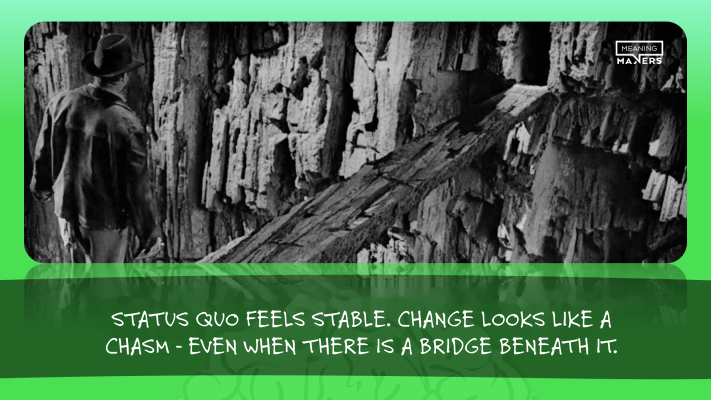
Will you take the step?
I see this regularly in companies. The strategy isn’t perfect, but it works “well enough”. Everyone is aware that the market is changing, that the competition is investing, that technology is accelerating. Yet the move is postponed. Not because the data is unclear. But because the leap into the unknown has an undefined cost.
In sales, a client often admits that their current solution doesn’t meet all their expectations. However, staying with it means maintaining known risk parameters. Changing supplier isn’t just about potential gain. It’s also the possibility that something will go wrong in the first few months, that the process will be more demanding, that unforeseen complications will arise.
The situation is similar in an expert team. The old process may be inefficient, but it’s predictable. A new one might bring improvement, but before that happens, it requires adaptation, learning, and a temporary drop in fluency.
The status quo has one psychological advantage: it is known.
People don’t stick with it because they believe in its perfection. They stick with it because it doesn’t generate an immediate threat. And for the brain, that is hugely significant.
From a biological perspective, the nervous system prefers known limitations to unknown risks. Our evolutionary history has taught us that a new environment can hide dangers we cannot predict. A known environment, even if far from ideal, provides a sense of control.
That is why the status quo is so stable. Not because it is the best option. But because it is the safest one we can imagine.
And change? Change requires stepping into a space that we cannot see in its entirety.
And this is where the real work of a leader, salesperson, and expert begins. Not on the level of arguments, but on the level of redefining safety.
And that is what this article is about.
So, if it’s not about a lack of awareness, but about a sense of safety, let’s see what decision psychology has to say on the matter.
What decision psychology tells us
A long time ago, I came across a study by Christopher Anderson, who in his work on decision avoidance (The psychology of doing nothing: forms of decision avoidance result from reason and emotion, 2003) described something that at first seems paradoxical: people regret actions more often than inactions. When we make a decision and something goes wrong, it’s easy to point to the moment when “we made the move”. The responsibility is unequivocal.
But… when we do nothing, and the situation slowly deteriorates, it’s hard to pinpoint a single turning point. The blame is spread over time, over circumstances, over the “market”.
That is why inaction is often psychologically safer than action.
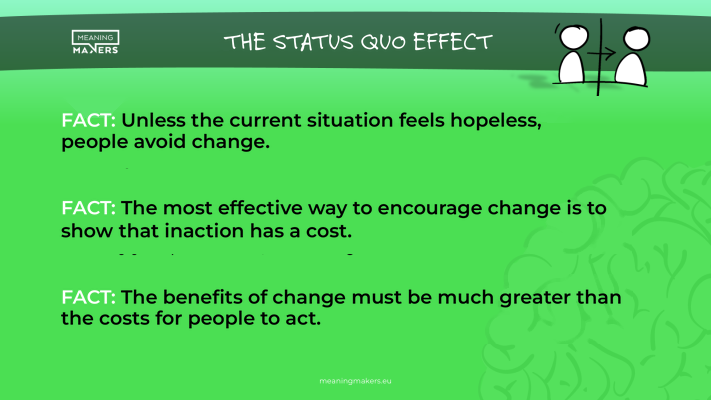
Then there is anticipated regret. Even before we make a decision, our brain runs a simulation. We imagine a scenario where the change fails. We see the conversation with our manager. We imagine the team’s comments. We hear the client’s questions: “Why did we choose this option?”. This process happens very quickly and often beyond our conscious control. The brain doesn’t wait for a real failure. It pre-empts it.
We can do a thought experiment. Imagine you are walking down a street in a rather unsavoury part of your city. Middle of the night. On the other side of the street, three hooded figures are walking.
What do you do? You don’t want to be such a pessimist, right? Surely nothing will happen. But your brain is very intensely suggesting – cross to the other side of the street. Just in case. If you cross, and the walkers turn out to be totally harmless, you’ve lost nothing but a minimum of extra effort. But if you don’t cross, and they turn out to be hostile?
You see, this is your brain’s quick risk analysis. It’s better to assume the worst.
Just as it’s better to assume that the change someone is proposing to you – might not succeed.
From a neurobiological point of view, this makes sense. The system responsible for detecting threats doesn’t exclusively distinguish physical danger. It also reacts to the risk of losing status, reputation, and influence within a group. For our ancestors, losing their position in the community could mean a real threat to survival. Today, it doesn’t get us cast out of the tribe, but it still triggers similar stress mechanisms.
In practice, this means that change increases visibility. And visibility means vulnerability to judgment.
When you introduce a new strategy, a new process, or a new supplier, the decision becomes tangible. It can be analysed, commented on, and held to account. When you stick with an old solution, even if it’s mediocre, responsibility is diffused. There is no single moment when “it was your decision”.
Therefore, inaction is not passive. It is an active strategy for minimising reputational risk. It is a way of protecting one’s identity from a potential blow.
And that is precisely why it is so difficult to move people from the status quo with arguments alone. An argument works on a logical level. The mechanism blocking the move works on a level of social and emotional protection.
So again: the status quo isn’t comfortable. It’s predictable. And for the brain, predictability is more important than potential improvement.
If you don’t take this into account, you’ll be surprised that the data is convincing, yet there is still no decision.
The same brain in different roles
When working with boards, I see how strategic decisions are postponed, even though analyses indicate the need for action. Short-term fluctuations in results are more tangible than the long-term risk of losing position. In the calendar, the next quarterly report weighs more heavily than an abstract vision of the future.
The situation in sales is similar. The client admits that the current solution is not ideal, but at the same time, they fear the consequences of change. If the new partner fails to meet expectations, the responsibility will be assigned to a specific person. Sticking with a mediocre but known solution is easier to defend.
An expert with an idea for process improvement calculates not only the project’s value but also their own risk. If the initiative does not bring immediate results, it may affect how they are perceived in the organisation.
The roles are different. The mechanism is identical.
In training, I often stress that people may have different experiences and positions, but they operate with the same nervous system. This system was designed to minimise threats. In a situation of uncertainty, the default reaction is caution.
A new environment always brings more variability. A known environment provides predictability. Even if that predictability means limitations.
Shifting the perception of risk: a lesson from Brexit
Do you know what margin of votes decided the United Kingdom’s exit from the European Union in 2016?
3.78%.
During training sessions, I often use the example of Brexit in this very context.
Brexit is an interesting example of a change in the perception of safety. The difference in votes was small, yet it was enough to exit the existing arrangement. Why?
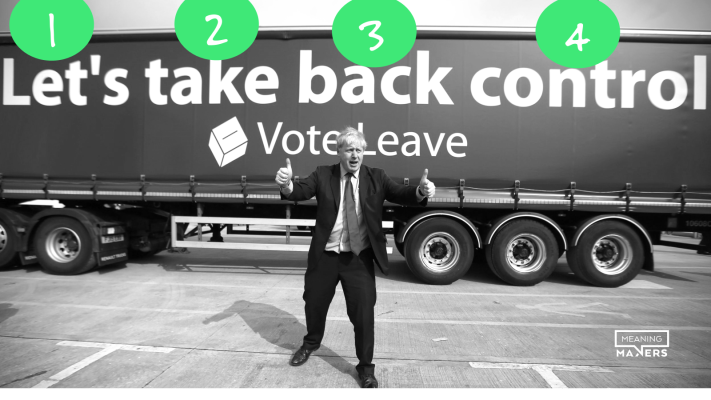
The campaign was not just about presenting the advantages of an alternative system. The key was to convince a part of society that the current state was associated with a loss of control.
The slogan to “take back control” did not have to prove that the future would be simpler or more predictable. It was enough to suggest that the present was risky. This is a classic reversal of risk perception, showing that the loss might lie precisely where you are now.
Was that the only reason for the decision to leave the European Union? Of course not. But could such a change in narrative have been enough to shift less than four per cent of voters in a certain direction? I think it absolutely could.
The brain reacts more strongly to a sense of threat than to abstract promises of benefits. If the status quo is no longer perceived as safe, the balance begins to shift.
The same applies to organisations. As long as the current way of working seems less threatening than the proposed change, resistance is rational. The moment the cost of stagnation is named and made real, the equilibrium starts to shift.
Why we stick with what we have
Imagine I offer you £100,000 today. The alternative is £120,000 in a year. The difference is 20%. In financial terms, this is a return that no bank guarantees at such a low level of risk. The maths is on the side of patience.
Despite this, many people choose the immediate payout.
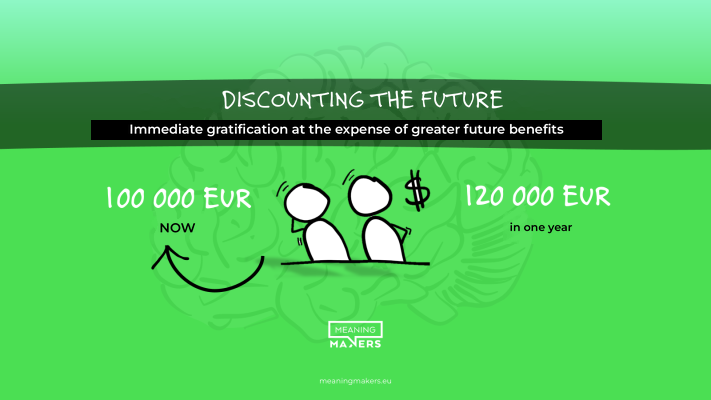
The reason is simple: distant benefits are discounted. The reward system reacts more strongly to what is available here and now. The future is less certain, less concrete, more abstract. The brain prefers certainty even when it is numerically smaller.
In the context of change, this means that the effort, stress, and risk appear immediately, while the gains are deferred. Reorganising a team hurts today. Implementing a new system complicates work now. Changing a supplier means temporary turbulence. The potential improvement in efficiency is somewhere in the future. The brain values uncertainty more highly than potential growth.
The status quo doesn’t win because it’s the best. It wins because it is immediate and predictable.
Choice overload as fuel for the status quo
There is one more mechanism (my favourite) that reinforces sticking to what is known: choice overload. I think it’s responsible for three-quarters of the cases where the topic of status quo comes up in training.
When a decision requires the analysis of many variants, the cognitive load increases. Too many options increase decision fatigue. In such a situation, the most energy-efficient decision is no decision.
This is very clear in sales. A salesperson, wanting to be professional, shows a client seven versions of a solution, three pricing models, four implementation variants, and several integration scenarios. The intention is good. The effect is often the opposite. The client, instead of feeling clarity, feels a burden. The analysis becomes tiring, the risk of error increases, and the safe way out is to stick with the current supplier.
It looks similar for leaders. A transformation presentation contains dozens of slides, charts, alternative paths, process maps, and several possible timelines. The team leaves the meeting with the feeling that the topic is too complex to move on now. We postpone the decision until later, which in practice means returning to familiar patterns.
An expert within an organisation also falls into this trap. They want to show the full extent of their knowledge. They present all possible approaches, every exception, every nuance. Instead of seeing a clear direction, the recipients see a labyrinth. And a labyrinth does not encourage action – it paralyses.
The greater the complexity, the stronger the desire for simplification. The simplest simplification is to stick with what already works.
The status quo wins not only because it is safe. It wins because, in a world overloaded with information, it is the cheapest cognitive decision.
Choice overload shows that:
the brain seeks simplification; the status quo is the cheapest in terms of energy
- the brain seeks simplification
- the status quo is the cheapest in terms of energy
If this is how the brain works, how can we realistically shift the balance?
Four ways to shift the balance
If the status quo seems safe because we know its limits, then change doesn’t start with better arguments. It starts with shifting the perception of safety.
You won’t convince anyone with a slide if, in their head, the current state is less risky than your proposal. It’s not enough to show the potential gain if the brain still sees a chasm.
Designing change, therefore, involves something more subtle. You have to make staying put no longer look safe, and moving in a new direction no longer resemble a leap into the void.
There are four ways I regularly see in practice.
1. Make the cost of stagnation visible
Imagine a conversation with a team that has been postponing a decision for months. Everyone agrees that the current process is inefficient. Everyone sees that the competition is accelerating. And yet, the meeting ends with the same conclusion: “let’s come back to this next quarter”.
Do you know that feeling when a problem is obvious, but no one feels the pressure to solve it?
As long as inaction doesn’t hurt in a concrete way, the brain treats it as neutral. Stagnation is diluted over time. Its cost has no date or invoice.
A leader who wants to move an organisation must translate an abstract problem into a real cost. What does another year without investment mean? How will market share change? How much exactly are we losing by maintaining an outdated process?
It works similarly in sales. A client often knows that their current solution is mediocre. It is only when someone calculates the cost of missed opportunities that it stops being an “opinion” and starts being a financial decision.
Stagnation ceases to be safe the moment it becomes measurable.
2. Reduce the psychological cost of the first step
Think back to a time when you had to make a big decision. A new job. A move. A change in your company’s operating model. The hardest part was the first moment when it seemed like you had to bet everything on one card.
The brain isn’t afraid of change itself; it’s often simply afraid of its irreversibility.
If a decision looks like a point of no return, the level of tension rises. If it can be tested, modified, or reversed, the perceived risk decreases.
In practice, this means pilot schemes, limited roll-outs, and stages instead of a revolution. In sales, it could be a trial version or a smaller initial scope. In leadership, it means clearly communicating that a test is not an assessment of competence but part of the process.
Change doesn’t have to start with a leap across a canyon, or a step into a chasm (Indiana Jones is back again, I must watch it!). It can start with checking the ground beneath your feet.
The smaller the cost of the first step, the greater the chance that someone will take it.
3. Limit the complexity of choice
Remember a time when you had to choose something simple, and you were given a dozen options? A subscription package, a product configuration, strategy variants. The more you analysed, the more tired you became.
Eventually, you postponed the decision.
Too much choice increases cognitive load. A brain that has to process many scenarios looks for the most energy-efficient path. Often, that path is inaction.
Sales is my favourite example here. My dear sales departments that I train seem unyieldingly resistant to the simple truth that LESS IS MORE. In sales, overloaded presentations and extensive tables can paralyse a client.
In organisations, multi-variant strategies cause the team to lose clarity. An expert who wants to convey the full context may unwittingly make the decision harder.
Reducing complexity is not about oversimplifying reality. It’s about facilitating decision-making.
One clear recommendation is stronger than five possible scenarios.
4. Redefine safety
Imagine a culture where a mistake is immediately associated with incompetence. In such an environment, people will protect the status quo, even if they know something could be done better.
Now imagine an organisation where testing is natural, and a controlled mistake is treated as part of learning. In such a place, the decision to change does not threaten one’s identity.
Safety does not have to mean an absence of stumbles. It can mean the ability to adapt.
If a team believes that an experiment will not destroy their reputation, the psychological cost of action decreases. If a leader clearly communicates that learning is a value, not a weakness, the chasm no longer looks like a chasm. It’s worth adding that by “communicates”, we mean they do it through their actions – they actually act that way, not just talk about it.
Then, change ceases to be an attack on stability. It becomes a tool for building it.
Quo vadis, status quo?
The status quo is not the enemy. It is a natural state in which a person protects what they know. The problem starts when protection turns into imprisonment.
You can work for years in a place that offers no growth, just because its limitations are predictable. You can stick with a supplier who brings no value, because at least they don’t generate surprises. You can lead a team in a way that is safe, but not bold.
In each of these cases, it is not about a lack of intelligence or ambition. It is about the brain choosing what seems less risky here and now.
Getting out of such an arrangement is not about gathering more arguments. It’s about learning the lesson from Brexit – and shifting the sense of safety. Only when the current place no longer looks safe, and change no longer resembles a leap into the void, does real movement occur. Then, the prison ceases to be a comfort and becomes a limitation worth overcoming.
The final question
So if the status quo wins because it looks safe, then the real question is not: “Is the change better?”. The real question is: “What do you consider safe today – and are you sure you’re right?”.
Take a moment to look at your own decisions.
Where are you staying just because you know the limits of the current situation? In what area are you telling yourself that “it’s not that bad yet”, even though you know the potential is greater? In your relationship with a client, in your team, in your career – where have you decided that stagnation is less risky than movement?
You don’t have to leap across the canyon straight away. Sometimes, it’s enough to ask yourself honestly whether the bridge really doesn’t exist, or if you’re just afraid to take the first step.
Because the most enduring prisons are those we have deemed to be safe .