
A few months ago, I ended an important collaboration in my company. It was a decision I had been mulling over for almost two years.
The most interesting part? I had known for a long time that I should make it. But I didn't. Do you know that feeling?
You see, rationally, everything added up. The arrangement was generating more and more stress, less and less satisfaction, and I had long felt that I didn’t want to work like that anymore. And yet, for months, I did nothing about it.
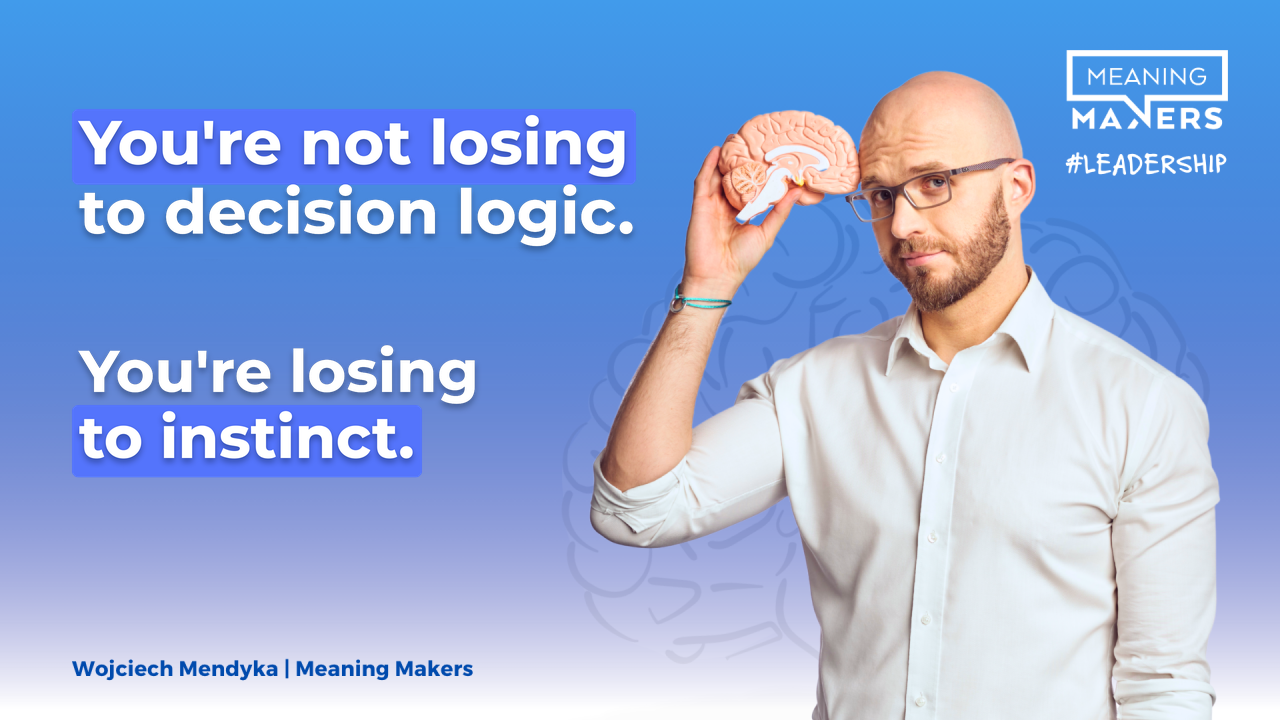
I knew what to do... but I wasn't doing it. My brain was far more afraid of loss, uncertainty, and leaving a familiar arrangement than of continuing with a bad decision. I was losing to instinct, not to logic and rationality.
We don’t make the decisions that are best for us. We make the decisions that seem psychologically safer.
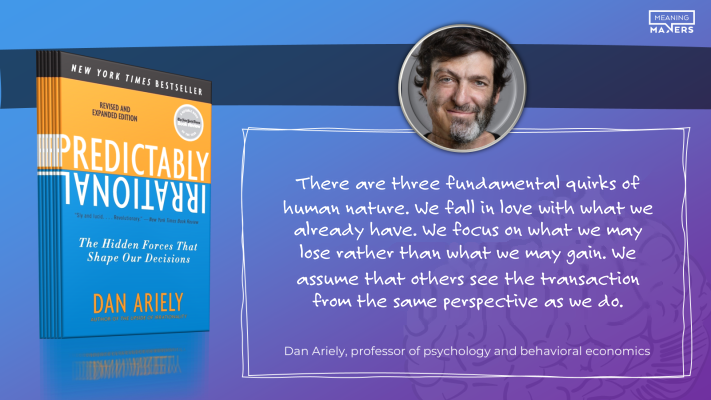
Dan Ariely, one of my favourite authors, once described an interesting experiment on decision-making. People were asked to choose a holiday. They had three options.
The first option was an all-inclusive trip to Paris. The second – an all-inclusive trip to Rome. The choices were split pretty evenly – 50/50.
Then the researchers added a third option: Paris without breakfast.
Pfft. So what, right? Who would choose Paris without breakfast when they have an all-inclusive option? You're right – no one chose it.
(Come to think of it, I think I would have chosen it – a French-style breakfast of a croissant and coffee isn't for me.)
However, something strange happened. Suddenly, 75-85% of people started choosing… Paris with breakfast.
Why? The new option wasn’t meant to be a real choice, but its mere presence completely changed people's decisions. Suddenly, the “Paris all-inclusive” option started to look better in contrast to the one without breakfast, even though objectively, that option hadn't changed at all.
But the decisions changed. What was 50% became a clear majority.
Ariely describes this experiment in his book Predictably Irrational (published in Poland as Potęga irracjonalności. Ukryte siły, które wpływają na nasze decyzje). A perfect title.
Very often, we don’t make decisions rationally. We make them relatively.
Our decisions depend on context, comparisons, emotions, and a sense of security far more than we’d like to believe.
This is why even very intelligent people regularly make terrible decisions. Companies drag on with projects that should have been stopped months earlier. Teams are afraid to say a strategy makes no sense. Managers put off conversations that everyone knows are inevitable. People stay for years in situations that stopped working for them long ago.
Looking from the outside, many of these decisions seem completely irrational. Most of the people making them considered them to be reasonable.
But how can you make better decisions when your brain works in this very way?
Why you keep making the same decisions
Think about how often you choose the exact same thing. The same restaurant. The same product. The same way of doing things.
Even when you objectively know there are better options. It’s no coincidence.
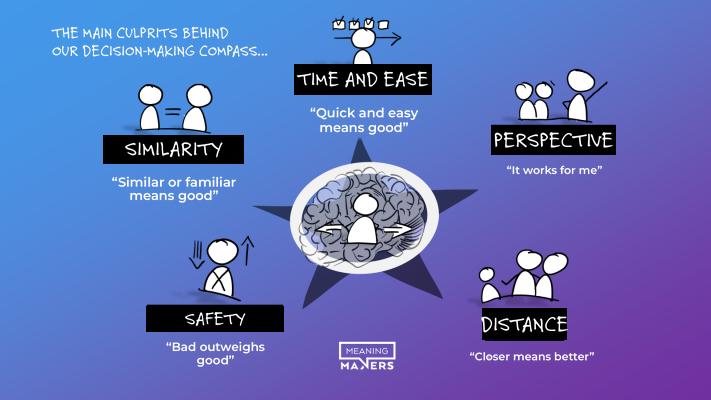
The brain loves predictability. Known solutions require less cognitive energy. You don’t have to analyse them from scratch. You don’t have to face uncertainty. This is perfectly illustrated on streaming platforms. People have access to thousands of films and series, and yet a huge number of them go back to things they have already watched.
Familiarity gives the brain a sense of security.
This is exactly what the decision to end my collaboration was like for me. The arrangement itself had long ceased to be comfortable. It generated stress, frustration, and a feeling of being stuck. And yet, I stayed in it.
Because it was familiar.
My brain knew this arrangement. It knew what every week, every problem, and every crisis looked like. It was tiring, but predictable. Ending the collaboration meant something much harder – stepping into the unknown.
The brain very often loses to its own instincts. A familiar problem seems safer than an unknown change, even if that change logically makes much more sense.
The same mechanism is at work in organisations. A company talks about innovation, and then reverts to the same old processes. Leaders declare they are open to change, but under pressure, they go back to their old ways of operating.
It’s simply that the brain is much quicker to trust what it already knows.
The brain confuses safety with quality
This is one of the most insidious traps in decision-making. If something seems familiar, the brain very often interprets it as more reasonable or less risky.
Unfortunately, familiarity has nothing to do with quality.
People regularly stick with poor decisions, drag out projects, or ignore warning signs. The more effort we've put into a given decision, the harder it is to back out of it.
In my case, this was very evident over time. The longer this collaboration went on, the harder it was for me to end it. Over time, I began to focus more on how much time, energy, and emotion had already gone into it, than on whether the arrangement was actually still working.
That’s when the brain starts to defend the earlier decision. Backing out of it becomes psychologically uncomfortable. This is, of course, evident in large organisations. A project is officially still “ongoing,” even though everyone quietly knows it isn't working. No one wants to be the person who says, “We should stop this.”
The decision stops being just a business decision and starts to touch on ego, status, and one's sense of competence. This is why many bad decisions persist for years.
It’s simply that the psychological cost of backing out starts to seem greater than the cost of continuing with the bad decision.
Loss hurts more than gain satisfies
“Do you want the good news or the bad news first?”
I sometimes ask this question during training sessions, and the answer is almost always the same.
The bad news.
But why? After all, the good news is more pleasant. It should interest us more. It should give us more energy. Yet most people want to hear what might hurt first.
This shows very well how the brain works. Loss, threat, and potential problems grab our attention more strongly than gain. The bad news seems more urgent because the brain wants to check as quickly as possible if it needs to defend itself, react, or prepare for the consequences.
Daniel Kahneman and Amos Tversky described this mechanism decades ago. Psychologically, a loss hurts us more than an equivalent gain pleases us. As you can probably guess, this affects a huge number of everyday decisions.
That's why we put off difficult conversations, fear change, and cling to the status quo even when it has long stopped working.
In my case, it also wasn't about a lack of logic. Rationally, I saw the potential benefits of ending the collaboration, but my brain was much more focused on what I might lose than on what I might gain. Uncertainty began to seem like a greater threat than simply staying in a situation that hadn't served me for a long time.
Sometimes the cost of staying put is enormous.
However, the brain perceives a potential loss “here and now” as more dangerous than the long-term consequences of inaction.
Most decisions are social
This is probably the most underestimated element of decision-making. We may think we are machines of analysis, but in reality, somewhere deep inside us, this “tribalism” is hardwired.
We very rarely make decisions completely independently of our environment.
We want to be accepted and seen as competent. To avoid embarrassment. And naturally, we want to belong to the group. From nursery to the heights of the corporation.
The brain takes social risk extremely seriously. In meetings, people don't ask questions, admit to doubts, or agree with the group despite their internal resistance.
Psychologically, it's much easier to make a mistake together (right?) with the team than to make a controversial decision on your own.
A big part of my decision was also a simple sense of responsibility towards other people. The situation itself had long ceased to be purely about business. It had started to touch upon relationships, loyalty, and how I myself would feel about it.
It's incredible how often the brain tries to protect us not only from financial loss or business risk, but also from simple social discomfort.
This is why people so often stay in situations that, internally, stopped making sense long ago. When in social threat mode, the brain isn't looking for the best solutions.
First, it tries to protect itself within the context of the group.
How to make better decisions despite the way your brain works
You can't become a perfectly rational person. It's impossible.
The brain will always simplify reality, seek safety, and try to protect you from risk.
However, you can learn to spot much more quickly the moments when it's not logic driving a decision, but autopilot, fear, or the need for comfort. The mere awareness of this mechanism changes a great deal.
1. Don’t trust your brain's first reaction
The first reaction is very often an attempt to simplify the situation, not to genuinely understand it.
Especially when under pressure or tired.
For a very long time, my brain suggested the simplest solution: leave everything as it is. It was the option that didn't require a difficult conversation, a change in operations, or a step into the unknown. Simply maintaining the status quo.
That’s why it's sometimes worth giving yourself a moment between the initial reaction and the final decision. Very often, it’s only then that we really start to think.
Time helps to separate the emotional impulse from a real assessment of the situation. Especially with important decisions, it's worth asking yourself: “Is this really my conscious decision… or just my brain's automatic reaction?”
2. Watch out for when a decision starts to give you a sense of security instead of quality
Just because something seems familiar or comfortable doesn't mean it's good.
The brain very easily confuses predictability with reason.
For a long time, this is exactly what it was like for me. The arrangement itself had long ceased to be satisfying, but it was predictable. I knew what to expect. I knew the problems, the tensions, and the limitations. And the brain really likes familiar problems.
Sometimes more than a potentially better solution.
That's why it's worth regularly asking yourself one question: “Do I really think this is a good decision… or have I just got used to this arrangement?”
It's a very uncomfortable question, but it’s often the one that reveals the difference between the real quality of a decision and mere psychological comfort. Because something can be familiar and still not serve us at all.
3. Separate the fear of loss from the real risk
Very often, the biggest risk isn't the change, but staying in the exact same place.
For a long time, I focused much more on what I might lose by ending the collaboration than on what I might gain. My brain naturally directed my attention towards uncertainty, potential problems, and worst-case scenarios.
It was only later that I understood how much I was ignoring the cost of continuing in a situation that had been draining my energy for a long time.
This is where many people fall into a trap. We analyse the risk of change, but we very rarely analyse the risk of no change. And yet, not making a decision is also a decision. Sometimes it is even far more costly in the long run than the very move we are afraid of making.
What do you lose by doing nothing?
4. Check if the decision is really yours
We make a great many decisions under the influence of the group, status, or the need for social acceptance. Of course – we usually don't even notice.
In my case, this decision had long ceased to be purely about business. There was a sense of responsibility towards other people, a fear of being judged, and the simple human discomfort associated with ending a professional relationship.
Sometimes we think we are making a decision rationally. In practice, we are trying to avoid guilt, conflict, or disappointing other people.
That's why, with important decisions, it's worth pausing for a moment to check: “Do I really want this… or am I just trying to meet the expectations of others?”
This is naturally harder than it sounds. Especially when we've spent years learning to be “fair”, responsible, and loyal to other people.
You know how it is. Decisions that are good for you will often be “bad” for others. That's the essence of life.
The biggest problem? You think you’re more rational than you really are.
The more I work in the neuropsychology of decision-making, the more I get the impression that the greatest challenge for modern humans is not a lack of intelligence (especially not the artificial kind, right?).
The biggest problem is the illusion of complete rationality.
When we are convinced that our decisions are completely logical, we stop noticing the emotions, automatic responses, and social reactions that are constantly influencing our choices. This is why we so often stick with decisions that, deep down, stopped making sense long ago.
Today, I know that for a long time I didn't lack data, arguments, or awareness of the situation. My brain simply trusted what was familiar far more than what was potentially better.
This is exactly what Dan Ariely's experiment showed. The “Paris without breakfast” option objectively made little sense. And yet, its mere presence completely changed people's decisions.
It's amazing when you start to notice how often our decisions are not made objectively. They are made relatively. In the context of emotion, comparison, security, social comfort, and the fear of loss.
Sometimes, one extra second of reflection is worth more than more data, analyses, and presentations.
Especially when the biggest source of error is not a lack of information.
But your own brain.
Now, over to you
What do you think – in which recent decision was your brain seeking security more than quality?