


Imagine you’re given a map of a city.
You can see all the streets. The roundabouts. The shortcuts. The distinctive buildings that, to you, are obvious landmarks. You pick a specific point, and your task is to guide another person there. There’s just one condition – they can’t see the map. They can rely solely on your words.
You start to explain.
“Straight on to the roundabout. After the roundabout, turn left. Then take the second exit. You’ll pass a small park. Turn before it. No, not at the first junction, the next one. Yes, where that low building is.”
After a moment, you feel something isn’t quite connecting. The other person starts asking questions. They get the turns wrong. They go back to the starting point. They ask about something that’s obvious to you. What’s going on?
After all, everything was clear in your head.
The hardest part of this situation isn’t explaining the way.
The hardest part is forgetting that you already know it.
We do this exercise regularly in our training sessions. What’s more, the other person even gets the same map – and the same thing happens every time. The person explaining is convinced they are speaking simply and logically. The person listening feels like they’re getting a series of fragments that are difficult to piece together into a coherent whole.
Why? The point is, even though they’re looking at the same map, the sheer number of options, streets, and possible choices makes it easy for them to get lost and take a wrong turn.
The conclusion is simple. If they take a wrong turn, at some point they’ll decide they don’t know how to reach the destination. And when they can’t see the path, they stop walking.
Now imagine that the destination isn’t a point on an artificial map, but your sales results. A new strategy you’re trying to implement. A process change the board is counting on. A presentation on which a client’s decision depends.
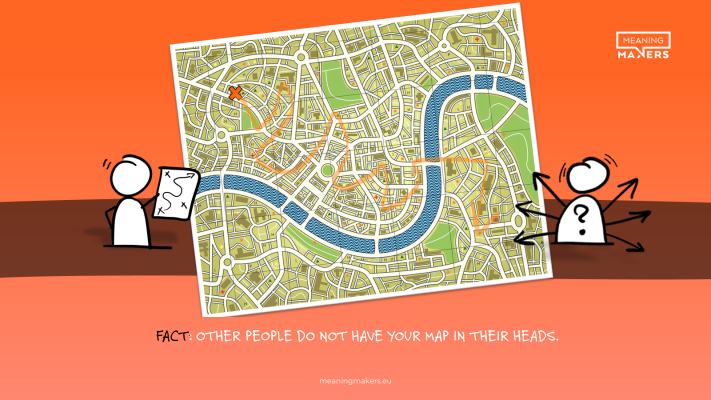
If the other person takes a wrong turn, you won’t get feedback like, “I got lost at the third junction”. You’ll see something else. A drop in engagement. Decisions being postponed. Partial implementation, or none at all. A client who says, “We need to think it over”.
And at that point, it’s no longer a communication problem.
It’s a lost decision, or a lost result.
And that is exactly how the curse of knowledge works.
We nod our heads. We don’t have the map.
Now imagine a different scene. You’re standing in a foreign city and, by some miracle, you don’t have your phone… (I know – unrealistic, but let’s go with it for a moment).
You ask someone for directions, and they start to explain.
They talk about a red brick building. A roundabout with a fountain. A small grocery shop that “you’ll see”. They mention a shortcut between apartment blocks that they’ve used every day for years. They describe a crossing that is obvious to them. After all, it’s probably their city.
What do these directions look like in their head?
In their head, the route is like a film. Coherent. Continuous. Logical. They are probably simulating the journey step by step. They are walking it in their imagination. They see the turns. They pass the buildings. They turn in the right place.
Don’t we do exactly the same thing when we explain something to someone? We walk that path ourselves in our own minds.
And what do you hear? You hear a series of instructions. Straight on. To the right. After the shop. Then slightly to the left. Before the church.
You nod. You smile. You say thank you.
And you know what happens next because you’ve done it many times in your life. You’re grateful that someone wanted to help and explain. But inside, you feel that something didn’t connect. That you got lost at some point.
So what do you do? You wait for that person to walk away. And you ask someone else.
In companies, it’s similar, only it’s harder to notice.
A leader explains the strategy for the coming years. They talk about direction, transformation, priorities. For them, it’s the logical consequence of board discussions, market analyses, and months of work.
A director explains a process change. She talks about optimisation, a new accountability model, better resource utilisation. For her, it’s the answer to real problems she has been seeing for a long time.
An expert presents a solution. They talk about features, advantages, parameters. For them, it’s the obvious evolution of what came before.
The team nods. Questions are asked about details. The meeting ends. And then it turns out that everyone understood something different.
Not because they weren’t listening.
But because they only heard fragments of the melody that you’ve had in your head for months.
What’s worse – everyone thanks you, so you might get the impression that the matter is settled. That the message has landed – the topic is closed. But in reality, everyone leaves with a different version of the same story.
If you’re an external supplier, they might thank you and simply look for someone else. Someone who “explains it better”. Someone with whom they feel a greater sense of clarity. At Meaning Makers, we say they’ll find someone who makes THEM feel smarter.
If you’re inside the organisation, of course, they won’t “change the supplier”. Things will simply start to fall apart.
The strategy will be interpreted in several ways. The process change will be implemented piecemeal. The presentation that was supposed to change the direction will become just another slide in the archive.
And no one will say outright, “We didn’t understand”. Because, after all, everyone said thank you…
And it’s at this very moment that the curse of knowledge does the most damage.
The curse of knowledge – the psychology of different maps
The curse of knowledge is a psychological phenomenon in which a person who possesses certain knowledge has difficulty imagining the state of mind of someone who does not possess that knowledge.
It’s a nice, intuitive name.
In the literature, it’s known as the curse of knowledge – a term used in cognitive psychology and behavioural economics. It is not a separate clinical entity, but rather a side effect of other cognitive mechanisms that, under normal conditions, help us think faster and more efficiently.
You see, herein lies a paradox. As is often the case – and as you can even read in the description of this newsletter – it's counter-intuitive.
Because the very thing that increases our effectiveness as experts can simultaneously make it harder for us to explain things to others…
It’s not about a lack of empathy or consciously ignoring the perspective of others. The source of the problem is the way our brain organises and compresses knowledge.
Look at how it works.
When you learn something new, your brain builds connections. Over time, these connections become stronger. Entire networks of associations are formed. Information ceases to be a collection of separate points and begins to form a system. You start to see patterns and relationships that you didn’t notice before.
An example? At first, you hear the word “margin” and you only think of a percentage. After a few years, you no longer see just a number. You see a cost structure, product positioning, a pricing strategy, the client’s negotiating power, the consequences for cash flow. For you, this one concept triggers a whole network of connections. For someone new, it’s still just a number on a slide.
And that is exactly when the difference in maps begins.
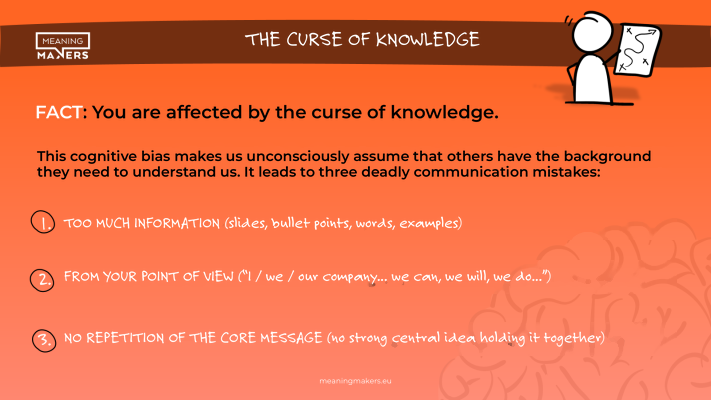
Cognitive psychology describes several mechanisms here. Each of them is adaptive in its own right. The problem begins when we fail to notice that they are the very things getting in our way.
The first mechanism: difficulty in adopting the cognitive perspective of others
Have you noticed that once we know something, it’s very difficult for us to go back to the state of “not knowing”?
This phenomenon is sometimes described as cognitive egocentrism. Our current knowledge becomes a filter through which we interpret the world. You can’t just set it aside, even if you really want to. I sometimes try.
If you understand a model, you see its logic. If you know the context, you interpret facts in a certain way. If you know what decisions were made before, new information forms a coherent story.
A person who doesn’t have this knowledge doesn’t see this story.
And you, even with the best intentions, have a limited ability to go back to the moment before you understood. It’s hard to remember what the world looked like when a certain concept wasn’t yet obvious.
That’s why the thought so often arises: “But it’s so simple”.
Simple – but from your perspective, smart alec.
The second mechanism: the illusion of transparency
The illusion of transparency is the tendency to overestimate how much our thoughts, intentions, and reasoning are visible to others.
“But I’ve already explained that in detail…” – have you, really?
Since something is coherent and clear to us, we assume that this clarity is automatically transferred to the outside world. It seems to us that the logic we see in our heads is also legible in the sentences we speak.
In practice, the other person doesn’t have access to your thought process. They don’t know all the assumptions. They don’t see the connections that are obvious to you.
You feel that the topic has been explained because everything is organised in your head. The recipient only hears a fragment of that structure.
The illusion of transparency gives a false sense of effective communication. You think that since you’ve said enough, the other person should “get it”. Often, they don’t, because they don’t have all the pieces of the puzzle.
As you’ve probably heard, “The single biggest problem in communication is the illusion that it has taken place.”
The third mechanism: automation and compression of thought
TLDR: you’re lazy.
In other words: The brain doesn’t want to use more energy than necessary.
Things we repeat often start to become automatic. Steps that were once conscious are no longer noticeable. Thinking becomes compressed. Instead of going through each stage, we jump to conclusions.
For an expert, this is a huge advantage. It allows you to analyse situations, make decisions, and connect threads more quickly. I love it.
In communication, however, this shortcut can be problematic…
When you think in shortcuts, you speak in shortcuts. You skip stages that you once went through step by step. Not because you want to hide something. But because you no longer see those stages as separate elements.
For you, the topic is a system. For the other person, it’s a set of loose elements.
If you start explaining from the level of your system, the recipient hears individual points and tries to connect them without a shared map.
And when they can’t connect them, they start filling in the gaps with their own assumptions.
And that’s exactly when the disconnect appears, which isn’t visible at all at the beginning.
My own curse
So how do you stop the curse of knowledge? It’s simple.
Stop learning! I know, expecting that from someone who reads this newsletter…
You see, it just so happens that I teach about this phenomenon – about the curse. This topic comes up regularly in my work with sales departments, leaders, and experts. It returns in presentation training, in discussions about strategy, in designing communication for change. I show it with examples, I break it down into its component parts.
And yet, I regularly catch myself falling into this trap.

This is a good example of how our brain works. Automatically. Quietly. In the background. Even if we know about the existence of a certain mechanism, it doesn’t mean we are immune to it. Knowledge doesn’t grant immunity. At best, it gives you a chance for a moment of reflection.
Sometimes you manage to react earlier. Sometimes only in the middle of it.
What does it look like in my case?
Before many training sessions, I catch myself thinking: “They know all this. These are experienced leaders. What new thing can I tell them?”.
This is a very treacherous assumption.
I’ve been immersed in these topics for years. I design programmes. I run workshops in various industries. The models I talk about have become a foundation for me. I move around in them freely. And I see the connections more quickly than I used to.
And that’s exactly why I start to treat them as a foundation for everyone.
My brain shortens and connects threads faster. It uses concepts that are obvious to me. It skips stages that I once went through step by step. What once required effort now seems natural.
If I didn’t consciously stop myself, I would start explaining from a level where only I am standing.
Unfortunately…
The curse of knowledge doesn’t disappear with awareness of its existence. It’s not enough to know that such a mechanism is at work. This is not a problem of lack of information. It's a problem of automaticity.
Awareness only gives you the ability to pause for a second longer. To catch yourself thinking a certain way. To ask yourself the question: “Am I speaking from the level of my map?”. This, of course, requires discipline.
The more experience you have, the greater the risk that you’ll start speaking in shortcuts to people who haven’t walked the same path.
And perhaps that is the most uncomfortable conclusion from the entire curse of knowledge. The better you are at your subject, the more careful you have to be about how you talk about it.
…alternatively, you can always stop learning and developing.
What really helps in daily communication
You can’t switch off the curse of knowledge. But you can reduce its impact.
Most communication problems don’t stem from a lack of data. They stem from the false assumption that the other person has the same map as we do.
Before you get into the specifics, stop and check if you aren’t explaining from a level where only you are standing.
Below are four things that genuinely help with this, and which I use regularly myself.
1. Start with the meaning, not the content
Before you go into details, answer one question.
Why is this important?
What will happen if we don’t do this? What are the consequences? What will change in practice?
Imagine a leader who starts a meeting with a slide showing three new strategic initiatives. KPIs, a timeline, responsibilities. All logical. All well-thought-out. Except the team doesn’t yet know what’s driving this change. They don’t know what problem we are solving. They don’t feel the tension or the risk.
As a result, people take notes, but they don’t connect it to their own work. They hear tasks. They don’t see the meaning.
Now, reverse the situation.
The same leader starts with the sentence: “If we don’t change how we serve our key clients, we will lose 20 percent of our revenue in this segment within two years. We are already seeing the first signs.”
Suddenly, it’s not a list of bullet points.
It’s a response to a real threat.
Only then come the initiatives, KPIs, and timeline. Now, the listener’s brain isn’t filtering the content as just another project. It’s looking for solutions to the problem that has just been named.
If you start with a list of points without context, the recipient hears a series of facts. If you start with the meaning, their brain starts looking for connections with their own experience.
Meaning captures attention. It provides direction. It helps people understand why it’s worth listening at all.
How can you tell if you’ve fallen into the curse of knowledge here?
If you start with details before anyone understands why you’re talking about it. If you see the question “why is this important?” in people’s eyes, while you’re already three slides ahead. If after the meeting you hear, “Sounds interesting”, but no one can say what it changes.
That’s a sign that the meaning was obvious in your head.
Except it was never said out loud.
You can read more about this topic here: LINK
2. Simplify ruthlessly
Ask yourself a brutal question.
Can this be said more simply, without losing its meaning? Hint: it can.
In business, complexity often sounds like competence. We use industry jargon, acronyms, models, and English terms. It shows we know our stuff.
To us, they are precise. To others, they can be a smokescreen.
Imagine an IT expert explaining the need for a system migration to the board. They talk about architecture, redundancy, scalability, API integrations. Everything is correct. Except some of the listeners don’t understand how this translates to the business.
The same decision can be communicated differently: “If we don’t change the system, we risk a sales outage during periods of high traffic. The new solution will allow us to handle twice as many customers without increasing costs.”
Suddenly, technology is no longer just technology. It becomes the answer to risk and growth.
Simplifying doesn’t mean dumbing down. It means removing the unnecessary layers between an idea and understanding. It’s the decision to choose one key thread instead of five side ones. One story instead of four concepts. One example instead of an abstract model.
The recipient’s brain has to do the work anyway. If you give it too many parallel tracks, it will lose the main direction.
How can you tell if you’ve fallen into the trap here?
If, after your presentation, people say “that was a lot of information”, but can’t point to a single key takeaway. If you feel satisfied with the quantity of content you delivered, rather than its clarity. If the most common question is: “Could you explain again what that was all about?”.
That’s a sign that your map was denser than it should have been.
You can read more about this topic here: LINK
3. Check for understanding, not agreement
The question “is everything clear?” gives a false sense of control.
Most people will say “yes”. Because they don’t want to look like they’re not keeping up. Because they don’t want to prolong the meeting. Because they assume they’ll figure it out later.
Imagine a manager announcing a new way of reporting results. They present a model, show a sample dashboard, and explain the logic of the indicators. At the end, they ask, “Is everything clear?”.
Silence. A few nods.
A week later, the reports come in different formats. Everyone understood “key indicators” slightly differently. The intention was shared. The interpretations were not.
Instead of asking about clarity, ask about application.
How will you use this in your work? What will you change starting tomorrow? How will you explain this to your team?
This is the moment when the gaps emerge. When someone tries to translate your words into their own context, it becomes clear whether you have truly built a shared map.
If the answers are vague, uncertain, or very different, it’s a sign that the message was only understood superficially.
Agreement does not mean understanding.
You can read more about this topic here: LINK
4. Take off your expert glasses
Consciously try to see the topic through the eyes of someone who is hearing it for the first time.
Where might they get lost? What assumptions are you making without saying them out loud? Which shortcuts are natural for you but unreadable for others?
Imagine a salesperson presenting a new solution to a client. For them, the differences between version A and B are obvious. They see the advantages, the parameters, the product history. For the client, this is their first encounter with the topic. They have no context, they don’t know the previous models, they don’t know what the limitations were.
The expert says: “It’s a natural evolution of the previous solution.” The client thinks: “But I don’t know the previous one.”
Expert glasses make you start your communication in the middle of the story. You assume a shared foundation that often isn’t there.
A simple exercise helps.
Explain the topic as if you were explaining it to someone from outside your industry. Or to a new employee in their first week. If you can’t do it without using shortcuts, it means that some of the steps are already invisible in your head.
How can you tell that the curse of knowledge is at work here?
If you catch yourself thinking “but that’s obvious”. If you get annoyed by questions that seem basic to you. If you shorten your answers because “there’s no point explaining from scratch”.
That’s the moment you’re speaking from the level of your map, not from the recipient’s starting point.
And that is precisely the difference that, in practice, determines the effectiveness of communication.
You can read more about this topic here: LINK
Warning signs that you’re working from your own map
There are moments when the curse of knowledge makes itself known very clearly. You speak faster when a topic is obvious to you (this is a frequent problem of mine – a fast pace).
You get irritated when someone asks a question that seems trivial to you. You use industry acronyms without explanation. You leave a meeting convinced that “everything was clear”, and then you’re surprised that nothing has changed.
At first glance, this looks like a problem on the other side. It’s easy to think it’s a lack of engagement, a lack of responsibility, or a lack of initiative. Meanwhile, it’s often not about the people, but about the difference in maps.
The curse of knowledge has one particularly dangerous feature. It offers us a convenient explanation for the situation. Your brain prefers a story where it’s “their fault”.
When a message doesn’t have the desired effect, we naturally look for the cause in the recipient. The team “didn’t deliver”. The client “didn’t understand the value”. People “weren’t listening carefully”. The thought that we might have started the story from a place they hadn’t yet reached rarely occurs to us.
If there’s no action after your presentation, it doesn’t always mean resistance. Sometimes it means uncertainty. If a change wasn’t implemented, it’s not always about a lack of motivation. Sometimes it’s about a lack of clarity. If the client didn’t buy, it’s not always because they don’t see the point. Perhaps they just didn’t see it as clearly as you did.
The most treacherous sign is a different one. You have the feeling that you’ve said everything. That you had the impression you showed the whole route. That the message was complete. That’s exactly when it’s worth stopping. The curse of knowledge doesn’t manifest as chaos in your head. It manifests as certainty!
And this is the moment when it’s good to ask yourself one question. Not whether I spoke clearly. But whether the other person was starting from the same map as me.
So, if you take one lesson from this article, let it be this:
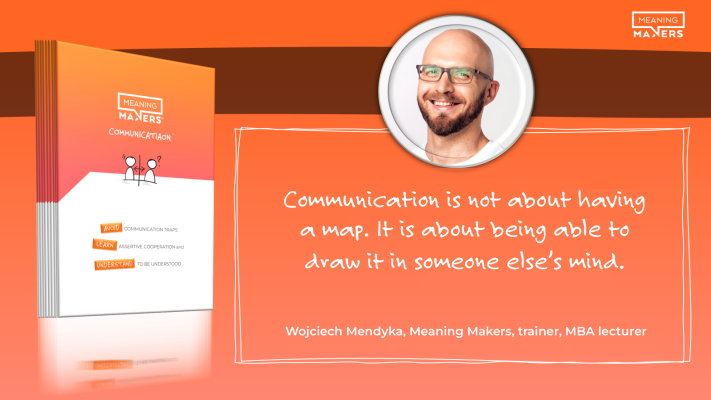
Communication isn’t about having the map. It’s about being able to draw it in the other person’s mind.
And you – when was the last time you spoke from the level of your own map, assuming that others already had it?