

What does a palindrome have in common with effective communication... and with dragons? More than you might think.
You might have paused at “palindrome”... So, what is it anyway?
It's a word, sentence, or sequence of characters that reads exactly the same forwards and backwards.
Examples? Madam. Level. Radar. Anna. Kayak... (see it?)
That’s their whole phenomenon. No matter which way you look at it, you see the exact same thing. There’s no room for interpretation. There are no different versions. Everyone sees an identical arrangement of letters. We might differ on what the word means to us, but the fact itself remains unchanged. We see the same thing.
Unfortunately, it doesn't work that way in communication...
Here, the situation is completely different. It's very rare for two people to look at the same situation and see the exact same thing. The same events lead to different conclusions. A boss in a bad mood might mean pressure from above to one person, a problem with their work to another, and organisational chaos to yet another. We look at the same moment, but we construct entirely different pictures of what happened.
If the starting point is the same, where do such different interpretations come from?
The answer lies in what happens a moment before. In the way our brain processes information and reaches conclusions.
In reality, we don't react to facts. We react to the conclusions we build based on them. And we do it in a flash, often without even noticing the moment that conclusion is formed.
We absolutely need this tool. Without it, we wouldn't be able to function. It allows us to make decisions quickly, simplify reality, and act without constantly analysing everything from scratch. From a survival point of view, this is a huge advantage.
The problem begins in everyday communication. At work, at home, in conversations that require understanding the other person. That's where this same mechanism starts to get in our way. It makes us quickly jump to our own conclusions and start treating them as facts, instead of discovering what is really happening.
From that moment on, most of the problems you call “communicational” begin. But in reality, it's the moment when you stop understanding and start assuming...
The problem starts before any words are spoken
In most companies, conversations about communication revolve around words. We talk about clarity, precision, structure. We look for better ways to formulate messages, as if they were the source of the problem.
Except the problem starts much earlier. Before you say anything, you already have a conclusion ready in your head. The conversation isn't about discovering meanings. It's an attempt to defend what you’ve already decided is true, right?
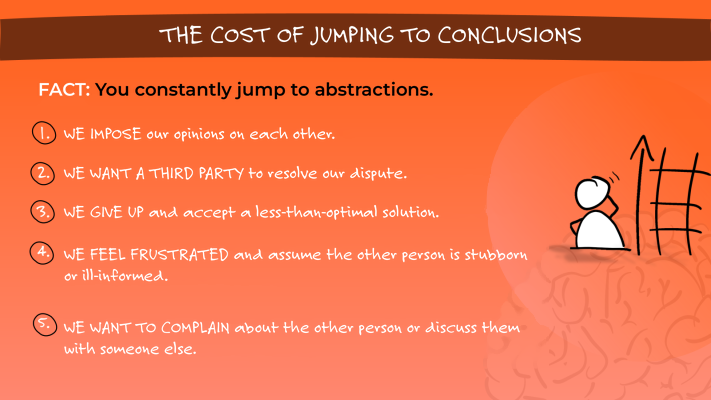
Where does this come from? From how the brain works. Its job isn't to patiently analyse reality. Its job is to quickly make sense of what it sees. It selects a piece of information, matches it to what it already knows, and closes the case. This allows you to act without constantly having to think about everything from scratch.
This works great, until you get into a conversation with another person.
Imagine a simple situation. You send someone a message. A few hours pass, and you don’t get a reply. A conclusion very quickly forms in your head. They're ignoring me. They’re not taking this seriously. Something’s wrong.
Except there is only one fact. “You haven't received a reply!” The rest is an interpretation your brain constructed to close the loop on the situation.
The consequences of this innocent operation? When that person finally replies, you no longer enter the conversation with curiosity. You enter with a ready-made story in your head.
The jump to a conclusion happens faster than we can notice it. We listen to the other person, but not to understand their way of thinking. We listen to confirm our own.
You know it's true.
The ladder we don't see
To grasp this, it's worth looking at a simple model described by Peter Senge in his book “The Fifth Discipline”. It's called the ladder of inference and it shows how, in a few seconds, you go from facts to a conclusion that you begin to treat as self-evident.
Let's look at it in a specific situation.
Imagine a team meeting. A sales report appears on the screen. A dozen or so people, lots of numbers, different results, comments, questions. The amount of data is enormous. At the same time, everyone is looking at something slightly different.
This is the first rung of the ladder. Facts. Raw data. Everything that is available in this situation. Except you can't process it all. That's why we often say today that “data is infinite”. So you move on to the next step, often unconsciously.
You select data. Out of the entire report, one thing catches your attention. One person's result has dropped by 11%. You no longer pay as much attention to the rest. You don't analyse other results. This one element begins to dominate your picture of the situation.
Then you assign meaning to it - you interpret. The drop is no longer just a number. It starts to mean something. Something is wrong. Tension appears.
And then you start adding to the story. Maybe this person has stopped caring. Maybe they've lost their motivation. Maybe they can't cope with the new demands. This story starts to come together very quickly and seems coherent.
Finally, a conclusion emerges: “She's not delivering.” Except it no longer sounds like a supposition. It sounds like a fact.
What might happen here? You start to act as if it were a fact. You look at this person differently. You listen to what she says differently. You talk to her differently. Maybe you ask more controlling questions. Maybe you have less patience.
Except if you stop, you might see something else... There was other data in the same report. This person might have had the most difficult clients that month. She might have been working on a project that isn't visible in the numbers. She might have had a temporary dip, which is natural.
Is your conclusion definitely wrong? No, but it's only one of the possible ones.
This is how the ladder of inference works. The conclusion itself and the process of drawing it is a natural sequence. Unfortunately, in all the “commotion”, you lose sight of something crucial - how you arrived at that conclusion (and which mental shortcuts you gave in to).
Why the brain rushes to conclusions
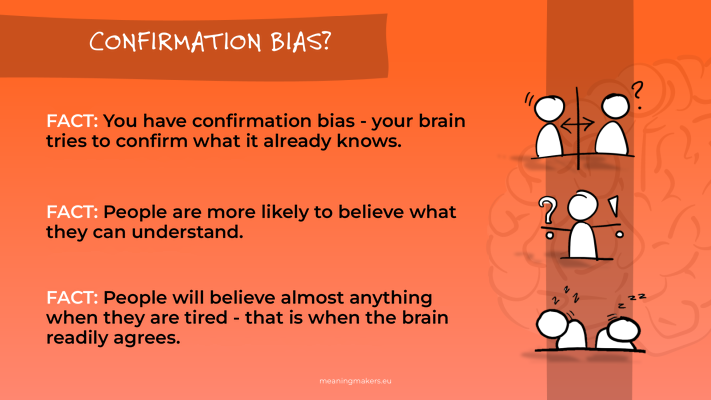
One of the key mechanisms here is what's known as confirmation bias. Once the first conclusion appears in your head, the brain starts treating it as a working version of reality. From that point on, it filters information to maintain that version.
From an evolutionary perspective, this makes sense. The brain wasn't created to analyse everything from scratch. It was created to make quick decisions with limited data. It was better to mistake something for a threat and be wrong than to analyse for a long time and react too late.
That's why, once you “know something”, the brain tries to confirm it and maintain consistency. It looks for signals that align with what it has already accepted as true and ignores those that introduce uncertainty.
The same mechanism that once helped us survive now affects the quality of our conversations and decisions. Instead of checking whether our conclusion makes sense, we very quickly start to reinforce it.
This is precisely why in our work at Meaning Makers we return to this topic so often. Today, the winner isn't the one who provides more information. The winner is the one who can direct attention to what really matters.
If you leave people alone with data, everyone will choose something different. Everyone will build their own story. Everyone will reach a different conclusion.
The role of a leader, presenter, or salesperson is therefore about something much more important than just delivering content. It's about helping the other person see what is worth looking at and what isn't. It's about focusing attention on a few key elements and only then building conclusions and meaning upon them.
A world that rewards quick conclusions
“I don't know, I need to think.”
Would you feel comfortable giving such an answer?
The longer I work with teams, leaders, and clients, the more I see one thing.
The scale of change in recent years has been enormous. The pace of work is increasing. The amount of information is increasing. The number of decisions that need to be made in a day is increasing. We are flooded with data, opinions, and ready-made interpretations. It only takes a few seconds for someone to give you a “conclusion” in a simplified form.
There's a sense that you should know everything. Have an opinion on every topic. React quickly. Be up-to-date. In many environments, the speed of reaction is starting to be confused with competence.
Meanwhile, when you think about people who truly have authority, the picture is different. These aren't people who answer everything straight away. These are people who weigh arguments, check assumptions, and are able to stop and say, “give me a moment, I want to think this through”.
Today, such a moment of pause is sometimes perceived as a weakness. As if the lack of an immediate answer signifies a lack of knowledge. That's why a quick conclusion often replaces thinking.
This context strongly reinforces the mechanisms we discussed earlier. The brain gets even more stimuli and even greater pressure to quickly close topics. Instead of checking if a conclusion makes sense, we start treating it as something we have to have.
The effect is simple. The faster we act, the more often we confuse interpretations with facts. The more often we do this, the more we entrench this way of thinking. Over time, it ceases to be a single mistake. It becomes the default mode of operation.
The blind spot in dialogue
In practice, this mechanism very quickly translates into what happens in a conversation. It stops being about understanding and starts being about defending one's own conclusion. Each side feels they see the situation clearly and tries to convince the other.
The effects are very repetitive. You can play bingo and wonder which of them you've recently experienced - in yourself or in others:
Imposing your own opinion because “it's obvious”. In your head, the conclusion is already sealed, so the conversation stops being a search and becomes about convincing. The other person has no space for their own interpretation because you treat them as someone who simply “hasn't understood” yet. Attributing intentions instead of checking facts. Instead of stopping at what happened, you start to fill in the blanks about why someone did it. Assumptions about the other person's motivations appear very quickly, which sound credible but are rarely verified. Growing frustration and tension in the conversation. Each subsequent statement from the other person that doesn't fit your conclusion starts to feel like resistance. Instead of curiosity, irritation appears, because the conversation isn't going in the direction that seems “logical” to you. Selective listening that only reinforces your own conclusion. You start to pick up mainly the fragments that fit your story. The rest of the information ceases to matter or is immediately dismissed as less important. Withdrawal or apparent agreement on solutions that are not well-thought-out. At some point, one side stops engaging in the conversation. Sometimes this means open withdrawal, and sometimes it's an agreement that looks good in the meeting but doesn't translate into action later.
- Imposing your own opinion because “it's obvious”. In your head, the conclusion is already sealed, so the conversation stops being a search and becomes about convincing. The other person has no space for their own interpretation because you treat them as someone who simply “hasn't understood” yet.
- Attributing intentions instead of checking facts. Instead of stopping at what happened, you start to fill in the blanks about why someone did it. Assumptions about the other person's motivations appear very quickly, which sound credible but are rarely verified.
- Growing frustration and tension in the conversation. Each subsequent statement from the other person that doesn't fit your conclusion starts to feel like resistance. Instead of curiosity, irritation appears, because the conversation isn't going in the direction that seems “logical” to you.
- Selective listening that only reinforces your own conclusion. You start to pick up mainly the fragments that fit your story. The rest of the information ceases to matter or is immediately dismissed as less important.
- Withdrawal or apparent agreement on solutions that are not well-thought-out. At some point, one side stops engaging in the conversation. Sometimes this means open withdrawal, and sometimes it's an agreement that looks good in the meeting but doesn't translate into action later.
Sound familiar?
At a certain point, the conversation stops being an exchange of thinking. It becomes an exchange of conclusions, and that's the moment when dialogue stops.
Because neither side is showing how they arrived at their conclusion.
Two swords to escape this trap
If you treat this situation like a story, at some point you encounter a dragon. That dragon is your own conviction that you already know what's going on. Your unreflective conclusion.
Good news. You have two very specific tools at your disposal to break through this. Let's stick with the story - these are your swords of effective dialogue (I know, a sword and dialogue, a bit counter-intuitive, but trust me).
The first sword is curiosity. This is the moment when, instead of defending your conclusion, you start to test it. Curiosity opens up a space that wasn't there before. It allows you to see that the other person might have access to different data or assign a different meaning to it. Instead of building more arguments, you start asking questions. Instead of speeding up the conversation, you slow it down for a moment to see more.
The second sword is more difficult because it is directed inward. It’s the conscious search for gaps in your own conclusion. The brain naturally wants to confirm what it has already accepted as true. Searching for gaps requires stopping and making an effort. It also requires accepting that you might be wrong or that your picture of the situation is incomplete. When you start asking yourself what you might not be seeing, what you’ve missed, and what other explanations are possible, a space suddenly appears that wasn't there before. It is in this space that better decisions and more productive dialogue begin.
You have the swords, so it's time to swing them a bit, but not blindly - preferably according to a specific technique...
Four ways to stop jumping to conclusions
Simply understanding the mechanism doesn't change much if you keep acting the same way. You have two swords now, so the point is to use them consciously, not to swing them around blindly.
This isn't a set of tricks to be used in a “difficult conversation”. Look at it more as a way of viewing your own conclusions before you start defending them.
1. See what you have selected from the whole of reality
It starts with a simple fact. You never work with all the data. You always select only a fraction of it.
This is the first moment where you can use the second sword, the one directed inward. You stop and check what you actually based your conclusion on.
What you see is not reality. It's a slice of it that caught your attention.
Imagine a meeting where one person interrupts you several times. You think about it after the conversation and say, “He doesn't respect me”. Except in that same meeting, that person might have also asked good questions, returned to your points, or tried to clarify something.
You chose one element and built an entire story around it.
The first step is to see that your “picture of the situation” is already a filter, not an objective record.
2. Check if someone else sees it differently
The second step is harder because it requires stepping outside your own perspective.
This is where the first sword comes in: curiosity. Instead of defending your conclusion, you start checking other possible versions of the same situation.
The same data can lead to different conclusions because everyone looks at it through their own experiences.
Returning to the same situation. You see a lack of respect. Someone else might see engagement and a need for clarification. Yet another person might just think the conversation was dynamic.
The problem isn't that one of these people is wrong, but that we often assume only one interpretation is possible.
Only when you see other viewpoints do you begin to understand how much your conclusion was just one of the options.
3. See what you might not know
The third step is where a real change in the quality of thinking begins.
Here, both swords work together. Curiosity directs you outward, while awareness of your own gaps forces you to pause.
What you know is rarely the full picture. There is always data you don't have.
Imagine a client who says the price is a problem for them. The natural reaction is to defend the value or try to lower the price. Except it might turn out that the problem isn't the price, but internal pressure, KPIs, or previous experiences with a similar project.
If you don't see what you don't know, your actions will be based on an incomplete picture.
This step is about accepting that your knowledge is only a fragment of the whole.
4. Separate interpretation from fact
Finally, you arrive at the most important place.
Most communication problems arise because we treat interpretations as facts.
“He's ignoring me”, “the client just wants a lower price”, “this project makes no sense”. It sounds like a description of reality. In practice, it's already a ready-made interpretation.
The fact is what happened. The rest is the meaning you gave it. When you start to separate these, the conversation changes instantly. Instead of defending a conclusion, you can show how you arrived at it. And the other person can do the same.
Only then does space for real dialogue emerge.
Palindromes and dragons
Palindromes work because, regardless of perspective, they remain the same. You read them from one end and the other, and you always see the same thing. Communication isn't like that and never will be, because each of us looks at situations from a different place, with different experiences and different data that we've selected along the way.
The problem begins the moment we treat our conclusions like palindromes – as something obvious and unambiguous. That's when the dragon enters the stage: the conviction that you already know. Instead of checking, you start defending. Instead of understanding, you start assuming. The swords that were meant to help end up hitting the wrong target.
Added to this is the context in which we operate today. The pace, pressure, and amount of information make a quick answer seem more important than a good answer. Stopping and saying “I need to think this through” rarely looks like strength, even though that's exactly what builds it.
That's why one of the most important skills in working with people remains curiosity. Not as something innate, but as a conscious decision. A decision not to close the story too quickly, to check your conclusion, and to see more than the first interpretation.
This is precisely why I often say in my training sessions that productive dialogue begins long before the words. It begins with how you think about what you see.
Now, you
When was the last time you were so sure you were right that it didn't even occur to you to check?