
If you spend your whole life avoiding tension, you're not learning assertiveness. You're learning to avoid tension.
I live by a forest, and every time the wind really howls, I catch myself thinking the same thing. I look out the window at the tall pines and wonder how on earth they are still standing.
Some are easily over 20 metres tall. In stronger gusts, their crowns sway by several metres, the trunks visibly bend, and from the perspective of someone standing below, the whole thing looks quite alarming. Especially when one of these trees is growing near your house. So, how is that possible?
Simple.
Thigmomorphogenesis.
To put it very simply, it’s about how plants adapt their growth to regular mechanical stress. Studies on fir and poplar trees, among others, show that wind and repetitive bending affect how the trunk grows, its thickness, and its mechanical properties. The root systems of trees have also been studied, showing they changed their architecture to help them resist the forces exerted by the wind.
So, what I had considered a problem for the tree its whole life is also one of the stimuli to which it adapts.
And can you guess what else in life is similar?
Of course, your assertiveness.

We do a lot to avoid things getting awkward
Think about a difficult conversation you've recently been putting off. Maybe you needed to say something to your manager, question a client's idea, say no to someone, or simply state in a meeting that you see the situation differently.
The problem usually isn't a lack of words. We more or less know in our heads what we’d like to say. The trouble starts a moment later, when we simulate the other person's reaction.
How will they take it? Will they get upset? Will I ruin the relationship? Will I come across as difficult? Maybe it's better to wait until tomorrow, next week, or until the issue magically resolves itself.
The brain really likes that last option.
Avoiding the conversation brings immediate relief. The tension drops, nothing needs to be explained, no one is offended. Except the issue usually remains. And now, instead of one difficult conversation, we have a difficult conversation plus several days of carrying it around in our heads.
In a Crucial Learning study of 1,100 people, 43% of respondents reported spending at least two weeks dwelling on an unresolved problem at work. One in three also estimated that a situation where they failed to speak up at a crucial moment cost their organisation a lot of money.
That's a bit more than just an “uncomfortable conversation”.
Assertiveness has terrible PR
Over the years, the word “assertiveness” itself hasn't built the best brand.
Some people hear it and picture someone very decisive who speaks their mind, sets boundaries, and generally doesn't let anyone walk all over them. A moment later, and we're bordering on the type of person who proudly says, “I just always tell the truth”, after which half the team avoids them in the kitchen.
For me, assertiveness is a much calmer competence.
It's the ability to clearly state your own position, need, or boundary while leaving space for the other person's reaction. Sometimes that reaction will be exactly what we expect. Sometimes it won't.
Naturally, it’s this second possibility that we have the biggest problem with.
You might ask for a pay rise and hear “no”. You might tell a client their idea carries a risk and see their dissatisfaction. Or you might disagree with your boss and for a moment sit in a very unromantic silence. Those who know me will know that this last example is almost the founding moment of Meaning Makers .
You see, assertiveness requires you to accept that you can control how you communicate, but you don't have full control over what the other person does with it.
That tension is an inherent part of the whole situation.
Why your brain prefers you to stay quiet
From the brain's point of view, the social reactions of other people are no small matter. For most of our species' history, our position in the group, acceptance, and relationships with others were directly linked to our safety.
Today, the consequences of telling your boss “I disagree” are obviously different from the consequences of being thrown out of the tribe several thousand years ago. However, the warning mechanism still reacts to the possibility of losing status, damaging a relationship, or conflict.
That's why we can spend weeks analysing a conversation that will objectively last three minutes.
It’s also why we so easily let our brain sabotage us. We weaken our own message at the exact moment we want to sound clear. We say: “I need this by Monday,” and a second later we start adding that we understand the situation, of course, that Tuesday might also be possible, and actually, if someone has a lot on their plate, we'll manage somehow.
After a minute, the other person no longer has any idea whether Monday was a deadline, a suggestion, or a vague dream.
The tension has dropped. And a large part of the message has disappeared along with it.
The best information might be lurking beneath the surface
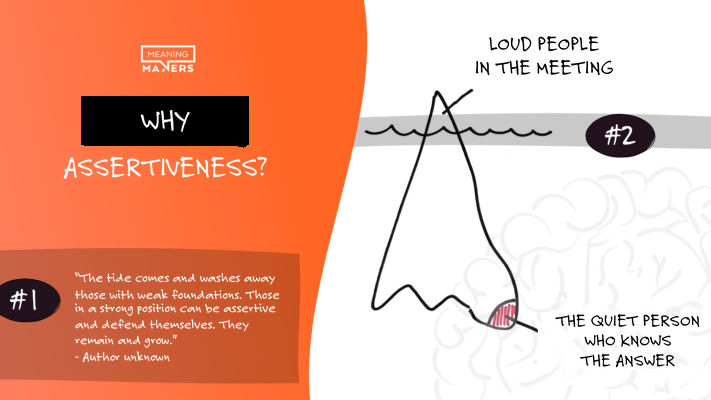
In one of my workshops, I use a simple drawing of an iceberg.
Above the water are the people who are easy to notice in a meeting. They speak up, make comments, react quickly to ideas, and have a relatively low threshold for entering a discussion.
Beneath the surface sits someone who says much less. The problem is that sometimes this is the person who knows the answer.
I've seen this in different companies and at various levels of the organisation. A discussion goes on for ten or fifteen minutes, two or three people gradually set its direction, and someone sitting slightly to the side has information that could change the entire decision. They don't speak up because the conversation has already picked up pace, someone more senior is speaking, or past experiences have taught them that questioning ideas doesn't always end well.
After the meeting, the information often comes out over a coffee.
That's when my favourite question comes up: why didn't you say that fifteen minutes ago?
The answer usually isn't about knowledge. It's about relationships, hierarchy, self-confidence, or fear of the reaction.
James Detert and Ethan Burris have spent years researching the phenomenon of employee voice. In Harvard Business Review , they pointed out that even managers who are convinced of their own openness may not realise how much valuable information their employees keep to themselves.
This has an interesting consequence for the whole discussion about diversity.
An organisation can gather people with different experiences, knowledge, cultures, and perspectives around a table. Still, not much comes of it if some of those perspectives remain solely in their heads.
Diversity only starts to create value when it appears in the conversation.
The loudest person doesn't always know the most
Early in your career, it's easy to assume that the people who talk a lot in meetings simply know more or are more sure of their opinions.
After a good few years of working with groups, I see it a bit differently.
Of course, there are people who speak up because they have vast knowledge. There are also those who simply find it easier to tolerate the social tension that comes with joining a conversation. They are quicker to interrupt, challenge ideas more easily, and aren't as concerned that someone might disagree.
That's enough for their point of view to start having a greater influence on the group's decision.
That's why assertiveness is more than just “the skill of having difficult conversations”. In practice, it affects whether your knowledge even gets a chance to be put to work.
If I had to say one thing to the younger people who sometimes read my articles or attend my workshops, it would be this: don't wait to practise this competence until the stakes get really high.
A big conversation is rarely a good place for your first training session.
It's better to say in a meeting that you don't understand something. Question one element of an idea. Ask for something directly instead of hoping someone will guess. Say no to a small thing when you really don't want to do it.
These are small situations, but over time, they change how you react to bigger ones.
When I look at my own career, I see plenty of moments like these
I have no problem admitting that my assertiveness has sometimes turned into plain stubbornness. It probably still happens. You grow as a person, but miracles don't happen.
At the same time, many decisions that later proved important for me required saying something it would have been easier not to say.
This applied to conversations with superiors, career choices, terms of collaboration, and moments when someone suggested a direction that seemed reasonable from their perspective but didn't fit with what I wanted to do.
I also see this very clearly today in my work with clients.
When you're young, it's easy to believe that a good supplier should, above all, please the client. The customer is always right, isn't that so?
Years later, you start to notice that some clients hire you precisely so that you will occasionally tell them something uncomfortable.
If I see a risk in a client's idea and yet I nod along because I'm afraid of spoiling the atmosphere, it's hard to call that a partnership. It's pleasant, but the client hasn't received the expertise they probably paid for.
Of course, the other extreme also exists. Nobody needs a consultant who comes into a company and spends two days proving to everyone that they know best.
The whole art lies in being able to say the difficult thing in a way that helps the conversation move forward.
Four things worth practising
I don't have a single magic formula for assertiveness. Besides, I'm suspicious of any formulas that are supposed to work regardless of the person, relationship, or situation. However, there are four elements I regularly focus on when working with people. They work best together, because the recipient isn't just listening to the words. They're assessing the entire message.
1. Words - say what you really want
An assertive sentence should give the other person a chance to understand your position. It sounds trivial until you notice how often we communicate an expectation in such a way that, if a problem arises, we can pretend it wasn't an expectation at all.
“It would be great if maybe we could have this sooner” doesn't mean the same thing as “I need this by Monday”.
Here, it's enough to limit the guesswork, without resorting to brutal directness. If the other person still doesn't know what you wanted from them after the conversation, it's hard to be resentful later that they didn't do it.
2. Tone - calm can still mean firm
Sometimes people try to “sound assertive” and unconsciously raise their voice, pace, or tension. The effect can be the opposite, as the other person starts reacting to the threat signal instead of the content itself.
The most persuasive people I know often say difficult things very calmly. They don't need extra energy to show they take their own position seriously.
This is especially important in a situation where the other person is already upset. If we add our own tension to that, the conversation quickly becomes about the tone instead of the problem.
3. Body - don't send a second message
You can say a very clear sentence while nervously smiling, avoiding eye contact, and physically withdrawing from the conversation.
People are excellent at picking up on such inconsistencies. They don't even have to consciously know what feels off. They just sense that the message isn't entirely confident.
This isn't about training a dominant posture straight out of a TED Talk. It's enough to pay attention to whether the way you sit, look, and speak is sabotaging the very message you're trying to convey.
4. Silence - don't negotiate with yourself
This is probably the most difficult element.
You've said what you want. The other person is silent. A second passes, maybe two, but in your head, half an hour has just gone by.
The brain will gladly use this moment to “help” you. It will offer an additional explanation, a softening of your position, a small discount, or several reasons why the other party doesn't really have to take your request so seriously.
Sometimes the best thing you can do then is nothing.
Finish your sentence and give someone the space to respond.
Silence doesn't mean conflict just yet. It often just means the other person is thinking.
Tension doesn't have to mean something went wrong
This is probably one of the things that took me the longest to learn myself.
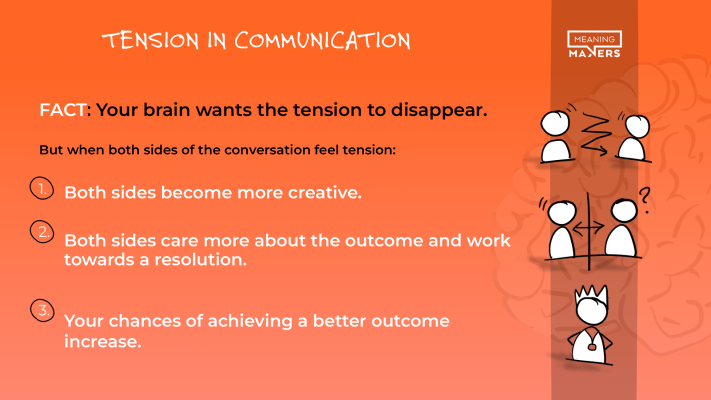
If you care about a relationship, you naturally want the conversation to go well. The problem arises when “well” starts to mean “without any discomfort”.
Good teams have strong differences of opinion, business partners can question each other's ideas, and a client can be momentarily dissatisfied with an answer and still feel it was necessary.
This is also an important distinction in conversations about psychological safety. It is sometimes mistakenly reduced to an environment where people feel comfortable.
Comfort is pleasant, but it's not always necessary.
Safety is having the opportunity to say something that might temporarily disrupt comfort, without fear that you will be socially punished for simply speaking up.
It is in such an environment that assertiveness has room to grow. Like those trees.
Roots grow before the storm
Remember the trees from the beginning of this text?
They don't start adapting to the wind on the day the biggest gale arrives. The changes happen earlier, during thousands of much smaller stresses. Each one is information for the plant about the environment in which it will have to function.
In humans, of course, it doesn't work in the same biological way. The metaphor has its limits.
But as a way of thinking about assertiveness, it fits me very well.
If you spend years avoiding every situation where someone might disagree with you, it's hard to expect to feel completely calm during the most important conversation of your career.
But you can start earlier. With small conversations, small refusals, minor differences of opinion, and moments when, instead of leaving an important thought in your head, you let it enter the conversation.
It will probably get a bit windy sometimes...
But don't worry - you'll survive. Trees do it their whole lives.
And that's why they can stand for so long.