
Order changes everything
With some things, the order decides the result. Cooking? You can have perfect ingredients, but throw them in the wrong order and the result will be underwhelming (so I've heard). Same with coding. Call one function at the wrong moment and the whole system comes unstuck.
Communication works exactly the same way. The very same content can either move people or switch them off. The key? You guessed it. Order. Most of the time it isn't about the content. It's about where you start when you present it.
Most people start at the wrong end. They walk in, put up a slide and say: “Today we're going to talk about…” Up goes the agenda. Straight away. No sense of why it matters. No attention earned. And that's the moment the audience mentally unplugs. You haven't said a thing yet, and they're already back in their inbox, back to work, glancing at their second, third or fourth screen (sign of the times).
In practice, you lose people before you've managed to say a single sentence worth hearing.
So why do we start badly in the first place?
Because that's how we were taught.
At school, at university, in our first meetings at work - we heard the same routine everywhere: “Agenda first. Introduce yourself first. Housekeeping first.” Logically, it sounds sensible. The trouble is that deciding whether to engage isn't logical. It's emotional, instinctive and based on a quick scan: “Is this for me? Is it worth getting into?”
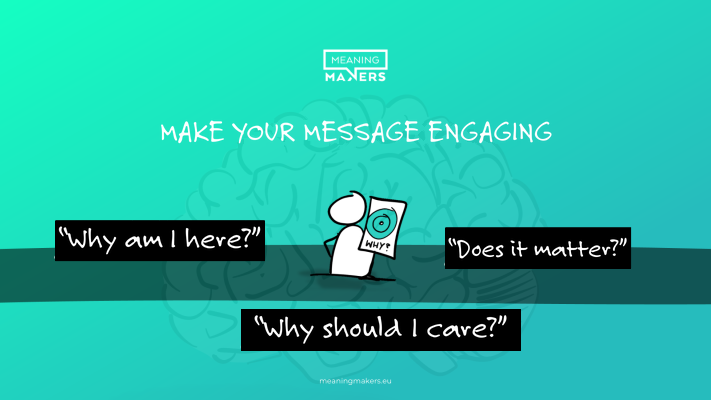
That's why most meetings you sit through make you want to... crawl into your shell. Quite simply, your brain isn't getting what it needs. No meaning. No reason. No “Why”.
It wants one thing before it will even start listening: “Tell me why this matters - before you tell me what you've got on your slides.”
Why we start in the wrong place
Starting with “Here's what we've got for you” comes naturally. It's quick, concrete, clean. The brain loves shortcuts like that. This style works brilliantly for day-to-day stuff - tasks, lists, checkboxes. For operational work it's practically perfect.
But when your job is to move people, change how they think, take them into a new topic or win them over to a change, “What” falls completely flat - at least as an opening.
We live in a world drowning in content. Each of us sees hundreds of messages a day. One more dose of “What” just adds to the information spam. The brain asks: “Is this worth my energy?” And if it can't see the point, it doesn't invest. It saves energy, because it has to. It's like a Tesla on 6% battery: it only does what's absolutely necessary.
The brain is built to save energy, not to be inspired
Starting with “What” isn't a sign of poor communication. It's a biological shortcut. “What” lets you wrap a topic up quickly and get on with the next task.
The problem is that communication that gets tasks done and communication that inspires run on different frequencies. To move an audience, you have to flip that natural order. Meaning first. The reason first. “Why” first. Only then “How” and “What”.
The Golden Circle - where meaning starts
In 2009 Simon Sinek showed the world the Golden Circle. A simple drawing: Why - How - What. One idea that changed the way people think about communication. Why? Because it's not a metaphor - it's biology:
- What / How → neocortex (logic, data, analysis).
- Why → limbic system (emotions, trust, decisions).
Your audience can understand your “What”, but they only engage when they feel your “Why”. And in a world overloaded with information bombarding the neocortex, meaning is the scarcest resource there is.
Every Meaning Makers workshop starts with exactly that: getting the meaning right. Because only then do the techniques, models and tools really start to work.
Dirk and my “first book”
For years I didn't read books. Not because I couldn't. I just… didn't have a “Why”. School did a great job of telling me “What” to read and “How” to analyse it. But it never explained what it was all for. The result? I read bits and pieces, but the odds of catching me with a book… slim.
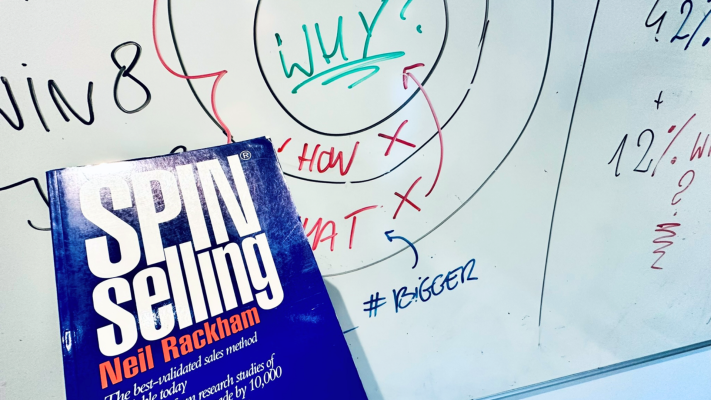
It all changed thanks to a certain Dirk (hi, Dirk). My manager, circa 2010. He had the knowledge, the calm, the style and an approach that genuinely inspired me. And one thing clicked: if I ever wanted to be someone like that, I had to start reading. That was my real “Why”.
Crafty Dirk gave me a book. And there was something in that gesture that stays with you for years - someone seeing more in you than you can see in yourself at the time.
I read it straight away. Not because it was gripping, but because I'd found a meaning bigger than the effort. Like Rocky training at 5 a.m., I was getting up… half an hour earlier to read another ten pages.
Why “Why” grabs attention
“Why” lands where decisions get made. Emotions steer attention, and attention is the gateway to engagement.
That's why an agenda at the start of a presentation is one of the worst ways to sabotage your own presentation. The agenda lives at the “What” level. And “What” only works once the audience knows “Why” they should listen to you at all.
It's exactly the same logic as the gym in January (you know how that goes). Everyone knows “What” to do - train, eat less, stay disciplined. But without a real “Why”, without a reason bigger than being tired, people last a week, two at most. Because “What” won't carry you once the first rush of enthusiasm wears off.
That's exactly why I always start my workshops with “Why”. It's the first thing we set up, before we move on to any techniques at all.
When a brand loses its meaning, everything falls apart
What do MTV, Windows 8 and Jaguar have in common? A failed attempt to change their original “why”.
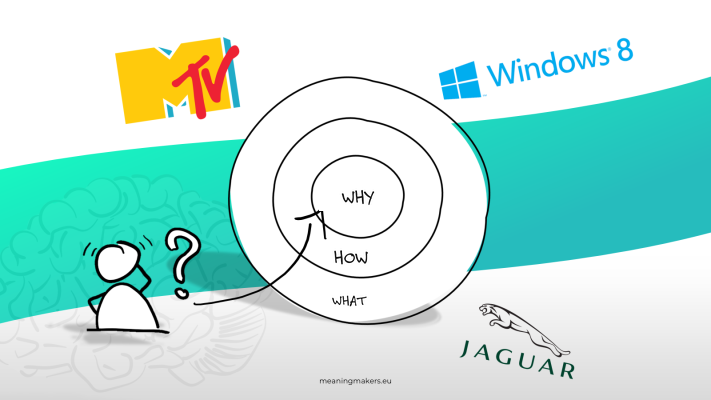
MTV started out as a music revolution. It had a clear “Why”: to show young people the music and culture that defined them. It was fresh, bold, authentic. Today? There's hardly any music left. The shows are random, the topics all over the place, and the brand has no consistent direction. People don't know what it's there for.
Windows 8 was a brilliant project technologically. The tiles it introduced were ahead of the market at the time. The problem? Nobody asked: “What's the point of this change for the user?” Microsoft didn't answer “Why should I use this?”. Users didn't buy the meaning - because they were never given one.
For decades Jaguar was a symbol of classic elegance. The new styling direction in 2025 was more about fashion than authenticity. The market reacted in a flash - huge drops in sales. People didn't buy the “Why”, because it no longer fitted what the brand had been. Did it still matter that the car might be great? Sadly, not any more.
Each of these stories shows the same thing: a Why that's vague, inauthentic or out of place doesn't work. You can have it written down in a PDF. But if your audience doesn't feel it, it might as well not be there.
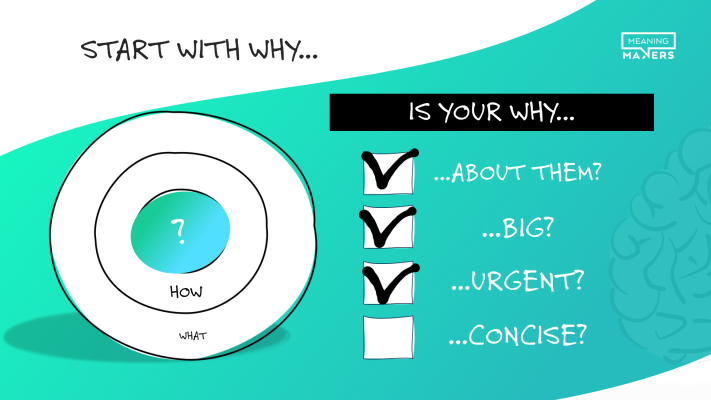
Four qualities of a good “Why”
Over years of working with leaders, experts and salespeople, I've worked out a simple test that never lets me down. If your “Why” passes these four checks, you've got a meaning that will really move your audience.
1. A good “Why” is about the audience
It's never about you, your company or your product. It's about their world, their problems, their ambitions and their risks.
Bad: “We have a new system.” The hero is the system. Better, but still weak: “Thanks to this system you'll get back 6 hours a week” - because it's still about the system.
Good: “You'll be able to decide your own priorities and finally take back control of your week.” Here the hero is the audience, not the technology.
Everyone likes hearing about themselves, because the brain treats “me” as an energy priority. That's why a message “about them” engages twice as strongly (Cialdini).
2. A good “Why” is big
Big themes move people because they're about things that really matter: the future, security, threats, ambitions, change. If your “Why” sounds like a feature list, you don't have a “Why”.
Example. Bad: “This process will speed up reporting.” A minor detail. Zero emotion.
Good: “Right now we make decisions a week too late. If we don't change that, the competition will be taking market share faster than we can analyse it.”
Now that's big. It sets the stakes. Nancy Duarte calls this the Big Idea - something that concerns the audience's whole world, not one little tile in their week.
3. A good “Why” is urgent
Urgency doesn't mean panic. Urgency means being aware of the consequences. Your audience has to feel: “If we don't do anything about this, we'll pay for it.”
Daniel Kahneman showed that the brain reacts more strongly to avoiding a loss than to a potential gain. That's why urgency gets things moving.
Example. Bad: “We should modernise this process.” That's a request.
Good: “Every month of delay costs us an average of 40 working hours and pushes errors up by 18%.” Now there's time pressure - a reason to act now.
4. A good “Why” is concise
If you need 10 slides to explain your “Why”, you haven't got one. A good “Why” fits into one sentence. It's like a key that opens the door in a second.
Example. Bad: “This solution will allow us to streamline processes, reduce working time and increase operational efficiency…” Nobody will remember that.
Good: “The point is for people to stop wasting time on things that make no sense.”
This is where the 5 Whys method (Toyota) helps - it gets you to the heart of the matter. When you get to that one sentence, you can physically feel it: “OK. That's it.”
How to use it in practice
Whether you sell, lead people or explain complex topics, the rule is the same - always start with a meaning that's about your audience, and only then move on to the details.
Are you in sales?
Don't start with the product. Don't start with the offer. Don't start with the features. Start with a market problem, a risk, a change the client will have to deal with anyway.
Example: instead of “we have a new service”, say: “Over the last three quarters, the time it takes to win a client has gone up by 27%. Companies that don't tackle this will see their pipeline shrink.”
Are you a leader?
Don't start with a list of tasks. Start with a challenge that genuinely affects the team.
Example: instead of “we're rolling out a new reporting system”, say: “Our decisions are running weeks behind, so projects start too late. If we don't stop this, the competition will overtake us.”
Are you an expert?
Don't start with how your solution works. Start with why it matters.
Example: instead of “we have a new predictive model”, say: “Right now, as many as 40% of our decisions are based on historical data that doesn't predict market changes.”
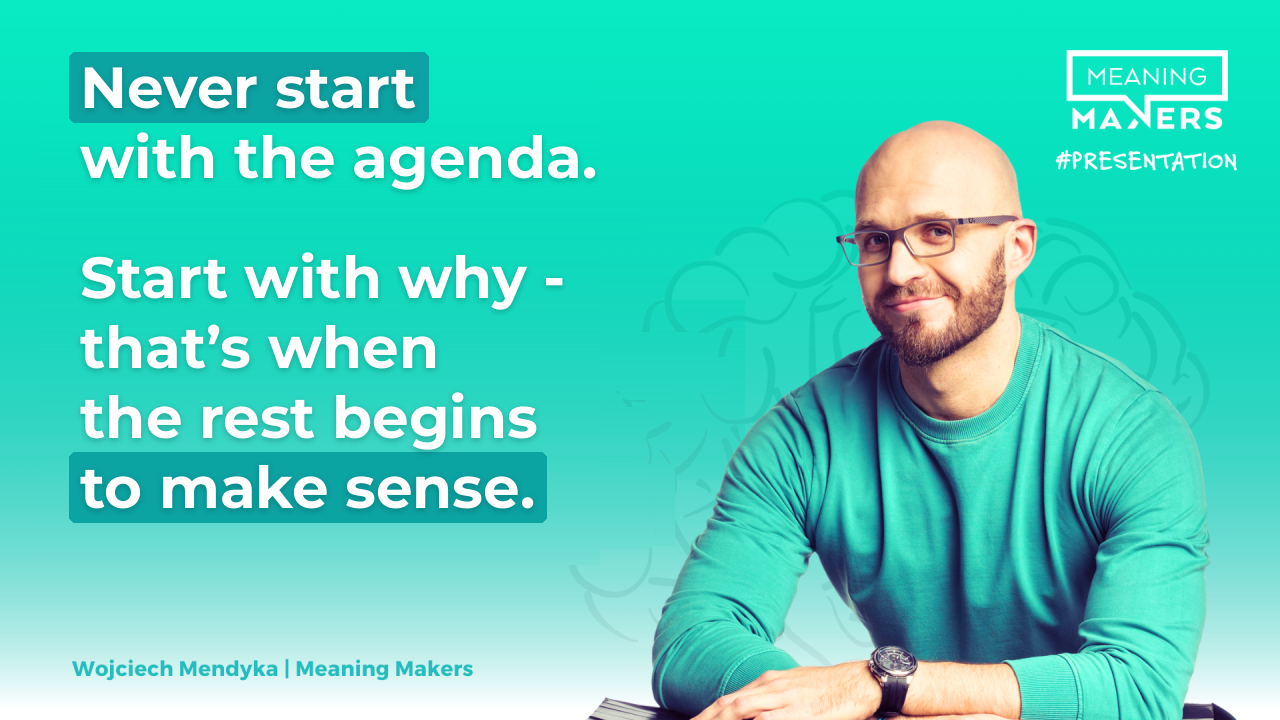
And one of the most important sentences in this article: Never start with the agenda. The agenda sits at the “What” level. People only hear the “What” once they know the “Why”.
I see the same thing in every workshop group - as soon as participants flip the order and start with meaning, their presentations instantly become clearer.
Finally - it all comes back to the start
Order matters. In cooking. In coding. In training. But in communication it matters most. You can have great slides, data and examples. Start with “What” and nothing happens. Start with “Why” and suddenly everything else starts working.
That “Why” sets up everything that comes after it. It gives the “How” its meaning, sharpens the “What” and lets your audience see a direction - not just information. Without the “Why”, everything else is just a list of boxes to tick.
That's why “Why” always has to come first.