
Every now and then, I see posts like: “PowerPoint is dead. Now AI will make your slides for you.”
I always smile to myself. Most people, after four decades of using PowerPoint, still don't understand what it's all about.
Interestingly, these posts always follow a similar pattern. High reach, lots of likes, and comments full of conviction that technology has finally solved the presentation problem.
You know what I think? It's not proof that communication has just jumped to a new level. It's proof of how easily we focus on what's visible, instead of what works.
You see, if you look at a presentation through the lens of slides, you'll naturally assume that better slides will solve the problem. If something looks cleaner, is created faster, and seems more organised, it’s easy to believe the message will be better too.
It won’t be. Today, it’s not about whether you have slides, and it’s not about whether AI makes them. It's also not about how they’re designed or how “polished” they are. The crux of it is whether you have one single idea that you can present in a way someone will truly understand—and remember.
You can have a perfect deck and leave nothing behind. You can have no slides at all and make someone change their way of thinking. The difference doesn't come from the tool or the level of visual polish, but from whether what you say and show takes into account how people make decisions. Today, the winner isn’t the one who shows more. The winner is the one who can point out what matters.
In a world where slides are overloaded with information, the expert isn't the one who knows more. The expert is the one who can direct another person's attention.
Decisions aren't made where there's the most content—they're made where someone finally sees the point.
Most people start with the slides. They open PowerPoint, choose a template, and arrange bullet points. They fill a space that was prepared by someone else. Step by step, something that looks like a presentation emerges. But it very rarely starts with the question of what should actually stick in the audience's mind.
The effect is predictable. The content grows, the number of slides increases, and everything starts to look more and more professional. At the same time, it becomes harder and harder to say in one sentence what it's all about.
...And then there’s our instinctive, defensive need to “hide” from the audience.
It's no wonder we're dealing with an out-of-control slide obsession today.
Are you suffering from it too?
Where the slide obsession came from
The main creator of PowerPoint was Robert Gaskins, who worked at a company called Forethought in the late 1980s. Dennis Austin, the lead developer, also played a key role alongside him. Yes, I know, 20 years with PowerPoint, but just like you, I only learned this a moment ago.
The first version of PowerPoint was created in 1987—initially only for Macintosh computers. Interestingly, it wasn't called PowerPoint back then, but “Presenter”. A short while later, Microsoft bought Forethought, and so began the story of the tool we know today.
But what's most important is the original intention. Gaskins didn't create a tool for reading slides. PowerPoint was made to help show something and organise thoughts in a visual form. It was meant to support the message, highlight the most important points, and help the audience see the structure instead of just the content.
Over time, its role began to shift. Slides became documents, reports, and knowledge archives. In most organisations, the deck now functions as a product that has to be prepared and passed on, often independently of the meeting itself.
If you work in a corporation, you probably see this every day.
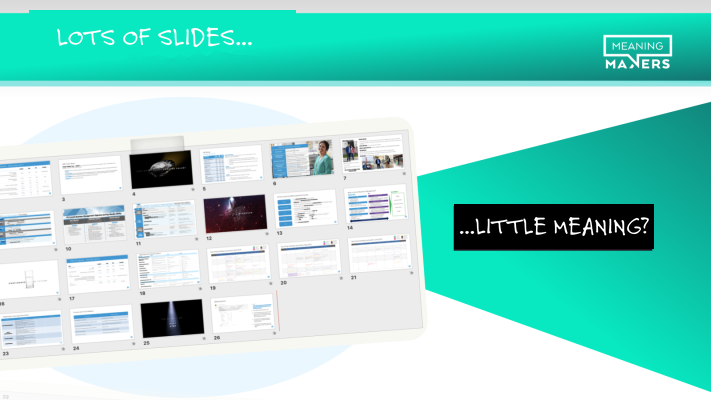
As a result, slides started to take over the function of conversation. Instead of supporting thinking, they began to gather all the information in one place. Everything we consider important ends up on the screen, without a clear distinction between what's crucial and what's supplementary. With this amount of content, the clear signal of what to focus on disappears. Every element starts to look similar, making it hard to distinguish what's truly important. What was meant to attract attention slowly becomes the background.
The value doesn't disappear because the content is weak, but because it ceases to be visible. Without selection and hierarchy, everything ends up on the same level of importance, and the audience is left alone with it.
You walk into a meeting and see dozens of slides, each full of content and each marked as important. In such a situation, the audience's brain has to decide for itself what matters. It usually simplifies the situation and ignores a large part of the information because that's the only way to cope with the amount of stimuli.
The end result is simple. The more you try to show, the less remains.
Why we hide behind them so easily
Every time I walk into a university—and I work with many—I have the same moment.
I look around the room and can see exactly what was happening there earlier. I don't even mean the layout of the room—the tables, the chairs, where the projector is. I mean the lecturer, or more precisely, the desk they were sitting at. There’s one particular room I walk into and I know immediately that someone sat at the desk, slightly to the side, hidden by a monitor, and clicked through slides for two hours. Everything about the setup gives it away. The position of the chair, the placement of the computer, the direction of the screen.
To be honest, it doesn't surprise me at all... If you look at it from the brain's perspective, the situation that someone was clearly avoiding here is completely unnatural.
You're standing in the middle of a room, and a dozen, sometimes several dozen, people are looking at you. All the attention is focused on you. Every movement, every word, every pause is visible. For our nervous system, this is a high-risk situation. In a biological sense.
For most of human history, being the centre of a group's attention meant judgment, threat, and sometimes exclusion. The brain doesn't fully distinguish a presentation from a social situation where you are being observed and evaluated. That's why the first reaction isn't “how do I deliver value?”. The first reaction is “how do I lower the tension?”.
The solution? Slides fell from the heavens! They offer something very simple. Shelter.
You have a screen to which you can shift the attention. You have a structure you can stick to. Most importantly, you have something that lets you step back from the front line. Instead of being the centre of attention, you become someone who is “presenting the material”. It's a subtle change, but for the brain, it's huge.
Additionally, you have a plan, you have a sequence, you have something that reduces uncertainty. This gives you a sense of control. From this perspective, slides aren't the problem. They are the solution. Of course, the problem appears a moment later. Because what works for you starts to work against your audience.
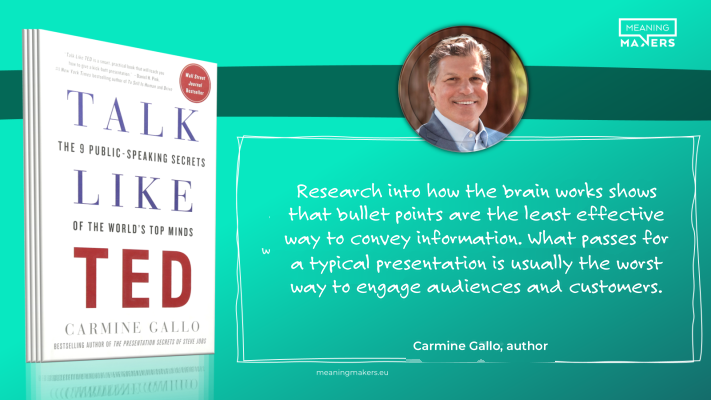
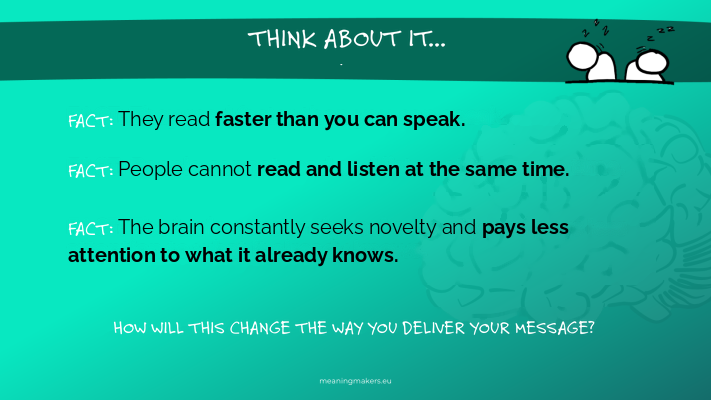
Attention shifts to the screen, and people start reading. And when someone is reading, they stop listening. When they stop listening, they stop building meaning. All that's left is text processing, often without deeper understanding.
And there's one more element. The brain operates economically. If it doesn't see a clear reason to engage, it limits its effort. Slides very often amplify this effect. They give the feeling that everything is already “served up”, so you don’t need to try too hard.
On a formal level, it looks good. On the level of attention and engagement, it starts to fall apart. That's why it's so easy to fall into this trap.
Let's be blunt: slides solve your problem. But as is often the case, they simultaneously create a problem on the other side. The side that you should probably care about—your audience's side.
“PowerPoint is dead. AI will make your slides for you”
Let's go back for a moment to those posts about the death of PowerPoint.
They aren't entirely wrong. AI really does speed up the work—it can generate a sensible structure or improve the aesthetics.
The problem, however, is that it directs attention to the wrong place. It directs it to the form, not to what needs to be understood.
You can have a perfect deck and still no one will know what you're talking about. This isn't an extreme case. It's a daily reality in many organisations—and you know exactly what I mean. How many slides have you seen today?
Most people can't clearly articulate one main idea. Slides mask this. AI, of course, does it even more effectively because it creates something that looks professional. It has structure, language, style—it just doesn't always make sense.
As a mental challenge, I can promise you (and I'd bet a lot on it) that I can hold a group's attention with a flip chart and two markers in my hand better than someone with a perfect deck generated by AI.
Where does this confidence come from? How do I know this? It's not because a flip chart is better—again, this isn't about the form. It's because you can't hide a lack of thought there. Attention doesn't follow aesthetics. It follows meaning and sense.
When everyone has access to the same quality of tools, it no longer matters who made the prettier slides. The differences start to show elsewhere. In who can simplify something, give it direction, and present it in a way that sticks in the mind.
Do you have something to say, or do you just have something to show? Because anyone can show something these days. To understand and guide another person's thinking is a whole different league.
You can't do that sitting hidden behind a monitor at a desk, clicking through slide after slide.
Four things you lose by having too many slides
We know from research on human behaviour that we react more strongly to loss than to gain (Daniel Kahneman, Prospect Theory). It's easier to notice what you're losing than what you might gain.
That's why instead of talking about what good slides give you, I'll show you here what you're really giving up when you have too many of them. Additionally, a powerful question forces the brain to identify with a problem much better than a statement does.
(yes, you can use both techniques in your presentations—they'll work better than the prettiest slide)
1. Are you really needed if everything is on the slide?
Imagine a presentation where every point is described in detail. Full sentences, definitions, conclusions. At some point, someone stops looking at you and starts reading. You're speaking, while they are scanning the text faster than you can say it.
In that moment, your role changes. You stop being the expert who gives meaning. You become a narrator for your own slides. Expert status doesn't come from the amount of information, but from helping others understand it.
What to do instead? Leave the bare minimum on the slide. A keyword, a number, a simple diagram. Add the rest verbally. Add an example, context, an interpretation. Show how you understand it. A slide is meant to open a topic, not close it.
2. When was the last time someone was genuinely surprised during your presentation?
You have a slide with eight bullet points. Before you even get to the second one, some people are already reading the eighth. Before you've built the context, they already know the ending. There's no moment of discovery, no suspense, none of that short “aha” that sticks in the mind.
An example? Show the result on a slide first, and then try to “narrate” it. It doesn't work. The surprise vanishes because the audience has already been there. Without that element, the presentation becomes predictable, and predictability is rarely memorable.
What to do instead? Build a sequence. First the question, then the context, and finally the conclusion. Reveal the slide at the moment you want something to “click”. Leave room for suspense. Let people reach the conclusion with you.
3. Who is leading your presentation—you or the room's reading speed?
Several paragraphs on one slide. Some people finish reading after a few seconds and start to drift off. Others are halfway through when you're already moving on. Everyone is in a different place, and you lose the shared rhythm.
Try asking a question during a slide like that sometime. Some people won't even hear it because they're focused on the text. Control in a presentation isn't a matter of voice or self-confidence. It's the ability to keep everyone in the same moment of thought.
What to do instead? One idea per slide. One decision you want to trigger. Lead at the pace of a conversation, not the pace of reading. Pause, ask a question, check for understanding. Keep everyone in the same place.
4. What do you do when the conversation goes in a different direction to your slides?
You have a prepared deck, a sequence, transitions. Someone asks a question that changes the direction. And suddenly, there's a problem. You go back to the slides, you skip ahead, you make excuses that “we'll get to that later”. Instead of seizing the moment, you go back to the plan.
The slides start to lead you. And flexibility is precisely the ability to follow what's happening in the room. A good message isn't a presentation from point A to point B. It's a conversation that responds to people.
What to do instead? Treat your slides as support, not a script. Have the main idea in your head and a few points you can return to. If an important question comes up, follow it. Draw something, explain it differently, change the order. You are leading the conversation, not the slides.
You naturally want to show everything. To cover the topic completely, include every point, use the template to its fullest. But in the process, you lose what really determines the outcome: attention, interest, engagement, and the ability to remember what's most important. By trying to give everything, you give up everything that matters.
Slides are a tool, not the message
Slides are fine. I love them. Anyone who has been to a Meaning Makers workshop knows—and I write this with full conviction—that nobody has slides like ours.
But they are not the centre of the message. The problem starts when they try to replace thinking instead of supporting it. When you stop treating them as a “place for everything” and start treating them as a way to show one thing, their role returns to its proper place.
This is exactly what they were created for. Not to store content, but to make it easier to show meaning.
In practice, this means one change. Instead of building your presentation around slides, you start building it around one idea. The slides come later. Not as the result and not as the starting point. Then everything starts to work.
Then slides help people see connections. They simplify something that was previously complex. They highlight the moment that needs to be remembered, and they support you instead of replacing you.
In this setup, you regain the things you were losing. Attention returns, because people are looking where you want them to. There's a pace again, because you are the one leading it. You create moments of surprise, because you can build a sequence. Control returns, because you're not tied to screen after screen. And the most important effect of all these “returns”—your influence returns.
It doesn't come from how much you show. It comes from what sticks in your audience's mind.
Questions that will change your presentation
Before you prepare your next presentation, stop for a moment. Don't start with the slides. Start with a few questions that will set up everything that follows.
Do you have one idea that you want to leave in your audience’s mind? Not five, not ten. One, that someone will be able to repeat in their own words after the meeting. Does what you’re showing help them see it, or does it just describe it? That’s a very big difference. A description requires effort. An image shortens the path to understanding. Do your slides guide thinking, or do they distract from it? Every element on the screen does something with attention. The question is whether it does so consciously.
- Do you have one idea that you want to leave in your audience’s mind? Not five, not ten. One, that someone will be able to repeat in their own words after the meeting.
- Does what you’re showing help them see it, or does it just describe it? That’s a very big difference. A description requires effort. An image shortens the path to understanding.
- Do your slides guide thinking, or do they distract from it? Every element on the screen does something with attention. The question is whether it does so consciously.
And finally, the most important question. Would you be able to have the same conversation without the slides? It's not about throwing them away. It's about checking whether you have a message that is independent of its form.
If the answer to that question isn't obvious, that's where the real work begins.
If you've been reading carefully, you already know that this won't be work on your slides.
It will be work on how you think about your message.
Now, over to you
In your last presentation, what really changed your audience's way of thinking—and what was just shown for the sake of “being there”?