
Why is it that in so many presentations, only one person is working, while the rest are just passengers?
In his book Outliers, Malcolm Gladwell describes a series of air disasters where the problem was neither a lack of competence nor technology. While analysing crashes involving Korean Air planes, among others, researchers began to listen to cockpit recordings. And they noticed something very distinctive. In many cases, the junior pilot saw that the situation was becoming dangerous, but didn’t say so directly. Instead of a clear warning, there were subtle suggestions or questions. The hierarchy in the cockpit was so strong that it was difficult to openly question the captain’s decision. The senior pilot was flying the plane. No one intervened. The plane crashed.
It was these stories that later led to the introduction of the Crew Resource Management system in aviation. This didn't just involve training pilots in flying techniques. The way the crew operated in the cockpit was changed. The junior pilot wasn't just allowed to speak up. He had an obligation to speak up when he saw a risk. And the captain had an obligation to take that information seriously. In practice, the design of shared responsibility in the cockpit was changed, not just the individual skills of the pilots.
Every time I come back to this story, I think about presentations. About rooms full of people. About online meetings where one person talks and the rest listen. Or pretend to listen.
If you are the only pilot in your presentation, the room very quickly turns into passengers. Passengers don't interrupt. Passengers don't correct the course. Passengers sit quietly and wait for the flight to end. And if things start to go in the wrong direction, they usually just mentally switch off.
And I’ll be honest with you. For years, I also conducted presentations like the only pilot in the cockpit. I spoke well. I had slides. I had a structure. Everything looked correct. And yet I often felt that something wasn't working. It was only much later that I understood the problem wasn't the message. The problem was the lack of responsibility.
And it wasn't even about my responsibility. The problem was that on the other side, there was none. There were no co-pilots.
The easiest explanation: “they weren’t listening”
When a presentation doesn't go well, what's the simplest story you tell yourself? You know the one. You've heard it in your own head countless times.
It goes like this: a difficult group. Or a lack of engagement. They weren't ready.
Maybe they weren't open-minded. It happens to everyone. Me included.
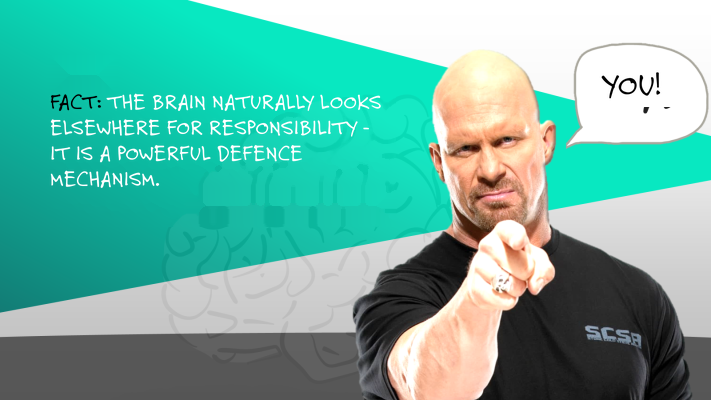
We have a natural tendency to spin a story that protects our ego. Our brain loves narratives where we are competent and the world is difficult. This isn't a character flaw. It's a defence mechanism. From a psychological point of view, something very simple is at play here: when something goes wrong, the brain instinctively looks for an explanation that allows it to maintain a sense of its own competence and control. This protects our identity and our sense of agency.
If something didn't work out, we're quicker to say “they weren't listening” than “I didn't design for attention”. Because the latter is uncomfortable. It requires a change on our part. And for the brain, a change on our part means one thing: admitting that we could have done something better.
The thing is, your audience's brain has no obligation to listen to you. It's an energy-saving organ. From an evolutionary perspective, survival didn't depend on listening to a presentation about a new project or strategy. The brain filters things out. It cuts off what doesn't require a reaction. It protects its resources. Every bit of focused attention costs energy, which is why the brain very quickly assesses whether a given piece of information is truly important.
If someone stops listening, it’s not because they are a bad person. It's just because their brain has decided it's not important enough.
And this is where responsibility begins, but whose?
Early presentations and the illusion of “good speaking”
I remember my first presentations. I was focused almost exclusively on making a good impression. On speaking fluently. On not making mistakes. On keeping my voice steady, my pace even, and my pauses well-timed. A lot of energy went into the delivery. Which is natural, by the way. When you're starting out, you want to sound professional, obviously. The fact that the group where I learned to speak – Toastmasters International (shout out to Wroclove Speakers) – placed a huge emphasis on this didn't help at all.
But there's a trap in this. You focus so much on how you're coming across that you stop looking at how the audience is doing.
For a long time, I thought of a presentation as a one-way broadcast. I speak, they listen. I prepare the content, they receive it. Even the word “presentation” itself suggests this model. Someone presents, someone watches.
It's a trap that most people who need to communicate something competently in a professional environment fall into.
It was only along the way that I myself understood that this is not a perfect model. You can speak correctly. You can have a great structure. And yet fail to build real engagement. Because you're concentrating on how you come across, instead of on what will happen on the other side.
What brought me a breakthrough in presentations, training sessions, and my professional life more broadly, was breaking this rule. I stopped treating a presentation like a performance. I started treating it like an interaction design project.
I no longer use the 'I speak, they listen' model. There is no glass screen between the presenter and the room.
And this is what we've been teaching at Meaning Makers for years.
A Meaning Maker doesn't stand behind a glass screen
According to the “founding myth” of Meaning Makers, a Meaning Maker isn't someone who speaks better. It's someone who designs the experience in such a way that the other side cannot remain passive.
This passivity can take various forms. Sometimes it's passivity in listening. Sometimes in engagement. Sometimes in the attempt to apply what we're talking about to their own experience. And sometimes it comes later – in action, in executing a plan, or in changing behaviour. Regardless of whether your presentation is about sales, strategy, or team development, it's always about the same thing: whether something will actually happen on the other side.
The problem is that we have a deeply ingrained pattern that a presentation means one-way communication. One person stands at the front. The rest sit. One person talks. The rest listen. This is that glass screen. You are on one side, the audience on the other.
And it's very easy to switch off behind a glass screen. You can watch. You can take notes. You can even nod along. And yet be somewhere else entirely in your mind.
Interestingly, television started to experience the same problem. For decades, it was one of the most engaging media in the world. But it was completely one-way. You sit on the sofa, look at the screen, and have no influence on what happens. Today, in a world of social media, comments, reactions, and algorithms that pull you into the conversation – even if it's just an illusion of participation – such one-way communication is no longer as attractive.
That's why television creators tried to break this model a long time ago. I remember a show from my childhood – Hugo. Viewers could call the studio and control the game's character by pressing buttons on their phones. It sounds a bit funny today, but back then it was absolutely fascinating. Suddenly, someone sitting at home could influence what was happening on television. For a moment, the glass screen disappeared.
A few years ago, a similar experiment even appeared in the world of TV series. In the interactive film Black Mirror: Bandersnatch, viewers could decide the main character's choices and the direction of the story. The streaming platform turned watching into a series of decisions.
Why do such things always arouse interest? Because people don't like being just spectators. They like to have an influence. Even a minimal one.
A Meaning Maker, therefore, understands that responsibility isn't about speaking even better. It's about breaking that screen. Pulling people in. Giving up a piece of the space. Inviting them to co-create.
This doesn't mean chaos, and it doesn't mean giving up control. It means consciously designing a situation in which attention is no longer a courtesy from the audience, but becomes their decision.
Why responsibility increases attention – three brain mechanisms
The fact that people start to pay more attention when they feel jointly responsible for the course of a conversation is not just an intuition from the training room. There are very specific brain mechanisms behind it.
When an audience member stops being a passive spectator and becomes a participant in the situation, the way their brain processes information changes. There is greater alertness, greater cognitive engagement, and a greater readiness to act.
This can be boiled down to three simple mechanisms:
1. Energy saving – because you are inherently lazy
No offence, but you know it's true. And it's a very good thing that it is.
The brain operates on a simple principle: minimum cost, maximum effect. If it doesn't have to react, it won't. If it can remain passive, it will. This isn't laziness. It's optimisation.
From an evolutionary perspective, excessive alertness was costly. Energy was a resource that had to be conserved. That's why the nervous system very quickly learns to ignore what doesn't require action.
If your presentation doesn't require any reaction from the audience, their brains switch to power-saving mode. They hear sounds. They register slides. But they don't invest cognitive resources.
The moment a question requiring a decision, a show of hands, or writing down a single thought appears, something changes. The brain gets a signal: this concerns me. This requires a reaction. And suddenly, it switches on.
2. Social alertness – because the brain guards its position in the group
We are a social species. I'm an introvert myself (I know that if you’ve seen me in a training room, you might not believe it), but I still need people.
For thousands of years, belonging to a group was a condition for survival. Exclusion could mean death. That's why our brain is exceptionally sensitive to social cues.
Being called by name, the gaze of others, the awareness that you might be asked to answer in a moment – all of this activates the systems responsible for status and belonging.
This isn't about stressing people out. It's about natural alertness. When the group is watching, we are more present. When we know we might be asked a question, we are more attentive.
In the cockpit, the junior pilot was silent because hierarchy blocked his alertness. In a well-designed presentation, social alertness works in your favour.
3. The ownership effect – because people get invested in what they have an influence on
There's one more mechanism. When you co-create something, you start to treat it as your own. IKEA built an empire on this.
In Meaning Makers projects, I see this regularly. As long as I'm presenting a concept, it's “his idea”. The moment a client adds something, draws something, or modifies something, it suddenly becomes “our solution”.
The brain defends what is its own. It invests more attention. It remembers better. It's also more inclined to act.
If your presentation remains one hundred per cent yours, you don't activate this mechanism. If you let people co-create something, even on a small scale, the dynamic of the whole conversation changes.
Four ways to design for responsibility
If responsibility is to increase attention, it must be designed. It doesn't happen by accident, and it's not a matter of the presenter's charisma. If you drift off into reading slides or reciting bullet points, you'll lose your audience very quickly.
That's why, in a sense, you have to take responsibility for your audience's responsibility. Below are four simple ways to help you do that.
1. Break the barrier in the first few seconds
The first 30 seconds set the dynamic for the entire meeting. If you start with a slide, you establish a lecturer–student relationship. If you start with a question that requires a decision, you establish an interactive relationship.
Who here considers themselves an expert in this area? Who has already had a situation that ended in failure? Raise your hand if…
At this point, the room is no longer anonymous. Everyone has to take a stance.
In workshops, I often ask participants to rate something on a scale of 1 to 10 in the first minute, or to raise their hand if they already have experience with a given problem. Suddenly, instead of a passive room, there's movement, reactions, and energy.
If you don't do this, you create a glass screen. You're like a television. They can mentally switch you off.
Don't let them.
2. Personalise the interaction
Using names is a signal that the conversation is about specific people. When someone hears their name, their alertness increases.
This isn't about calling on people like in school. It's about building a sense that this isn't a speech to a crowd, but a conversation with individuals.
When there are no names, it's easy to hide in the crowd. When names appear, responsibility becomes more personal.
Often, a small thing is enough: “Mark, you said something interesting a moment ago – could you elaborate on that?” or “Agnieszka, what does this look like in your team?”. In an instant, the conversation is no longer anonymous.
Trust me – it works.
3. Micro-commitments
Write down one thought. Cast a vote. Turn to the person next to you and answer a question. These are small things, but they have a huge impact.
Every micro-commitment is a cognitive investment. And once someone has invested energy, it's harder for them to withdraw.
If for 60 minutes no one has to do anything, the responsibility remains on your side.
Sometimes I ask participants to write down one thing they want to test when they get back to work. That one line in a notebook often does more than ten extra slides.
They. Must. Do. Something. Themselves.
4. Hand over some of the controls
Even with a large room, you can say: you have one minute, talk in pairs: “What is the main reason for failure in…?”
Suddenly, everyone is talking. Everyone is processing something.
For the participants, it's a moment of engagement. For you, it's a moment to breathe and reflect.
Often, after such a minute of conversation, answers emerge that I wouldn't have thought of myself, because the participants start to relate the topic to their own experiences.
When this is absent, the pressure is only on you. When you design for shared responsibility, the energy is distributed differently.
Isn't that easier?
Responsibility goes beyond the presentation
Do you like your children's birthday parties? You can always chat with other parents for a bit, share experiences, complain about teachers.
Recently, during one of these conversations, a discussion arose about children's responsibility. Because these days, parents often do a lot for them. School also sometimes helps a little too much. And, as is usually the case in such conversations, after a few minutes, we arrived at a classic life truism.
Someone said that if a person doesn't learn to take responsibility for their actions, the world will do it for them.
It seems obvious. But sometimes obvious things need to be heard in a non-obvious context. And that context is precisely the topic of this article: presentations.
I have almost 25 years of professional experience. If I had to point to one factor that has most influenced my journey, I would say just that: taking responsibility for my decisions. Not looking for someone to blame. Taking action.
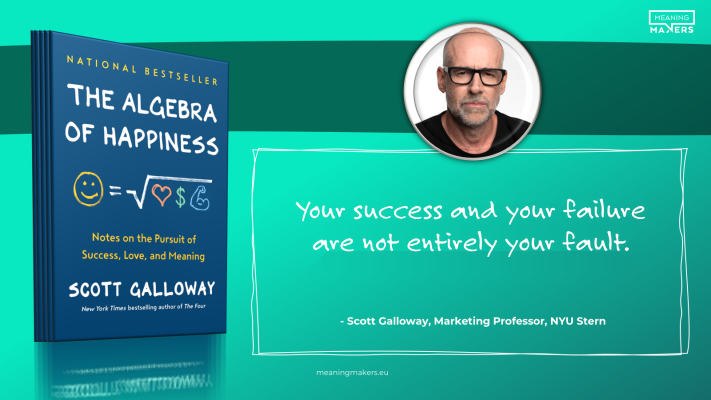
Scott Galloway once said something very interesting: Your success and your failure are not entirely your fault. And no – that's not a mistake. That's exactly the point.
The world is more complex than we like to think. Success is often made up of things we have no control over: timing, people, context, luck. Similarly with failure – it's rarely just the result of a single decision.
But there is one area where you have full control. The decision whether you take responsibility for what you create.
In a presentation, this means one thing: you stop waiting for others to make an effort. You start designing the experience so that the other side cannot remain passive.
Disasters that don't have to happen
The biggest air disasters didn't result from a lack of knowledge. They resulted from a lack of a system of shared responsibility in the cockpit. When only one person is flying the plane and the rest are silent, even a small mistake can have serious consequences.
In presentations, something very similar happens.
The biggest failures rarely stem from a lack of slides or knowledge. They usually stem from the fact that only one person is “flying”, while the rest are sitting like passengers. And passengers have the right to switch off. Just as a viewer in front of the television can reach for their phone or change the channel.
The brain likes to participate, not just watch.
So instead of fighting for attention, do something simpler: design for responsibility. Pull people into the conversation. Make them stop being passengers.
Because when a crew appears in the cockpit, the flight looks completely different.
And now a question for you.
Think back to your last presentation.
How many times during it did your audience really have to do something? Raise a hand. Make a decision. Write something down. Say something.
If the answer is “almost never”, then you know where to start making a change in your next one.
Because a good presentation isn't a performance. It's well-designed shared responsibility.
After all, we all want to land it somewhere.