
Imagine a new position opens up in your company: Choice Architect.
Are you applying? Probably not… not a big enough title for you. So let’s beef it up a bit: Senior Choice Architect. Better? No? Director of Choice Architecture. Now we’re talking. It sounds serious. Smart. Responsible. It brings to mind someone who designs things, understands interdependencies, and considers the consequences.
Unfortunately, you’re too late. But don’t worry. There’s another offer – Influencer. Okay, I know – maybe Director of Influencing? The reactions here are more mixed. For some, it’s fine; for others, it’s suspicious. Influencers haven’t had the best press lately. Too much self-promotion, not enough substance. A certain distance is setting in. But you don’t have to worry about that. Someone’s already been hired. Last chance – there’s one more offer...
Manipulator. My apologies – Vice-President of Manipulation. Still no? Of course not – nobody wants to be a manipulator, right? But are you sure?
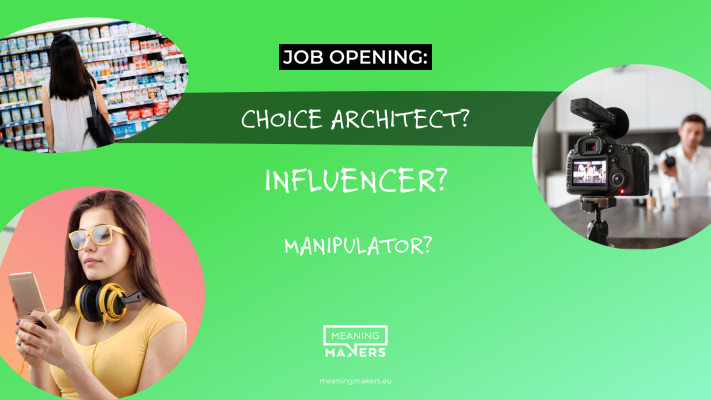
The key question here is, are these three roles really so different from one another?
If, while reading this, you felt a liking for the first title and resistance to the last one, something very specific has just happened. Someone influenced your reaction. Without arguments. Without data. Without pressure. All it took was the order, the label, and the associations.
This is important because it shows something fundamental. Influence doesn’t start with persuasion. It starts much earlier. At the level of perception.
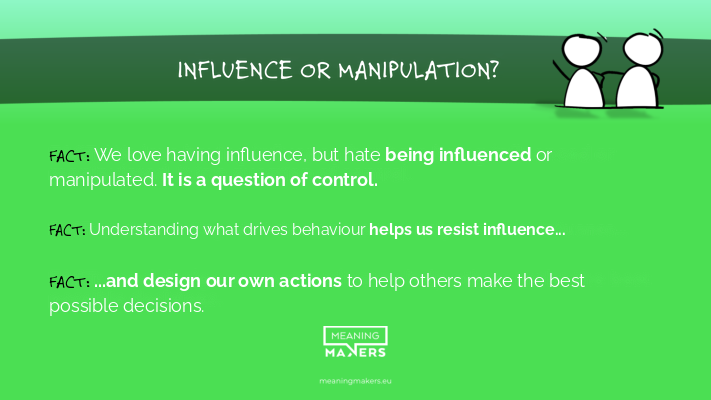
We love to have influence. We hate to be influenced
A short anecdote, one I’ve heard said, but it captures the essence of the problem well. Piotr Tymochowicz (a well-known PR specialist) supposedly once ran a training course called Techniques of Exerting Influence and Protecting Yourself from Manipulation. I don’t know if that was the intention, but the title already contains a little “wink” to the audience. Why? Because they are the same techniques.
We all know this tension, even if we rarely name it directly. When you influence others, it sounds good. We talk about competence. Communication. Leadership. Experience.
But when someone influences you, the narrative suddenly changes. It’s no longer “influence”. That ominous term appears – suddenly, the dark side of influence reveals itself: manipulation.
The mechanism in both cases is exactly the same. Only the perspective changes. The position from which we are looking.
We like to feel a sense of agency. We like to be in control – that’s why we love to “have influence”. And what we like most of all is the feeling that the decisions we make are our own. Even if, objectively, someone “helped” us a great deal with them.
From the brain’s point of view, this isn’t a character flaw or an ego problem. It’s a very old, very basic safety mechanism. A sense of influence is closely linked to a sense of control. And control, evolutionarily, meant survival.
A lack of control meant danger. Not figuratively. Literally.
That’s why the brain reacts so nervously to signals that someone might be controlling it – that we are being manipulated. Even today, when we are no longer fighting for food or shelter, this mechanism is still at work. Only the objects of threat have changed. Instead of a predator, it’s a boss, a memo, a presentation, a decision “from above”.
And that’s precisely why the word “manipulation” triggers resistance so quickly. Not because it always means something bad. But because, to the brain, it sounds like a warning of a loss of influence. And a loss of influence is something the brain guards very carefully. And takes deathly seriously.
Manipulation, or a hand on reality
Now let’s add something you can show off with at the Christmas dinner table as a result of reading this article. Theories of human behaviour? An interesting experiment? Nope. Nothing gets the job done quite like showing off with some Latin.
(A shout-out to the participants of a 2024 training session where two days were dominated by an exchange of increasingly sublime Latin maxims. My fault. I started it.)
You see, the word “manipulation” comes from Latin. From manipulatio. The root is manus – hand.
To manipulate is literally to shape something with your hand. To have a physical impact on reality. To arrange something, move something, support something, or push something.
And here’s the important part. In this definition, there is no deception yet. No intention. No moral judgement. There is just influence.
A hand can help. A hand can push. A hand can also pull someone in a less obvious direction.
It is only the intention and awareness that determine how we judge this influence. Whether someone is helping you see more, or trying to steer you from the shadows. Whether they take responsibility for the consequences, or pretend that “it just happened by itself”.
The problem, then, doesn’t lie in the influence itself. The problem starts when influence operates silently, without being named, without reflection, and without responsibility for what it does to the other person.
And this is the moment when the word “manipulation” ceases to be innocent. Not because it pertains to influence. But because it pertains to influence without awareness.
The brain reacts before you have time to think
Why was the job title alone enough to trigger emotions?
Because the brain isn’t a machine for analysing truth. It’s a machine for quickly assigning meaning (see, that’s why we’re MEANING-Makers). Its main task isn’t to “understand the world”, but to navigate it safely and as energetically cheaply as possible. That’s why the brain takes shortcuts. Not because it’s lazy. Because it’s effective.
It reacts to, among other things:
Labels - Because a label allows the brain to instantly file something into a familiar box – “safe”, “suspicious”, “known”, “foreign” – without the need for deeper analysis. Context - Because the same message in a different setting means something completely different – the brain always asks “where is this happening” before it asks “what exactly is happening”. Order - Because the first piece of information becomes the reference point for all subsequent ones – the brain very rarely resets a first impression. Tone - Because before we understand the content, the brain checks if the conversation sounds safe or threatening – tone tells it more than words. Cultural associations - Because we don’t start from scratch – every word carries with it a history, images, and emotions that the brain already knows.
- Labels – Because a label allows the brain to instantly file something into a familiar box – “safe”, “suspicious”, “known”, “foreign” – without the need for deeper analysis.
- Context – Because the same message in a different setting means something completely different – the brain always asks “where is this happening” before it asks “what exactly is happening”.
- Order – Because the first piece of information becomes the reference point for all subsequent ones – the brain very rarely resets a first impression.
- Tone – Because before we understand the content, the brain checks if the conversation sounds safe or threatening – tone tells it more than words.
- Cultural associations – Because we don’t start from scratch – every word carries with it a history, images, and emotions that the brain already knows.
First comes the reaction. Only then comes the thought. And even later comes rationalisation, which is the story we tell ourselves to justify what we’ve already felt.
That’s why “choice architect” sounds safe – because the word “architect” is associated with planning, responsibility, and order. And “manipulator” sounds threatening – because it’s associated with a loss of control and being steered.
The brain doesn’t check intentions. It reacts to the signal. And that’s precisely why perception so often wins out over rationality. Not because we’re unreasonable. But because that’s how the brain works.
We all manipulate. Every day.
If the word “manipulation” still makes you uncomfortable, let’s look at everyday life.
My nine-month-old daughter sees her dad coming down the stairs and starts to whine. Is she manipulating? Yes. Is she doing it consciously? No. Does it work? Absolutely. A moment later, the little beast is in my arms with a smile on her face.
We accept it because we see the intention. The child isn’t trying to take over the world. She’s trying to satisfy a need. The brain very quickly distinguishes a threat from a need. When it sees the intention, it lowers its guard and stops being defensive.
Makeup. Body posture. Sucking in your stomach when you see someone attractive. A change in tone of voice, a pause in a sentence, a glance at the right moment. These are all ways of influencing the perception of others.
We do it naturally, often automatically. Influence is embedded in social relations. If you don’t use it, it doesn’t mean there’s no influence. It just means that someone else is shaping the context for you.
People don’t know what they want. And that’s not an accusation.
Sometime around 2001–2002, my aunt gave me a Discman. The CDs skipped, the batteries died, but back then, it was something else. I felt like a trailblazer – after having worn out three Walkmans on my route from home to high school over the past few years.
Did it cross my mind then: “I can’t wait for someone to invent MP3s”? Was I thinking about streaming? About Spotify? No. Because I didn’t know such things were even possible.
In general, people don’t know what they want until they see what’s possible. Until they see the possibilities – most often thanks to someone else.
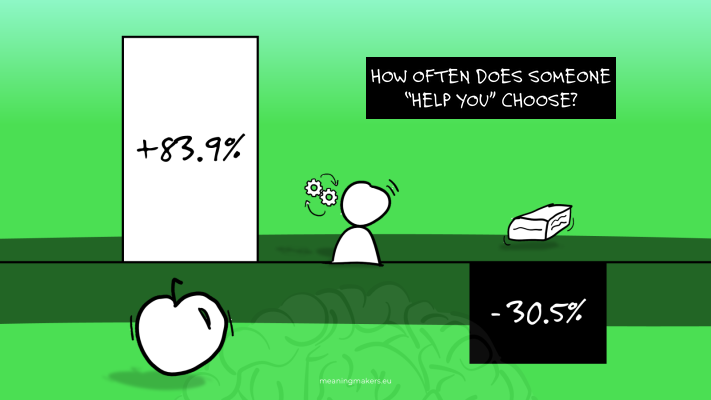
I have the perfect example. My own.
When I was running training sessions in a corporation, I was in a certain status quo. Most of my time was taken up by organisation and administrative matters. The training sessions themselves were a rare treat – even though that’s what I loved most. I was stuck in it because it was what I knew.
It was only when fate threw an international certification with an incredible trainer – Cheryl Geoffrion – my way that something shifted in me. That collision was an eye-opener. You can work like that? Come in, do a super job, then send an invoice and disappear? Turns out, you can.
Would I have figured that out on my own? I don’t know. What I do know is that this interaction “manipulated” my reality. And it’s thanks to that I am where I am today.
On another front – Steve Jobs supposedly once told someone at his company who suggested that “Apple should do research on what customers want” that it wasn’t going to happen.
Jobs allegedly stated that he wasn’t going to ask customers for anything. Instead, he would tell them what they needed, and they would buy it. It sounds strong, but there’s something to it. If you’re blazing a trail, breaking through the ceiling, being a pioneer – you can’t ask people what they want. Because how are they supposed to know, if they’ve never even considered it?
People operate within the framework of what they know. The brain needs reference points.
Very often, influence consists of someone expanding those frames. Showing a new possibility. A new category. A new way of looking at things.
That’s also influence. And very often, with hindsight, we are grateful for it.
Perception is currency
Reality is what it is. But it’s the perception of that reality that determines who has a voice, who is listened to, whom we trust, and who even gets a chance.
We don’t live in a world of facts. We live in a world of meanings assigned to facts. And meaning is never created in a vacuum. It always arises in a context.
That’s why two people can look at the exact same event and draw completely different conclusions. One will see an opportunity. The other, a threat. One will say, “that makes sense”. The other, “that will never work”. The facts haven’t changed. The meaning has.
The brain is not interested in objective truth. That’s not its main job. The brain asks something else. “What does this mean for me?”. “Is this safe?”. “Does this help me or threaten me?”. Only then, if at all, does rational analysis appear.
That’s why people don’t make decisions based on data, but on how that data is narrated to them. The same chart can be proof of success or a signal of failure. The same change can be an opportunity or a catastrophe. The same proposal can be exciting or suspicious.
So, if you’re not consciously influencing what meaning people assign to facts, someone else will do it for you. Sometimes by accident. Sometimes with their own interests in mind. Sometimes very effectively.
Perception is a currency. And like with any currency – you either manage it, or you let it circulate without your involvement.
When influence turns toxic
Influence in itself is not the problem. The problem is influence without responsibility.
Social media is one of the clearest examples here. A child with a phone in their hand is no longer comparing themselves to a few kids from the neighbourhood. They’re comparing themselves to the entire world. Or rather, to its retouched, carefully selected version.
To a world where everyone is more interesting, better-looking, more self-confident, and has a better life. At least on screen.
This is choice architecture on a mass scale. Except without a single architect. Without reflection. Without the intention of caring for the recipient’s well-being. Algorithms don’t ask if what they show is good for the brain. They ask if it will hold attention. And they do it very effectively.
Jonathan Haidt, a social psychologist and professor at NYU Stern, has for years been studying the link between smartphones, social media, and the mental health of young people. In his book The Anxious Generation, he describes what he calls “the great childhood rewiring”.
From a childhood based on play, relationships, and exploring the world – to a childhood based on screens, comparisons, and constant evaluation.
Haidt shows that this isn’t a matter of “bad content” or individual platforms. It’s a matter of constant influence on perception. A young brain, still building its image of itself and the world, is constantly exposed to stimuli that tell it what it should be, how it should look, and how much it deviates from the norm.
The effect? An increase in anxiety, depression, and feelings of inadequacy. Not because children are weaker. But because their brains weren’t designed to live in such an environment.
Haidt says it plainly. This is not a problem of individual choices. It’s a public health problem. That’s why he proposes simple but radical changes. Giving children smartphones later. No phones in bedrooms. Social media only after reaching adulthood.
Not to take away freedom. But to give the brain time to develop without the constant pressure of comparison.
All of this leads to one conclusion. Influence always works. Even if no one plans it. Even if no one takes responsibility for it.
And that’s precisely why the key question isn’t whether influence is good or bad. The question is, who is designing it, and with what intention.
Choice architect instead of manipulator
Richard Thaler, a Nobel laureate and author of the term “choice architect”, pointed out something very simple, yet inconvenient. Someone always organises the context of a decision. Always. Even when we think the decision is “free”.
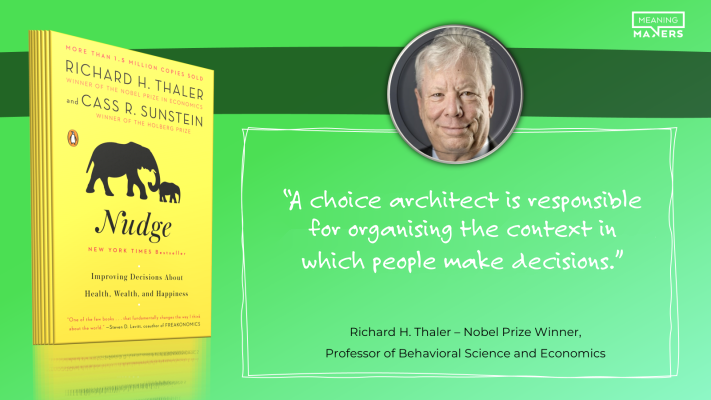
The layout of a menu. The order of options. The default settings. The way something is named and presented. All of this already influences a choice before anyone consciously begins to analyse it. And that’s a fact, not an opinion.
A choice architect doesn’t take away people’s freedom. They don’t force. They don’t push. They don’t say, “you must”. Instead, they design the environment so that good decisions are simply easier to make, and bad ones slightly more difficult.
Not because people are stupid. But because they are busy, tired, and operating on autopilot.
The difference between manipulation and responsible influence doesn’t lie in the technique. It lies in the intention and transparency. A manipulator tries to steer from the shadows. A choice architect says openly: “I designed this environment this way because I believe it helps”.
And they take responsibility for the consequences. For how their decisions affect the behaviours, emotions, and choices of other people.
In this sense, a choice architect isn’t someone “above” others. They are someone who accepts that influence already exists. And instead of pretending it doesn’t, they decide to use it consciously.
Four areas where you have influence every day
Influence doesn’t start with persuasion. It starts much earlier. The good news is that you don’t need to learn “techniques of influence” to start doing it consciously. It’s enough to understand a few areas where you are already having an influence every day – often without even thinking about it.
1. Context – before the first word is spoken
People react to context before they react to content. A meeting agenda, the form of an invitation, the timing of a conversation – all of this sets the perception.
What you can do: Design the context so that it doesn’t trigger defensiveness. Name a difficult topic directly. Instead of a “quick chat”, propose a working conversation. Start with a question, not a decision.
2. Language – words the brain hears before the meaning
Language doesn’t just describe reality. It co-creates it. A single word can trigger resistance or curiosity.
What you can do: Swap the language of control for the language of choice. Even if a decision is limited, the way it’s named makes a huge difference.
3. Order – what you show first sets the stage for everything
The first piece of information becomes the reference point for what follows. The brain rarely resets the context.
What you can do: Start with the meaning, not the details. First “why this matters”, then “how” and “what”.
4. Attention – what you direct it to, grows
Attention is a limited resource. What you reinforce with attention begins to dominate the picture of reality.
What you can do: Start reinforcing what you want to see more of. The questions you ask, the summaries you make, and what you consciously omit all build your team’s perception.
You already have influence. What will you do with it?
To finish, let’s go back to the hand. To manus.
Influence isn’t something you can switch on or off. It’s embedded in the relationships between people. A lack of influence is also a choice. It means handing your agency over to someone else. To someone who will arrange the context, name things, set the order, and assign meaning anyway.
Every day, you are in the role of a choice architect. Sometimes for your team. Sometimes for your clients. Sometimes for your children. Sometimes for yourself.
My nine-month-old daughter has no power. She has no arguments. She has influence. And she uses it exactly as she knows how. Intuitively. Effectively. Without ill intent. Because influence is the natural language of relationships, long before logic appears.
In the same way, someone once expanded my frames. They showed me that you can work differently. That you can move beyond the familiar status quo. Like with the Discman – I didn’t know what I “wanted” until I saw that something else was even possible. That influence didn’t deceive me. It shifted me.
And that’s exactly the point. Not all influence is manipulation. But all influence does something. To someone’s perception. To someone’s decisions. To someone’s sense of safety or agency.
That’s why the key question is not whether to influence. It’s whether to take responsibility for the influence we already have. And by whose hand the reality we live and work in is being shaped.