
We all know that moment. You leave the house, you’re on your way to work, you pass two streets and then you realise you don't have your phone. You turn back, even though you don't really need it to live... (controversial, I know). But seriously, why do you go back?
You see, you don't go back for your phone’s features or specs – for its megabytes, pixels or the 45 apps that theoretically “should make a difference”. On their own, they don’t change a thing in your life. Nor do you go back for the “value” the phone supposedly provides. Value sounds smart, but it’s so detached from reality that your brain has nothing to latch onto.
“Better organisation of your day”. “Greater productivity”. “Better access to information”.
Sounds good? Sure. Can you picture any of that in concrete terms? Probably not.
So why do you go back? You go back because without your phone, you can’t do the things that are essential for you. You can’t make a call. You can’t check your calendar. You can’t pay for things. You can’t join your meeting. You can’t get your day sorted.
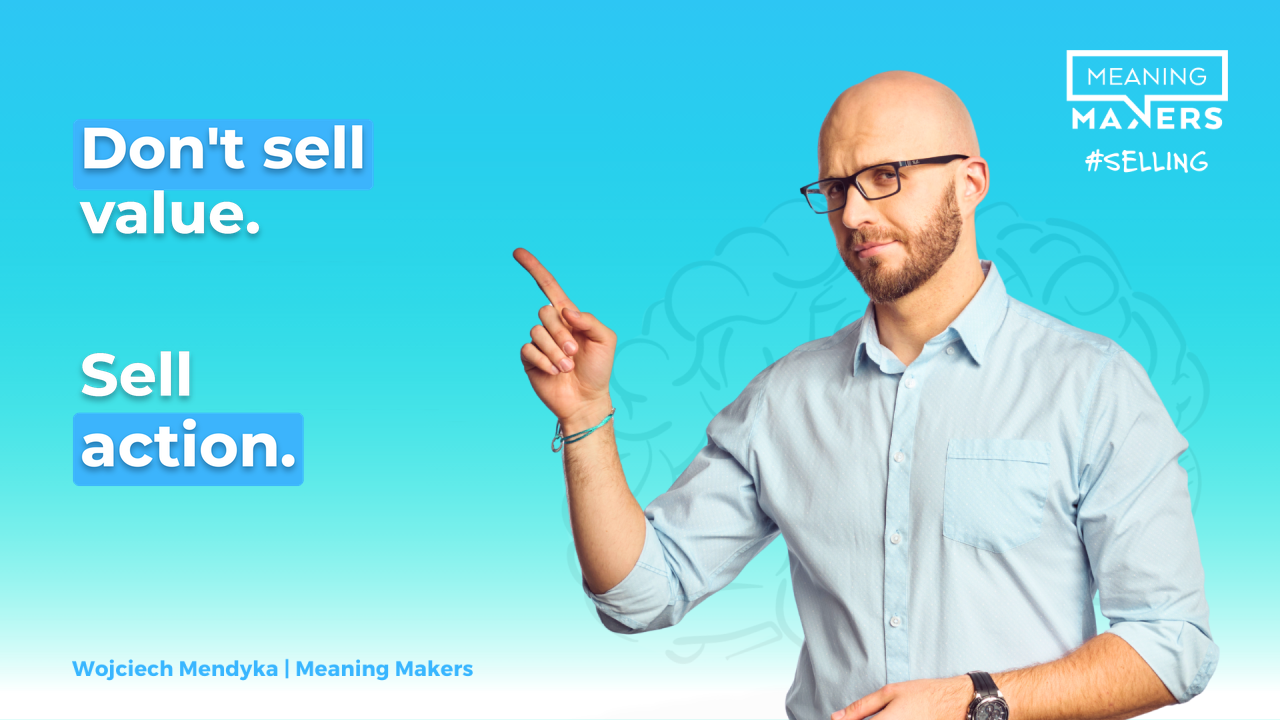
In other words – you go back for the action, not for the features and not for the abstract value.
And that’s the crux of it. The feature isn’t the reason. The value isn’t the reason. The reason is the action you’re unable to take.
Value that means nothing
In sales, it's exactly the same. Everyone talks about value, but value – if it isn’t anchored in action – remains an abstraction. And abstraction is the greatest enemy of differentiation. Because it doesn’t create any picture in the client's mind. It gives them no point of reference.
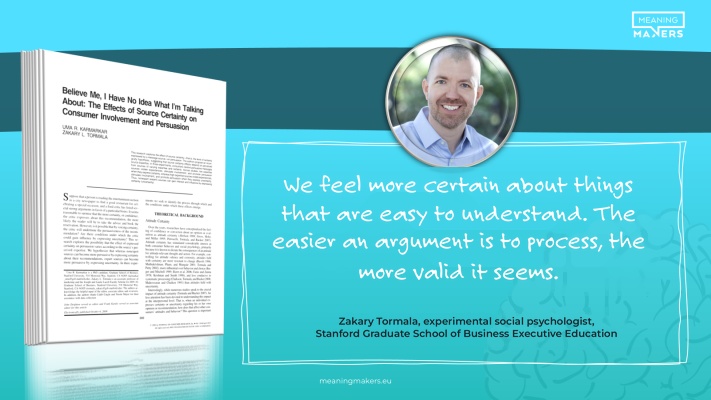
It’s like the word ‘democracy’. The word ‘democracy’ sounds important, but when you ask people to describe what it actually means, everyone will say something different. It’s an abstraction. Only when you say, “you go, you put your ballot in the box, you mark an X” – suddenly, a picture emerges. An action emerges. Meaning emerges. The brain needs that scene to know what it’s all about.
I see the same thing in my training sessions, when I ask participants: “Tell me, what is human attention? How is it shaped?”. People offer clever phrases – “stimulus filtering”, “energy management”, “mental focus” – but it’s all pure abstraction. Only when you show them a specific situation, like how the brain reacts to movement, contrast, or a change in tone of voice during a meeting, does everything suddenly become clear. Abstraction turns into a picture. A picture turns into understanding. And only then does a decision emerge.
It's exactly the same with sales slogans. You know those phrases about value that keep coming back like a boomerang? “We increase efficiency.” “We reduce costs.” “We strengthen communication.” “We boost engagement.”
This is all ephemeral, easy to copy, easy to repeat. That’s why it sounds the same, no matter who says it.
These are phrases that could be attached to any company on the market. That’s precisely why they stop meaning anything. Without action – without showing what a person will do differently – value is just an empty slogan. And the client simply doesn’t hear empty slogans anymore.
Selling “value” still only gets you halfway
For years, it’s been said that a good salesperson should go from feature to benefit. That was necessary because features don’t sell.
The problem is, that approach is only half the journey. Everyone jumps from the feature straight to the benefit, assuming the client will fill the gap with their imagination. But the brain doesn't work that way. A benefit remains an abstraction until it’s anchored in action.
“We’ll reduce production costs”, “we’ll increase efficiency”, “we’ll improve security” – these are big words that the brain can’t turn into any kind of picture. They don’t trigger anything.
The brain doesn’t react to declarations. It reacts to simulations. And a simulation requires action.
Now look at an example that works. If you tell the client that an operator will stop repeating the same task five times, that the team won’t have to manually collate the same data every week, that a leader will finally not have to go back to reports that get corrected at the last minute anyway, then we’re in a completely different place.
These are scenes from their work. This is a situation where they instantly know what their people's day looks like. You can immediately see how the pace of work changes, how much frustration disappears, how many errors will be prevented.
And only at this point can you say: “and as a result, you will reduce production costs”. Now that sentence makes sense, because it’s the result of an action, not a detached slogan. The brain understands what it can replay in its mind. Action creates a picture, and a picture creates value.
And what makes this change in action possible in the first place? Well, obviously: Thanks to the solution you're proposing.
The feature and the benefit are still needed, but it’s the action that opens the door to value. It’s the missing link between what you say and what the client really buys.
This is why the classic “feature → benefit” approach needs to be supplemented with a missing third element: action. Not the feature, not the benefit alone, but the ability to do something differently. This is what unlocks value, because it engages the areas of the brain responsible for planning, prediction, and emotion. Action is the bridge between what you say and what the client can imagine. And it's this bridge that determines their choice.
Cialdini, cable TV and Netflix
A classic study by Robert Cialdini illustrates this well. It tested two messages about the same cable TV service (yes, yes – it's pretty old research by today's standards).
In the first message, the hero was the product: “When cable TV is used properly, it allows you to plan which events can be watched.” This appealed to about 20% of the audience, who decided to sign up for the service.
In the second, the hero was the person: “When you use cable TV properly, you are able to plan which events you want to watch.”
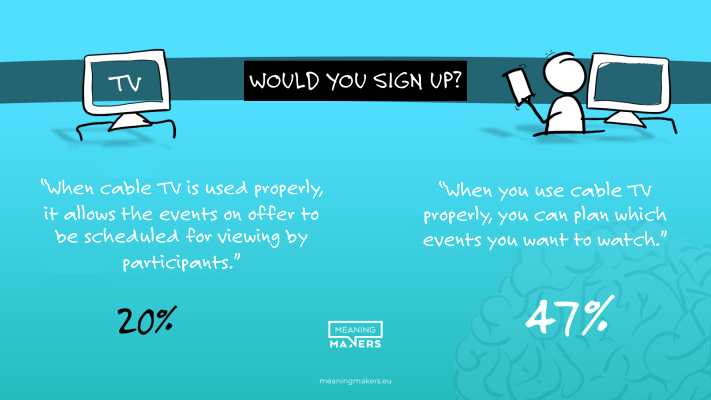
Effectiveness jumped to... 47%. Twice as many clients bought.
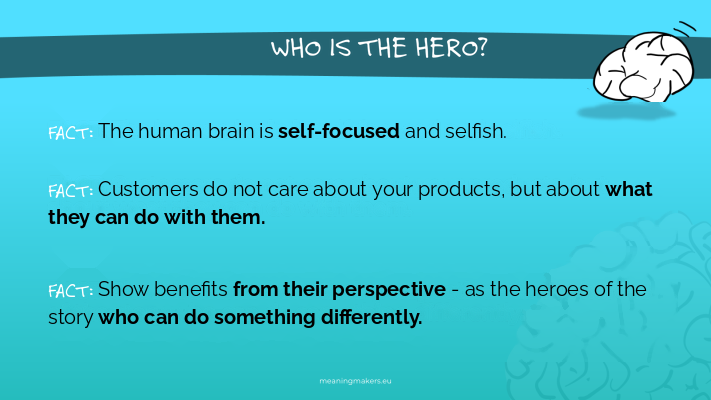
The difference wasn't due to style. It was because in the first message, the product acts, and in the second, the recipient acts. The brain responds to a scene in which a person makes a decision and takes an action. Only then does it start to make sense.
If this study were done today, the results would probably be similar. “Netflix has a large content library and great recommendations” – that's a description. “After a long day, you can put on something that will calm you down or draw you in, with no ads and no searching” – that's an action. The first sentence is about the service. The second is about a person in a specific situation. And it’s that situation that sticks in the memory. Notice that the second version isn't about “values”. It’s not about getting “peace of mind”, “time savings”, etc. That’s often an abstraction.
But for the brain, action is something concrete.
A story from recent weeks
A few weeks ago, I was in a conversation with a large tech company. The meeting had already been going for about forty minutes. We talked about their challenges, what their salespeople lack in daily conversations, and which decisions their clients make too late or not at all. We tossed around different approaches, analysed specific market situations, and considered what a “consultative conversation” versus a “catalogue presentation” meant for them in practice.
At one point, the question came up: “Okay, but what exactly will we teach our people?”. And I was able to answer without hesitation: “What I’m doing with you right now.” Because throughout our entire conversation, there wasn't a single slide with an agenda or a list of modules. I didn’t come to that meeting with a training catalogue, although I could have talked about it for four days. We focused on something else – on the actions their salespeople need to learn to conduct conversations differently from everyone else.
I showed them what a conversation looks like where the client discovers something important for themselves. How to guide the conversation threads so you don’t revert to features and functions. What the moment looks like when a decision emerges, not a presentation. In practice, we worked through the exact models and triggers that I will be teaching their team.
And that's what they bought. Not a description of a training course. Not the parameters of a workshop. But the change in action within their teams, which they saw during the conversation itself.
A few days later, the formal decision came through. The project was approved – a project that will involve several dozen people over the next year, with the potential for further spin-offs.
Was there competition? Of course. There always is. But from what I know, the competition was talking about training products.
The four stages of client awareness – and how to move the conversation forward in each one
Professor Leff Bonney of Florida State University described four stages of problem awareness in which a client might find themselves. This is one of the most practical tools because it helps you see why the same sales behaviours work in some situations but lead to a dead end in others. These four stages clearly show one thing: regardless of where the client is, talking about the product doesn't move the conversation forward in any scenario. Only one thing works – specific actions that the client can imagine.
1. The client doesn't see a problem
Most common mistake: The salesperson immediately presents the product: “Our system automates the process and allows you to increase efficiency.” No picture forms in the client's mind because they don't yet see what actually needs improving.
What works better: Showing a simple, specific moment from their work that is repetitive, slows the team down, or generates errors.
What this looks like in practice: Instead of talking about the system, say: “Look, here you're performing the same task three times. Once in Excel, once in the system, once in an email. This process can be done in a single step.” This is a moment the client can replay in their head.
2. The client feels discomfort but can't name it
Most common mistake: The salesperson tries to guess or throws in a list of features, hoping the client will “latch onto” one of them. This only deepens the chaos.
What works better: Helping the client walk through their own workday, step by step. Without the product. Without the solution. Just with questions that allow them to see where things are breaking down.
What this looks like in practice: “Tell me what happens from the moment a request comes in to the moment the client gets a response. Where does the flow of information most often get stuck?” This approach creates a clear picture – and a picture leads to a decision.
3. The client knows they need a change but doesn't know what kind
Most common mistake: At this point, most salespeople launch into a presentation. Options, modules, features, parameters. This looks like an answer, but in reality, it deepens decision paralysis.
What works better: Showing three possible ways of doing things – not three products. Three ways for the company to operate after the change.
What this looks like in practice: “You can leave the process as it is and continue to lose one day a week. You can partially streamline it and cut the work time in half. Or you can do X, which makes the whole process run in the background and doesn't involve your people at all.” This isn't a presentation. This is a conversation about future actions.
4. The client is comparing solutions
Most common mistake: This is the classic moment when a salesperson reverts to “our product has three more features.” The result? Instant commoditisation. You end up in an Excel sheet where only the price matters.
What works better: Instead of saying what the “product has”, show what the first week of work will look like after implementation. It’s a scene the client can imagine and compare with other suppliers.
What this looks like in practice: “In the first week, your team will stop filling out forms manually. The system will collect the data itself and send notifications. And your leaders will immediately see the full status without having to call people.” This is the moment when the product stops being a product and gives the client a new power – a new action they can take.
One common denominator
In each of these four stages, something very simple happens. Describing the product doesn't move the client forward. What moves them is a clear picture of what they will do differently – tomorrow, next week, next month.
The client doesn’t buy “features”. The client doesn't even buy “value”. The client buys the action that becomes possible thanks to your solution.
To finish
When I look at this whole story – the phone, Cialdini, Netflix, the Canary Islands, my conversation with that company – it all comes down to one point. What a person can imagine always wins. Not the feature. Not the description. Not the abstract value.
A phone on its own doesn't change anything. What changes things is that you can’t function without it. That’s why you turn back.
Brian Tracy didn’t sell you a plane flight. He sold you the moment you're standing on warm sand and, for a little while, you don't have to do anything. That's why it works.
The client in my story didn't buy a training course. They bought the ability to conduct conversations the way we did in our meeting. They bought the change in behaviour they saw with their own eyes. That's why the project got approved.
And this is exactly where most sales conversations go wrong. The salesperson talks about the product. Then they talk about value. But the brain still doesn't see a concrete, tangible action. There’s still no picture. There’s still no decision.
In a world where everything can be copied – a feature, a function, a slide, a description – abstraction is the worst enemy of differentiation. Because it sounds exactly the same coming from everyone. Only action makes value become real, unique... and associated with you – if you're the one who defined it, not your competition.
Value without action is a slogan. Action that translates into value is a powerful image that will influence the decision.
Your turn
So what’s the situation with you? Are you selling action or abstraction? If it's action – great, you're already miles ahead of the others. And if not, the good news is that this can be changed faster than you might think.