
The day before yesterday, I returned from Paris after a session for the sales department of a top IT company. One question kept coming up. A question whose genesis began 30 years ago, and which today has a real impact on what work in sales looks like.
What happened back then?
30 years ago, Garry Kasparov lost a chess match to Deep Blue.
Who was Kasparov? He wasn’t just a chess champion. He was a symbol of human intelligence in its highest form: intuition, creativity, and strategy. If anyone was going to “prove” that a human would always beat a machine, it was Garry Kasparov. That’s why his defeat in the first game against Deep Blue in 1996 was such a huge warning sign. Even though he ultimately won the overall match, something was already distinctly different.
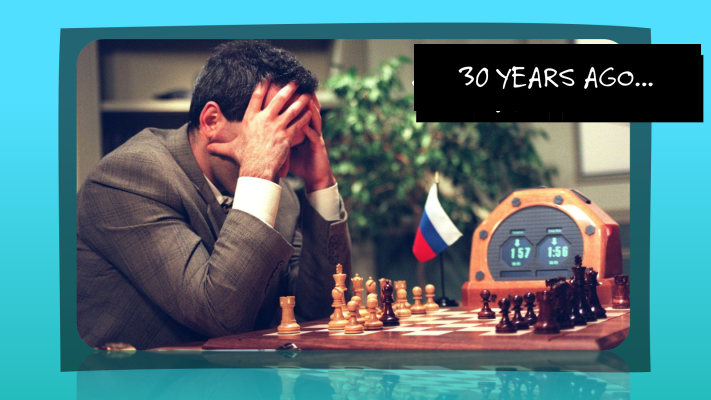
A year later, that signal returned—this time, much stronger. In 1997, an upgraded Deep Blue won the entire match against Kasparov. For the first time, a computer had defeated a world champion under standard tournament conditions. The machine had officially crossed a line that, just a moment before, we had considered safe.
Over time, the discipline of chess itself also changed. It turned out that an average chess player, supported by well-used technology, could defeat both the grandmaster alone and the machine alone. The combination of the two would win, but only when someone knew how to manage it consciously.
It seems to me that this is exactly where we are in sales today. But most teams aren’t losing to AI; they’re losing because of how they use it. AI in itself doesn’t create an advantage. However, there’s no denying that it accelerates (the importance of) what you’re already doing.
So if that’s the case—and if you’re already losing influence over the client’s decision today... You’ll just get to the place where you lose it completely much faster.
The same mechanism is now entering sales
This week I was in Paris, where I worked with an organisation that develops AI-based solutions—a company that implements AI on a large scale itself. Despite this, very specific questions kept coming up in the sales teams: how to use it in a way that actually provides an advantage.
A second, much less comfortable, topic also quickly emerged: At what point will it start to replace us?
This question doesn’t come out of nowhere, of course. In many areas of sales, it’s already clear how some tasks are disappearing or changing their nature. Where the role is reduced to answering questions, preparing materials, and tailoring communication, technology is raising the bar very quickly—while simultaneously stripping away uniqueness.
You see, the problem with AI in sales isn’t that it will replace you. The problem is that it very quickly makes you comparable. And when you’re comparable, you start to lose influence over the decision. Dark clouds over sales?

The trap most salespeople fall into
Why do good salespeople not have to worry about their jobs in an AI world… and yet so many of them are starting to lose their position?
This question seems contradictory. On the one hand, we hear that technology will take over some sales tasks. On the other, we see that the best salespeople are still winning, often even more decisively than before. The difference isn’t about whether someone uses AI or not. The key is the role it plays in the entire process.
Most salespeople do exactly what they’ve been taught to do. A client says what they need, so we respond. We tailor the offer, build the argumentation, and prepare a presentation. We want to be helpful; we want to show that we understand the situation. We strive to be fast, specific, and “to the point,” because that’s how professionalism is defined in many organisations.
This approach in itself is not a mistake. It was logical in a world where access to information was limited, and the mere act of gathering data, preparing an offer, or structuring a response provided real value (and of course, it still does, but...)
The situation changes the moment the entire market starts using the same pattern. Today, we’re not just talking about a few companies—most operate with very similar logic. AI has reduced preparation time to a minimum. Offers, emails, decks, and value propositions can now be created quickly and to a high standard. The problem is, it’s not just one company doing this, it’s all of them.
The result? Several companies respond to the same need in a very similar way. A similar structure, similar arguments, similar language. The client hears from different companies but feels like they’re hearing the same story.
And what happens when we hear something again? When we feel it’s nothing new? The perceived value of such a message drops drastically. Not because it has no value, but because our brain automatically assigns a lower priority to what it already knows.
AI doesn’t solve this—it accelerates it. The easier it is to create a good response, the faster all responses start to look similar. And the more similar the content, the harder it becomes to see the differences.
Then, the decision naturally simplifies. Complexity is reduced to a few variables: price, scope, deadline, risk. Clients aren’t being malicious—it’s not ill will on their part. It’s their way of coping with information overload.
If your role mainly consists of responding, tailoring, and presenting, where is your advantage? It’s precisely these elements that technology levels out the fastest.
The real difference only emerges when you stop just responding and start influencing how the client thinks and how they make their decision.
“Procurement Kill Zone”
AI accelerates entry into an area everyone knows, which I call the Procurement Kill Zone.
You know it well. The client says they need to compare options. Specific criteria appear. Price. Scope. Deadlines. You get a list of things to fill in. Suddenly, the conversation starts to look different.
You’re entering the Procurement Kill Zone—a term that recently came to mind while I was reflecting on the situation sales departments face.
The term is not accidental. In many organisations, this is when procurement or a procurement-style mindset comes into play. Comparison, optimisation, pressure on terms and conditions. From the company’s perspective, it makes sense. From a sales perspective, this is when the advantage starts to blur. That's why, when thinking about this phenomenon, I struggled to find a better name. It’s not a single mistake or one decision, but a space that systematically “strips away” the salesperson’s influence.
It’s precisely in the “PKZ” that you lose influence over the decision. And if you don’t have control over what the conversation looks like, AI will get you there very quickly.
What will it look like?
The client decides they have enough information and starts to simplify reality so they can make a choice. The criteria are created without you. The conversation is no longer a place where the decision is shaped. It becomes a place where the decision is compared.
In chess, it’s a situation where you put yourself in a bad position. The game is still on. It’s not over yet. But every subsequent move is harder than the last.
This is a space where AI excels. It compares, analyses, optimises. If your sales process ends up in this place, you start playing in an area where technology inherently has the upper hand.
Comparability starts earlier than you think
In my workshops, I often ask two questions that very quickly set the context.
First: how many of you sell something that has no real competition? Usually, silence falls. So I continue. What percentage of your offering is comparable? At the workshop in Paris this week, the answer was: 99%.
It sounds like a no-win situation. Except that’s not even the most interesting part. Because sales isn’t just about what you have in your catalogue. In practice, how you conduct the conversation is far more important.
That’s why the second question arises: what does your conversation with the client sound like?
To make it easier, I show a few typical phrases: leading industry solution, best-in-class support, full integration, individual approach, we understand your business...
Sound familiar?
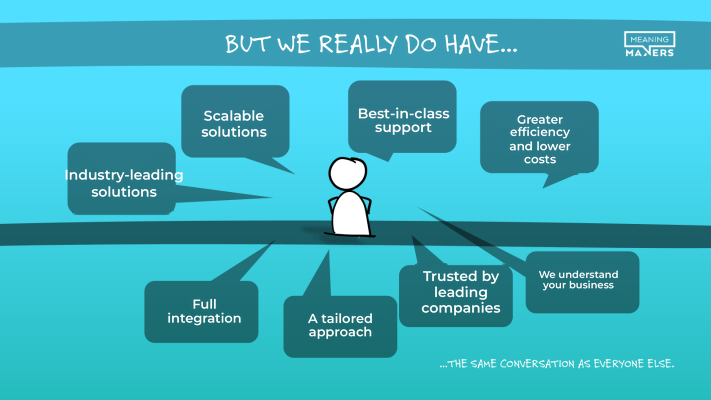
Regardless of the industry, people start to smile and admit, “Yes, that’s exactly what we say.” What’s more, these same phrases appear in companies so different they might as well be on separate planets. The same words, structures, and patterns.
It turns out we are much more similar to one another than we think. Comparability isn’t just about what you sell. It’s also about how you talk about it and how you conduct the conversation.
If you sell something similar and communicate it in a similar way, the client has no tools to see the difference. And if they can’t see a difference, they start to simplify, which makes you comparable, and you surrender the decision.
(...it’s another matter that if you sell something comparable—and comparably—you’re actually selling on behalf of your competition!)
The client doesn’t analyse you in isolation. They see a set of options. They try to simplify them. They look for points of reference. And they choose what’s easiest to compare.
Sales today isn’t a battle over the product. It’s a battle over how the client interprets their situation. If you don’t have influence over that interpretation, you don’t have influence over the decision.
Today, you can generate practically anything. Every presentation, every offer, every response. But if you don’t know exactly what you’re looking for and what a good conversation should look like, you get a huge amount of correct but completely indistinct content.
That’s not an advantage. It’s duplication.
That’s why the key problem in sales today isn’t a lack of information. The problem is a lack of a structure for thinking. Do you know how to conduct a good conversation?
How you lose your advantage before the decision is even made
Entering this comparison zone doesn’t look like a mistake. The process continues, meetings are held, the client is engaged, and from the outside, everything looks as it should. And that’s precisely why this situation can be so treacherous. You don’t have the feeling that something dangerous is happening. Yet the conversation begins to shift. Slowly, almost imperceptibly, but consistently.
Your position weakens not because you suddenly said the wrong thing, but because you entered a space where different rules start to apply. What are these rules?
An advantage turns into a standard. Just a moment ago, you had an argument that worked. The client responded, saw the value. Over time, however, that same argument ceases to impress or starts appearing in the competition’s pitch. That’s when a differentiator gets absorbed by the market. AI only accelerates this process—what was an advantage very quickly starts to look like a standard. The decision boils down to price. The conversation might start with value, but when the differences are no longer clear, the brain looks for a simpler filter. That’s when price comes in. Not because it’s the most important, but because it’s the easiest to compare. In this space, there will always be someone cheaper or better “packaged”. The criteria are created without you. You get a list of requirements to respond to. The process looks professional, but you no longer have any influence over what is being evaluated. You’re not building the decision—you’re adapting to it. At this point, you stop leading the conversation and start servicing it. The conversation descends to the level of detail. Instead of talking about business impact, you start analysing features, parameters, and conditions. This seems like a natural stage, but it means the decision has already been simplified. And if the conversation stays at this level, it’s very difficult to get back to value.
- An advantage turns into a standard. Just a moment ago, you had an argument that worked. The client responded, saw the value. Over time, however, that same argument ceases to impress or starts appearing in the competition’s pitch. That’s when a differentiator gets absorbed by the market. AI only accelerates this process—what was an advantage very quickly starts to look like a standard.
- The decision boils down to price. The conversation might start with value, but when the differences are no longer clear, the brain looks for a simpler filter. That’s when price comes in. Not because it’s the most important, but because it’s the easiest to compare. In this space, there will always be someone cheaper or better “packaged”.
- The criteria are created without you. You get a list of requirements to respond to. The process looks professional, but you no longer have any influence over what is being evaluated. You’re not building the decision—you’re adapting to it. At this point, you stop leading the conversation and start servicing it.
- The conversation descends to the level of detail. Instead of talking about business impact, you start analysing features, parameters, and conditions. This seems like a natural stage, but it means the decision has already been simplified. And if the conversation stays at this level, it’s very difficult to get back to value.
The client doesn’t always choose the better option. They simply stop seeing a difference between them.
How to regain influence over the decision
In workshops, the same question often comes up: What do we do when we’re already there?
There’s no single answer, but there’s one thing that recurs in my work with large and small organisations. It was true before the AI era, and it will be true in the current era.
Companies that win don’t focus on how to respond better. They focus on how to influence what gets compared in the first place, earlier in the process.
Here, the difference in how AI is used becomes very clear. If you only use it to generate responses, you very quickly end up in a space where everything starts to look similar. You accelerate the process that leads to comparability—straight into the PKZ.
However, if you understand how the client makes decisions, have a plan for the conversation, and know what the brain really responds to, AI stops being a content generator. It starts to amplify your influence.
The key isn’t to use AI better, but to know what you want to achieve in the conversation.
Just like in chess, there are always winning moves that make a difference. In my opinion, these four moves are an excellent start for anyone who wants to fight their way out of the PKZ.
1. Change your position before you make a move
In chess, the worst decisions are made from a bad position. Even a good move can’t save a poorly set-up board. It works exactly the same way in sales. When a client talks about a need, most people immediately try to respond to it. You take a step back.
You start with the question: where did this come from in the first place?
The client talks about efficiency. Instead of jumping to the solution, you break the topic down. You show where the loss is actually occurring, what’s driving it, where the system is misaligned. And suddenly, the conversation is no longer about what to buy. It becomes about what needs to change at all.
The winning move: Clients buy a solution to a problem. Show them that, thanks to you, they can understand it better than with anyone else.
2. Don’t just give more answers. Change their way of thinking.
More arguments rarely change anything. The client isn’t suffering from a lack of data. The problem is how they interpret it.
That’s why your role isn’t to add more slides. It’s to change their perspective. Instead of a list of features, you show one situation. One scenario that frames the problem differently than before.
Sometimes, a single sentence is enough for someone to see something they hadn’t seen before. And only then does the real conversation begin.
The winning move: Less is more. Instead of piling on information, help them reduce it and focus on what’s important.
3. Don’t play someone else’s game
If you accept the client’s rules, you’re playing their game. On their terms, by their criteria—and that’s when it most often ends in comparison.
Influence begins where you start co-creating those rules. You don’t just answer questions. You decide which questions even make sense by asking controlled questions that force them to think. This is one of the pillars of the Meaning Makers sales training.
The client is looking at price and time. You add something that wasn’t there before—the cost of this decision in six months, in a year.
Suddenly, a simple comparison is no longer enough. They have to stop and think.
The winning move: Ask questions that force them to think. Use strong data combined with open-ended questions.
4. Think about the endgame earlier
The best chess players see several moves ahead. Why? They know what they’re aiming for, but they also have a hypothesis about what the client is aiming for. In sales, this means talking about consequences, and yes—about what can go wrong.
Not about features. Not about what’s happening now, but about what will happen next.
Instead of describing the solution, you move the conversation into the future. What will happen if nothing changes? What will the situation look like in a few months? At this point, the decision stops being a choice between options. It becomes a choice between scenarios.
The winning move: Show the consequences of staying in the current situation. Disrupt the safety of the status quo.
The best part? You can use AI for all of these actions—but only because you already know what you want to achieve.
AI is not an advantage. It’s an accelerator.
To paraphrase something we worked on with the team in Paris—AI isn’t just a solution, it’s not even a tool. It’s an accelerator.
It accelerates what you’re already doing. It can shorten preparation. It can help you see more scenarios. It can be a thinking partner. But it only works one way. If you know what you’re looking for and what a good conversation looks like, it strengthens your advantage. If you don’t, it very quickly makes you look like everyone else.
AI shouldn’t think for the salesperson. It should broaden their field of vision.
The biggest risk arises when the proportions are reversed. When technology takes over most of the process, and the salesperson’s role is reduced to generating and tailoring content.
That’s when you very quickly end up in the exact space we talked about earlier—the Procurement Kill Zone. The place where the decision is compared, not created. In other words, where technology inherently has the upper hand.
Who really wins in the era of AI
Years after the Garry Kasparov vs. Deep Blue match, a model emerged that completely changed the way we think about chess. It was called the “Centaur”. Modelled on the mythical combination of a human and a horse, only here—it’s the combination of a human and a machine.
The best are not those who rely solely on technology, nor those who ignore it. The duels are won by players who can combine the two—but on their own terms.
In sales, we are in exactly the same place.
You can use AI to respond faster, create faster, and react faster. But that very quickly leads you to a situation where everything starts to look similar, and the conversation ends up in that zone where you lose influence.
Or you can use AI differently. If you know what you want to achieve, understand how to lead a conversation, and how a client makes decisions, you can use it to strengthen the mechanisms that will work anyway.
It’s not about playing someone else’s game better. It’s about influencing what that game looks like in the first place. Today, the winner isn’t the one with more answers. The winner is the one who has influence over the decision.
And now, you
Are you having conversations that change the client’s decision? Or just ones that are easy to compare?