
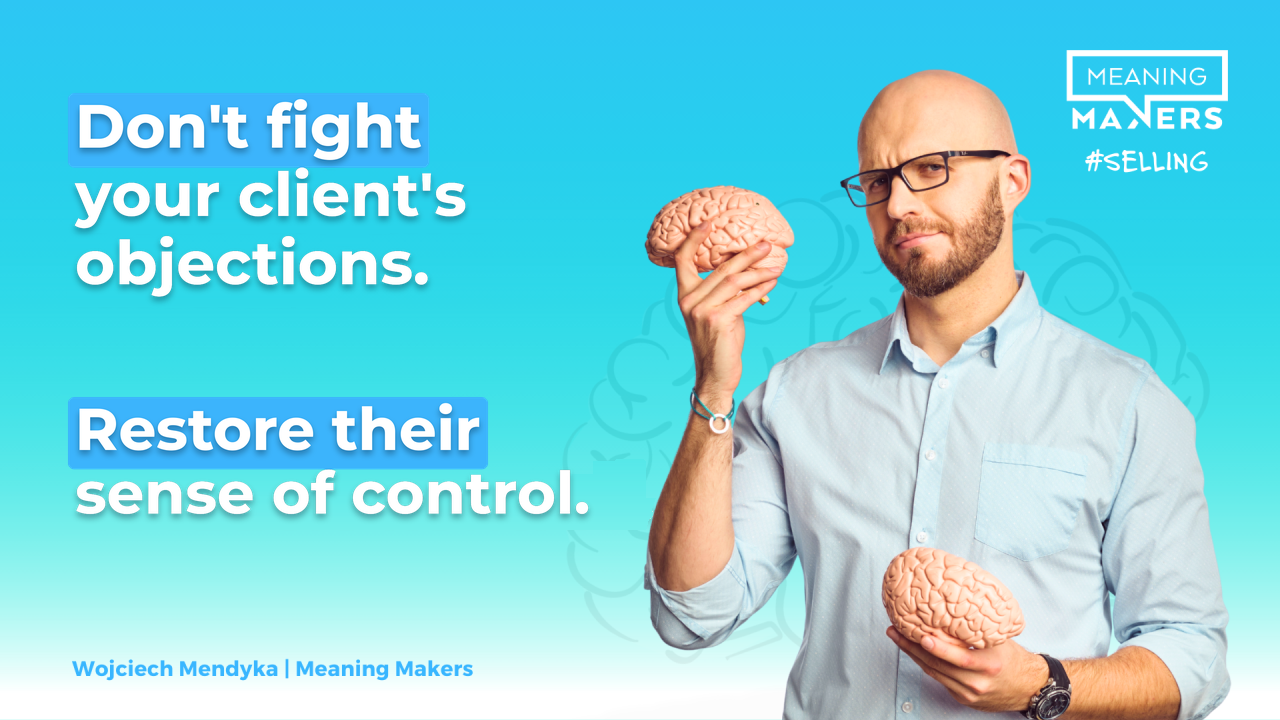
When a plane hits turbulence - what are you thinking about? You're probably not pondering aerodynamics. You just feel that the flight has stopped being predictable. And at that moment, most people do one thing: they look for any sense of control - most often the armrest or the back of the seat in front of them (that's me!)
An objection in sales is the same mechanism. It's a brain's reflex when a decision starts to seem risky and someone tries to regain control over it.
But of course, everyone has heard the phrase: 'An objection is a buying signal.' And let's be honest - that phrase is a bit tired by now... Objections are probably the most overworked topic in sales. Everyone's had the training. Everyone knows the techniques.
But what's next, when everything is decided in seconds anyway? What good is your trained response if you don't understand what's really happening in the client's head at that moment?
Because an objection is neither good nor bad. It's not proof that the client wants to buy. Nor is it proof that they don't. It's a signal that uncertainty has just appeared in their mind.
And now, the key question isn't: how do I win it? It is: how do I make sure the conversation keeps flying.
Of course, you weren't born yesterday, and you know that defusing an objection doesn't guarantee a sale. But it's a bit like how calming turbulence doesn't guarantee a perfect landing. However, both allow you to continue the flight. To stay the course. Not to stop the process midway.
Most salespeople treat an objection as an obstacle to be knocked down. Like a wall that must be jumped over. Meanwhile, an objection is very rarely a problem in itself. Much more often, it is a CONSEQUENCE of what happened earlier in the conversation.
And perhaps the most important question is not 'how to defuse it?' but 'what to do to make it appear less often?'. And when it does appear – how to make sure the flight continues.

Where Objections Are Really Born
An objection doesn't appear out of nowhere. It usually arises at one of three moments.
First, when the conversation moves to the product too quickly. Why does this generate resistance? Because a product is a concrete proposal for an exchange. And every exchange involves a cost. The client hears about the solution, features, scope, and price, and their brain immediately starts calculating: how much will this cost me in money, time, energy, reputation? If they don't yet have a clear picture of the problem and its consequences, the product seems like something 'added on' to the organization. And anything added on without a clear justification triggers a defensive response.
Second, when we circle around abstract 'value' for too long without showing a real change in operations. We wrote about this in previous newsletter issues. Every purchasing decision involves the loss of resources. Most often money, but also time, attention, and political capital. Value, on the other hand, can be abstract: 'Greater efficiency,' 'better communication,' 'process optimization.' The brain can't visualize this. And when it can't grasp something, it starts to get irritated. Just like when someone tries to explain something to you, and you don't understand, and the tension grows. In sales, this tension often takes the form of an objection.
Third, when the client doesn't see the consequences of the decision – neither its cost, nor its effects, nor the risk of inaction. This is a classic balancing act between gain and loss. We often focus obsessively on potential benefits. Meanwhile, research on loss aversion shows that people react more strongly to the possibility of avoiding a loss than to the possibility of achieving a gain. If you don't show what the organization is actually losing by sticking with the status quo, the decision will be postponed. And postponing a decision often takes the form of an objection.
When the client doesn't see a clear difference, can't imagine the change, or doesn't understand what will happen after the decision is made, their brain does something very natural. It hits the brakes. An objection is often that brake.
Why There Are More Objections Today Than Before
From my personal observations, decision-making power in organizations is increasingly weakened. I see it tangibly. Simply put - it used to be easier.
First, decisions are less and less often made by a single person. 10 years ago, I was already citing Gartner data in my training sessions - a minimum of 6-7 decision-makers in B2B deals. Today, decision-making committees are even larger, more dispersed, and often international.
The larger the committee, the greater the consensus required. And the greater the consensus, the harder it is to make a decision and the greater the risk of being judged by other team members.
Second, more and more junior managers are entering decision-making processes (ok, boomer - I know). They are often very competent, but they have less experience in making risky decisions. Naturally, they need more security. I see this in conversations with clients, and other salespeople confirm it. Today, it's much harder to 'push through' a decision than it was 20 years ago, when one person with a clear mandate often made the call.
In such conditions, each person on the committee may have different objections. One will worry about the budget. Another about technological risk. A third about reputation. The objection becomes a mechanism by which each committee member can secure their position.
The Objection as a Defense Mechanism
A purchasing decision in B2B is not like buying Pokémon cards on Allegro (this example might have something to do with my kids' latest hobby…). B2B has consequences. The risk of losing control, political risk, or the risk that the project won't succeed. The risk that someone will ask, 'who chose this?'. The brain doesn't like situations it can't predict. If it doesn't have a clear picture of the future, it activates a defense mechanism. That mechanism is the objection.
There's nothing strange about that, is there? The client simply wants to protect themselves. Just like you do when you buy something.
Sometimes logically, sometimes emotionally, sometimes under the guise of procedure. But in the background, there's always one question: is this a safe decision?
Turbulence over Madrid
I was returning from Madrid last week from a workshop that was part of a Sales Kick Off for a large international company. The approach for landing was quite nervous... The turbulence was noticeable, the plane was rocking slightly. And what happened then? You just had to look around. A large portion of the passengers automatically grabbed the seat backs… or at least squeezed their armrests tighter!
Does this really change anything? No. But emotionally, it changes a lot. The grip provides a momentary sense of control. A feeling that 'I'm doing something.' That I'm not completely at the mercy of the situation.
And that is exactly how many objections in sales work.
When a client says 'we need to think this over,' 'this looks risky,' 'this is a big project,' it's often not about analysis. It's about grabbing on. It's an attempt to regain control over a situation that seems unpredictable.
You see, if someone is afraid of flying, you're unlikely to convince them with statistics (you probably know that you're more likely to die on the road than in the air).
This fear is not about probability. It's about a lack of control. In sales, we very often try to defuse emotional objections with rational arguments. And that rarely works - in fact, it can have the opposite effect.
Three Types of Objections – Three Different Needs in the Client's Mind
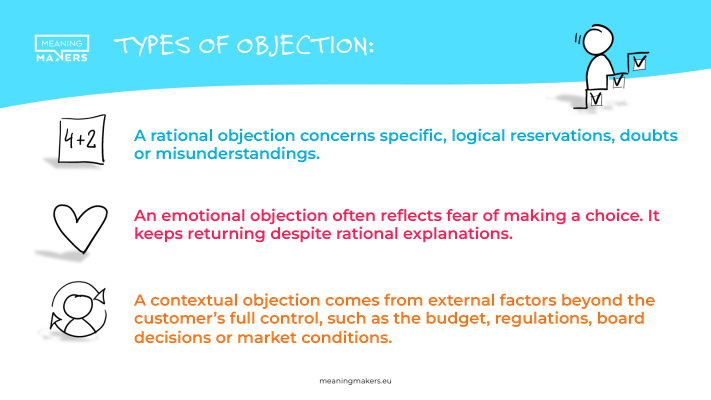
In practice, most objections fall into three categories. And this distinction is crucial because each stems from a different cognitive tension and requires a completely different approach.
1. Rational Objections – The Need for Clarity
Logic is at play here. Rational objections concern specifics. Numbers, scope, schedule, price structure, responsibility, technical parameters. Here, the client is genuinely trying to understand how the solution works and whether it is logically justified.
If a client asks:
- 'What exactly does this price consist of?'
- 'What does the implementation include?'
- 'How long will the implementation take?'
their brain isn't defending against the decision. It's trying to organize it.
This is the moment when the cognitive system wants to reduce ambiguity. A lack of clarity is a burden. Until it is removed, the decision won't move forward.
Good news! If you explain the price structure, show the component costs, the logic of the margin, the scope of work, and you hear 'okay, that makes sense,' you have just defused a real problem. Such an objection disappears after being answered, because its source was a lack of information, not fear.
The key feature of a rational objection: after a logical answer, the tension decreases. If it doesn't, it wasn't a rational objection.
2. Emotional Objections – The Need for Security
Emotional objections sound rational, but they have one very clear characteristic - they return despite explanations. The client says 'you're too expensive,' you show market benchmarks, ROI, comparisons... and they're still on about the price (just another day in sales).
Or they say 'this is a risky project,' you show case studies, references, implementation data, and they still look unconvinced.
Here, the problem isn't a lack of information. The problem is a lack of a sense of security.
The emotional brain doesn't respond to a chart. It responds to predictability and control. If a decision seems irreversible, public, political, or potentially compromising, the objection becomes a protective shield.
Often, the price isn't the problem. The problem is the question: 'what if I'm wrong?'.
An emotional objection has one characteristic feature: it comes back. You can break it down logically, but it still returns in another form. This is a sign that you're trying to treat fear with logic - that's not going to work.
In such moments, the question is not 'how to justify this?' but 'how to restore the client's sense of control?'
3. Contextual Objections – The Need for Navigation
Contextual objections concern the system, not the person. You might recognize them as a so-called 'smokescreen' - in other words, excuses. But that's not always the case.
'We don't have the budget,' 'IT has to approve this,' 'The board makes the decision,' 'The procedure takes three months.' This is often not about convincing your contact, but about the fact that they operate within a specific structure.
How many times have I been in a situation where my contact was willing, but something was clearly standing in the way? I can't even count…
This is a very common moment when a salesperson thinks: 'this is the end.' But it doesn't have to be the end. It's a signal that the decision is embedded in a network of dependencies.
A contextual objection requires navigation, not persuasion. Sometimes this means splitting the payment. Sometimes it means shifting the billing model. Sometimes it means jointly preparing the arguments for the committee. Sometimes it means changing the scope of the pilot to fit within decision-making limits.
Here, one thing is key: help the client navigate their system.
Because very often 'we don't have the budget' means 'I don't know how to get this through the structure.'
Radar for Uncertainty
People sense uncertainty very quickly. In sales, the client has to part with their resources. It's natural that a need to defend them arises. If a salesperson reacts to an objection with tension, defensiveness, or excessive talking, the client's brain perceives this as a warning signal.
And here a question arises that fascinates me. How is it possible that a salesperson in one industry encounters the same five recurring objections throughout their career, and yet is still unprepared for them?
At Meaning Makers, we run an objections lab. We collect real cases, classify them, practice responses, and tailor them to the type of objection. In a single industry, you can often use similar response structures.
Confidence comes from preparation.
Four Things You Can Do
Objections won't disappear. That's not the point. The point is to understand when and why they appear - and what is really happening in the client's head at that moment. If you look at them this way, they stop being a battle of arguments and start being information about the state of the decision.
1. Design the conversation to prevent objections
Most objections are born earlier than you think. Not at the moment the client voices them, but when something in the conversation remains unclear, too big, too fast, or too abstract. The brain doesn't like blank spots. If it can't see what the next step will look like, it hits the brakes.
Designing the conversation means thinking about these moments in advance. Instead of waiting for the client to ask, 'and what will this actually look like?', you show them beforehand. Instead of waiting for 'this seems complicated,' you preempt that fear by organizing the process.
An example? In a conversation about implementing a new system, many salespeople focus on features. Meanwhile, in their head, the client sees chaos: training, data migration, team resistance. If you immediately show what the first week after the decision looks like and what realistically won't change, the tension decreases. The objection that might have been voiced at the end simply doesn't appear.
2. Diagnose the type of objection before you respond
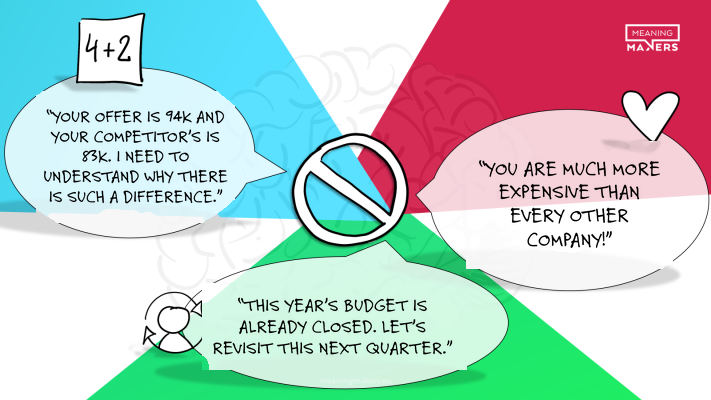
Not every objection means the same thing. The same sentence can have different sources. 'It's too expensive' can be a question about the price structure, an expression of uncertainty about the results, or a signal that your contact doesn't know how to defend this decision to the board.
If you react automatically, you might be responding to the wrong problem. You logically explain the price, but the client keeps coming back to the topic. This is often a sign that it's not about the numbers, but about security.
In one conversation, a client returned three times to the statement that the project was a 'big risk.' Each time, he was given data and market examples. Only when the conversation shifted to who would formally own the project and how to secure the initial stages did the tension drop. The problem wasn't the analysis. The problem was the feeling of personal responsibility.
3. Respond to emotional objections with control, not a chart
Emotional objections are the trickiest because they sound rational. The client talks about budget, risk, resources. You respond with a table, a benchmark, a case study. And they are still not 'defused.'
This is the moment to return to the turbulence metaphor. Grabbing the seat doesn't change the flight path, but it gives a momentary sense of influence. Similarly in sales – the client needs to feel that the decision is under their control, not that they are entering something from which there is no turning back.
In practice, changing the tone of the conversation from 'this works in 97% of cases' to 'we'll start with a small phase and after six weeks, we'll decide together whether to proceed' can do more than another chart. Control reduces fear faster than an argument.
4. End your response with an action, not an explanation
An explanation leaves the client with a concept. An action leaves them with a picture. And we make decisions faster when we can see ourselves in a specific situation after the change (we wrote about that here).
If you say 'this will increase efficiency,' you leave room for interpretation. If you say 'starting next month, the team leader will stop manually collecting data on Friday evenings,' you create a scene. That scene reduces uncertainty.
In one conversation about sales training, a client kept coming back to the question: 'what will really change after the workshop?'. Only when the conversation turned to how a salesperson would start opening a meeting differently in the first week and at what point they would stop presenting slides, did the conversation become concrete. The offer didn't change. The picture did.
And turbulence again...
In an airplane, the grip/handrail doesn't change the physics of the flight. It doesn't affect the wings or the landing path. It only changes one thing – the passenger's internal state. It gives them the feeling that in a situation of uncertainty, they have at least minimal influence.
In sales, an objection works similarly. It doesn't change the facts of the offer. It doesn't change the scope of the project or the price. It changes the client's internal state. It's the moment when their security system says: stop. And this is key. An objection is an attempt to regain control.
But you can also see it as a signal that uncertainty has appeared in the conversation, which someone doesn't want to leave unanswered.
Today, this uncertainty is greater than it used to be. Decisions in organizations are dispersed. They are rarely made by one person. Often, it's a committee. The more people, the more points of view and more potential concerns. In such a reality, an objection is often not an opposition to the solution, but a way of securing one's own position.
That's why sales is largely about managing uncertainty. If you leave too many blank spots in the conversation, if you react nervously, if you end with theory instead of specifics, uncertainty grows. And when uncertainty grows, the brain chooses… a PAUSE.
If, on the other hand, you show the next step, organize the risk, restore control, and end with a picture of action, the tension decreases. The objection doesn't magically disappear, but it ceases to be a blocker.
Behind most objections lies one simple question: is this a safe decision?
If you can answer it with the structure of your conversation, and not just with an argument, you're not fighting the turbulence. You're helping someone get through it.
And now for the most important part…
The next time you hear an objection, ask yourself one question: am I trying to win an argument, or restore the client's sense of control?
Because the answer to that question determines whether the conversation will fly on.