

Have you ever left a meeting feeling like everything was settled—only to find out a few hours later that each side understood something different? Or sent an email that in your head was neutral and to the point, but on the other end sparked tension, speculation, or defensiveness?
If so, the problem probably wasn't in the words. And not in the intentions.
For a long time, I myself thought that communication breaks down because someone said something wrong, didn't specify enough, or failed to choose the right tone. Only over time did it dawn on me that this is an oversimplification.
You see, it's like in comic books...
I've been reading comics since I was six years old. It's my dirty little hobby that has never left me—I have my own collection, I revisit old series, I catch up on new ones. For me, comics have always been more than just entertainment. They were a way of telling stories.
Scott McCloud, writing about comics in Understanding Comics, put it in one sentence: magic happens between panels—meaning magic happens between the panels/pictures.
Not in the frames themselves. Not in the drawings. Only in what happens between them.
It's the reader who fills in the movement, meaning, and emotion. That's where the story is created.
And the longer I work with communication, the more clearly I see that the exact same thing happens in conversations.
Because the most interesting—and most difficult—things in communication very often happen in between.
Communication Like Kung Fu, Not Like an Instruction Manual
Bruce Lee used the metaphor of water when talking about Kung Fu, the art of combat. Not about poetry. Not about philosophy. About the very practical skill of survival in a real fight.
(Comics, Bruce Lee—you already know this article is going to be interesting if you love pop culture)

You see, water is not rigid. It adapts to the situation. It reacts to what is happening here and now. And that's precisely why it works.
It's similar with communication. It's not about what you say, but about whether a flow between people actually occurred. Whether meaning has passed from one mind to another.
And this is where the biggest paradox of communication appears.
Very often, we think it has occurred.
Words were spoken. The email was sent. The meeting took place. Someone nodded. From a formal point of view, everything checks out. And yet, a moment later, it turns out that something was misunderstood, something didn't resonate, or the meaning of the conversation was lost somewhere along the way.
Autopilot and the Cost We Don't See
In the previous article from the #communication series in this newsletter, I wrote about autopilot, System 1, and System 2. About how we react much more often than we respond. But what are the costs of this automatism? You'll find out in this issue.
The first real cost of mental automatism is not an emotional reaction. It's a disrupted communication cycle. Because communication isn't a single act of speaking. It's a process that happens between people.
And here it's worth asking one question: if communication isn't working, at what point in the process is it derailing?
A Simple Model That Organizes the Chaos
In its simplest form, communication consists of four steps: You think → You speak → They think → They speak.
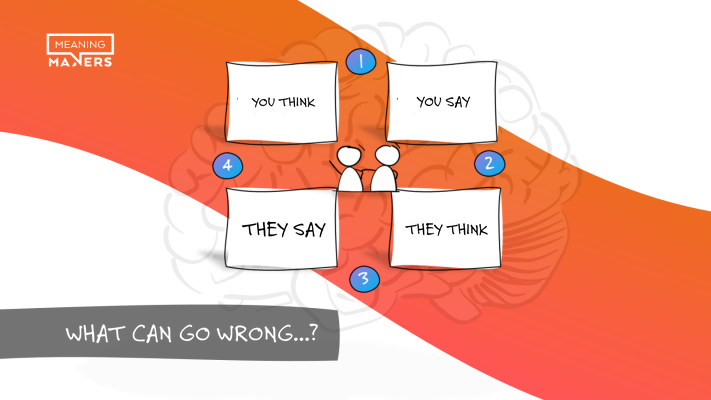
This way of thinking is not new. It is based on classic models of communication (sender–receiver–feedback), developed, among others, by Roman Jakobson and Claude Shannon. It's not perfect, but it has one huge advantage.
It shows that most problems don't appear at the points themselves, but between them.
Let's look at these transitions one by one.
Transition 1: YOU THINK → YOU SPEAK
(i.e., what breaks down before the conversation even begins)
The first crack in communication very often appears before the first sentence is even spoken. Between what we have in our heads and what we actually say.
The brain does three things at once here. First, it shortens thoughts. When we understand something, we stop seeing the path to that understanding and communicate only the conclusion, assuming the rest 'is obvious.' Second, we start to 'overthink' (pardon my English)—instead of a conversation, we have a simulation of it in our heads. We process, correct, and postpone. Third, the illusion of transparency appears—the belief that others see our intentions as clearly as we do.
I know this very well. I could carry a conversation in my head for weeks, postponing it from day to day. A classic case—a difficult topic from Friday gets pushed to Monday, and the entire weekend is spent thinking 'how to say it.' And it almost always turned out that the biggest problem wasn't the content of the conversation, but that the flow hadn't started at all earlier.
Have you ever had a similar experience? I'm sure you have.
Transition 2: YOU SPEAK → THEY THINK
(i.e., why the intention rarely gets through completely)
The second transition is the moment when the message leaves you and reaches the other person. And this is where their own interpretation begins.
Before someone starts analyzing the words, the brain reacts to non-verbal cues—tone, pace, tension. Then there's the medium. Email or an instant messenger cuts out emotion and context, and the recipient's brain automatically fills in the missing elements. Most often, defensively. The third filter is attention—if someone is tired or distracted, the message simply has nowhere to 'land'.
For years, I wrote long, very precise emails that were supposed to explain everything. And I often received similar ones in reply. The effect? Half a day of reading, half a day of interpreting, and a completely different understanding on both sides. The intention was good, but the flow was distorted along the way. Only my employer at the time knows how much time I wasted on this—although, come to think of it... they probably don't.
And how much time have you wasted on it?
Transition 3: THEY THINK → THEY SPEAK
(i.e., why we don't give people space to respond)
Another place where communication loses quality is the moment when the other person tries to formulate a response.
The tension of silence appears. Silence after a question is uncomfortable for the brain, so we want to fill it as quickly as possible. This leads to interrupting and finishing their sentences. Added to this are assumptions instead of curiosity—we start guessing what someone is about to say and carry the conversation forward ourselves.
This is perfectly visible in sales. A salesperson asks a good question, but in the same moment, stops listening to the answer. The client is speaking, and the other party is already formulating the next question or a counter-argument in their head. The conversation continues, but the flow stops halfway.
Do you know that feeling when you sense someone isn't really listening to you? Can anything destroy trust more effectively?
Transition 4: THEY SPEAK → YOU THINK
(i.e., how a single assumption can set the tone for the entire conversation)
The final transition is the moment when the words come back to us, and we begin to interpret them. And very often, this is where communication gets stuck in a loop.
Because instead of truly listening, our thinking process starts all over again.
We grab the first interpretation and treat it as fact. We start formulating the next question or response in our heads, instead of taking in the entirety of what the other person is saying. Formally, we are listening; cognitively, we are already a step ahead.
On top of all this comes confirmation bias. Once we assign specific intentions to someone, our brain starts looking mainly for confirmations of them. Neutral behaviors start to look suspicious, and we interpret a lack of information to their disadvantage.
I once had a collaboration that got off to a bad start. The initial tension caused me to quickly assign bad intentions to the other party. And from that moment on, I saw mainly confirmations of this narrative in their actions. Looking back, I see how much this affected the entire relationship.
The flow didn't stop because of the words, but because of an assumption that I didn't verify.
Why This Communication Is So Difficult...
Because the brain wasn't designed for good communication. It was designed to maintain balance.
Homeostasis is simply the drive to keep things 'relatively stable.' The brain constantly monitors energy levels, tension, and emotions. When something disrupts this balance, it treats it as a problem to be solved immediately.
And a conversation is very often precisely such a disruption.
A difficult conversation, silence after a question, no reply to an email—all of these increase tension. And tension has a cost. That's why the brain looks for the quickest way to regain a sense of control, even if it means simplifying reality.
This is where emotional economics comes in. The brain chooses the interpretation that is the most energetically cheap and the most predictable. Hence the mental shortcuts, assumptions, and closing the story in our heads without checking the facts.
Someone doesn't reply to a message, and a narrative immediately appears in our heads: 'they're ignoring me,' 'they disagree,' 'there's a problem.' Not because it's true. But because uncertainty is more expensive for the brain than even a bad answer.
And here we return to Kung Fu. Kung Fu doesn't mean talent or cleverness. It means doing difficult things against impulse, for a long time. It means remaining in discomfort long enough for the situation to clarify itself.
This is exactly what good communication requires. Not a quick reaction, but the ability to withstand a moment of tension.
And that's precisely why it's so difficult.
What Really Helps to Unblock Communication
If communication breaks down in the transitions, that's where you need to take action. Not at the level of 'prettier sentences,' but at the level of how the brain moves from one stage to the next.
In comics, you don't improve the story by drawing prettier panels. What's key is whether the reader can connect one panel to the next. Whether they have enough information, space, and time to fill in the meaning in between.
It works identically in a conversation.
If you want to unblock communication, don't focus on what else to say. Focus on whether the other person has the conditions to move on in the cycle—from thinking to speaking, from hearing to understanding.
Below are four things that make a real difference.
1. Slow down the transition, not the content
Most people try to save communication by saying more or being more precise. That rarely works. It is much more effective to slow down the moment of transition between thinking and speaking or between listening and responding.
In practice, this means a micro-pause. One or two seconds of silence before you answer. Not to think of something, but to give System 2 a chance to speak up.
A real-life example: Someone asks a difficult question in a meeting. Instead of answering right away, you say, 'Give me a moment, I want to organize my thoughts.' This single pause often changes the tone of the entire conversation. You are perceived as calmer, more reflective, and less reactive.
2. Treat silence as a tool, not a problem
Silence in a conversation is not a mistake. It is cognitive space. The problem is that most of us try to fill it immediately because the brain interprets it as tension.
If you want to improve the quality of communication, learn to endure the silence. Especially after a question. That's when the other person is really thinking, not reacting.
A real-life example: During a conversation with an employee or client, you ask a question and... say nothing more. Even if a few seconds of silence fall. Very often, after those few seconds, you'll hear an answer you wouldn't have heard before, because you would have talked over it yourself.
3. Turn assumptions into curiosity
One of the biggest saboteurs of communication is assumptions. 'He's definitely thinking...', 'She probably wants to say...'. Assumptions shorten the conversation, but at the cost of understanding.
Curiosity does the opposite. It slows down the conversation but deepens the meaning. And importantly—it automatically reduces tension, because a brain in curiosity mode is not in defense mode.
A real-life example: Instead of countering a difficult comment in a meeting, you say, 'Could you please tell me what you mean by that?' or 'I'd like to better understand where this is coming from.' The conversation changes from a ping-pong of reactions to a dialogue.
4. Manage energy, not just words
Communication doesn't happen in a vacuum. If you are tired, hungry, or under pressure, your System 2 has a much lower chance of participating in the conversation. That's when even the best techniques don't work.
That's why one of the most underrated elements of good communication is consciously managing your energy. Sometimes the best communication decision is not to have the conversation right here, right now.
A real-life example: You know you have a difficult conversation ahead of you. Instead of squeezing it in between meetings, you schedule it for a time when you have the space and resources. Or you say it outright: 'I'd rather come back to this tomorrow when I can be more present.' This isn't weakness. It's communicative maturity.
In conclusion
When I look back at those situations today—the overthinking, postponing emails, replying in the middle of someone talking, the lack of silence—I see one common mechanism. These were not problems with words. They were moments when I interrupted the flow because I was trying to resolve the tension more quickly.
Formally, communication took place. Words were spoken. The meeting ended. The email was sent. And yet the meaning of the conversation vanished somewhere along the way.

In a comic book, the story doesn't just happen in the panels. It happens between them. If the reader doesn't have the space to connect one panel to the next, the narrative falls apart—even if the drawings themselves are great.
It's exactly the same with communication.
It doesn't break down because someone chose the wrong words. It breaks down when we don't leave space in between—for silence, for reaction, for clarification, for correction.
That's why good communication doesn't have to be perfect. It has to be possible.
If something went off track, don't just ask: 'what did I say wrong?' Ask: 'at what point did I interrupt the flow?'
And now it's your turn.
When was the last time you felt that communication 'theoretically' took place, but practically didn't work? Where—in your opinion—was the space in between missing?