
Einstein said that doing the same thing over and over again and expecting different results is insanity. What did he clearly not predict? That in the 21st century, everyone would be doing the exact same thing—and getting the exact same result.
What's today's topic? You guessed it. AI.
AI gave us speed, but it flattened the way we talk about sales today. Conversations are sounding more and more alike. The same arguments, the same questions, the same language about 'customer needs.' Of course, AI didn't break sales. In a way, it just accelerated what was already happening anyway.
For years, most customer conversations have started with what's on offer—the product, the proposal, the features. I've been hearing about value selling for 15 years—and for 15 years, it's been the same uphill battle against human nature. AI simply multiplied this template by the thousands. As a result, more and more conversations sound alike.
Value ≠ Information
We've been talking about selling value for 25 years. And yet, most sales conversations still sound like a catalog. Features, parameters, PDFs, discounts. In this flood of information, the client only feels fatigue.
Research from SiriusDecisions shows that decision-makers are four times (4x!) more likely to talk to a salesperson who brings a new perspective, not just another batch of product data. It is precisely this ability that is becoming a real advantage today. Because AI can speak correctly, but only a human can say something that changes the way people think.
A Delay That Worked Out for the Best
I was recently reminded of a project from over ten years ago. A company reached out to me with an inquiry, but I replied too late—I was traveling at the time (I've had a few such slip-ups in my career—nobody's perfect!). When I got back and called them, the matter was already closed. They had chosen someone else. A cheaper option, I know (that's no surprise). The decision had been made—at least officially.
Still, I decided to give it another shot. I didn't call the CEO, but a person one level below who had influence on the decision. I didn't try to persuade them—I simply asked for a short meeting. I got it. That meeting opened the door to the next level up—to the CEO himself.
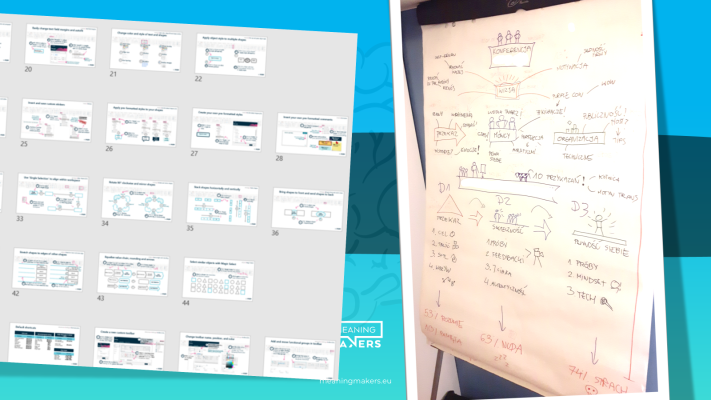
I knew that if I wanted to stand out, I couldn't go in there with slides. I just made sure there was a flip chart in the room. I didn't bring a presentation. I brought four markers.
I prepared for the first meeting for several hours. For the meeting with the CEO—several days (no exaggeration, my room looked like a detective's office with a wall of photos, pins, and printouts). I knew I only had one shot.
I wasn't selling the CEO a solution. I helped him (quite effectively, I think) see his problem in a new light. He sort of knew what he wanted—but he saw it differently. More completely. I drew out the situations they themselves had described. I connected facts they had previously treated as separate. It wasn't a presentation—it was a conversation that ended with a shared vision on a flip chart. I still have a photo of that flip chart page to this day.
At the end, I was told that the decision had already been made anyway, and the competitor was cheaper. A few days later, they called back. They had changed their minds (boom!)
Not because my product was fundamentally all that different (okay, let's be honest—of course it was better). But mainly because the conversation was different. It allowed them to look at everything from another angle. That was enough to trigger a change of decision.
Buying vision: a sale that creates direction
Studies from Sales Benchmark Index show that 90% of won deals come from vendors who were in the initial consideration set. If you're not in that top three, you practically have no chance.
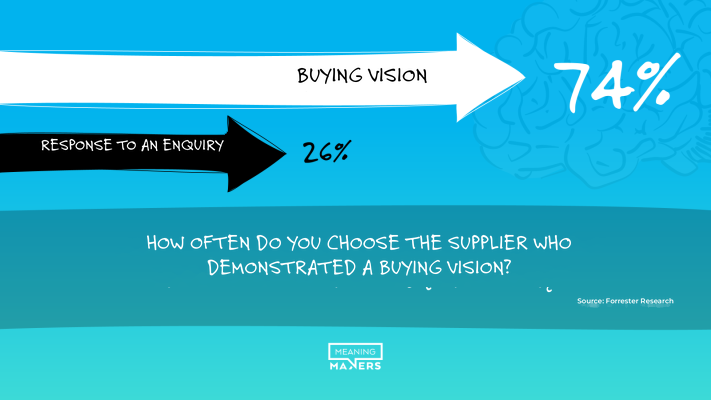
Salespeople respond to inquiries instead of creating conversations that change the client's way of thinking. And this is where the so-called buying vision comes into play. A study by Forrester Research showed that 76% of B2B decision-makers choose the salesperson who was able to build a so-called buying vision—that is, showed them a new way of understanding their situation.
Not the one who best answered the questions. Not the one who had the lower price. The one who helped them understand how to think about the problem differently.
This is exactly what happened back then—on the flip chart with that CEO. I didn't have a product that was so different from the competition. But I had a conversation that gave them a new perspective. As a result, that project opened the door to something more. It was right after that project that I founded Meaning Makers.
Looking back today, I think that was the moment I entered my own Momentum Loop—exactly the one I wrote about last week.
Tool ≠ Conversation
Fast forward to 2025. Two situations. Google and Mr. Tomek.
I spent most of February and March on planes—five countries, seven workshops for the sales departments of a certain giant that is currently battling OpenAI for a piece of the AI market.
Paradoxically, even though there was no escaping the conversation about AI in sales in any of these places (the sponsors were even pushing for it)—the focus of the discussion was not the tool, but the message.
How to build a story that people will remember. How to talk about data so that it sounds meaningful, not like a slide. How to make technology help, but not speak for you.
This experience only confirmed that AI will not replace conversation. It can speed up preparation, help with analysis, suggest ideas—but it cannot build trust. It can't evoke emotions, change its tone of voice, or adapt to the moment when the other person is truly listening.

Steve Jobs understood this better than most of us. Although he created one of the world's most influential tools, he limited his children's access to iPhones and iPads. In an interview with The New York Times, he said it plainly: 'We don't use them at home.' Not because he didn't trust the technology. But because he knew how easily it could take control of the conversation.
AI can talk, but it can't... well, do something more. And that's precisely why the biggest winners will be those who use it not to say more—but to speak smarter.
Why This Still Wins
From the domestic front—last week I spoke with Mr. Tomasz, a sales leader at an industrial company. I practically did a repeat of the first Meaning Makers project, only this time on a whiteboard—virtually.
He later said simply: 'Strategy means nothing if people can't tell its story.' He also said that he absolutely buys what I presented to him.
The best plans, products, and offers won't change a thing if the sales department can't show value in a conversation. Not in a proposal. Not in an email. In a conversation.
I prepared for that project for several days. The meeting with Mr. Tomasz—a dozen or so minutes. I think the result will be similar, though the talks are still ongoing.
And that is precisely the difference between then and now: technology allows you to prepare faster, but it's still the conversation that decides if something will work.
This is why at Meaning Makers, we teach that you don't sell with a product. You sell with a conversation. A conversation that gives the client a new perspective. A conversation that gives them confidence that the decision they are making makes sense.
AI in Sales: Four Things to Remember
AI is not the enemy of sales. It's a tool that can empower the best—provided you don't let it take over the conversation. It's worth remembering four simple things:
- Preparation isn't enough. AI shortens research from hours to minutes. But data doesn't sell itself. What you do with it in the conversation is still up to you. So learn to lead that conversation—with your own mouth.
- Personalization isn't understanding. AI can help tailor the words, but not the tone of the conversation. The client can feel when you're talking to them—and when you truly understand them. Or when you're just running a macro.
- Data isn't reflection. Analyses, notes, and summaries are just material. It's just knowledge. Without a moment of thought, they're worthless. Less is always more. What will you choose from the flood of information that AI has generated for you?
- AI will teach you how to talk, not how to listen. Most models teach you how to formulate sentences... But in sales, the most important things happen between them.
Don't Scale Mediocrity
AI is a huge opportunity. But only for those who know what they want to do with it. Because if you don't have a strategy, AI will replicate chaos. And if you don't have a conversation that brings value—it will replicate emptiness.
As Toby Newman said: 'AI allows humans the time to truly comprehend what brings value to their lives.' AI doesn't take the conversation away—it makes space to finally reflect on it.
So don't scale mediocrity. Scale conversations that clients will remember. Because in a world where everyone sounds the same, the real difference still starts with an equation—perhaps a little less complicated than Einstein's:
human + human (+ AI) = new perspective.