
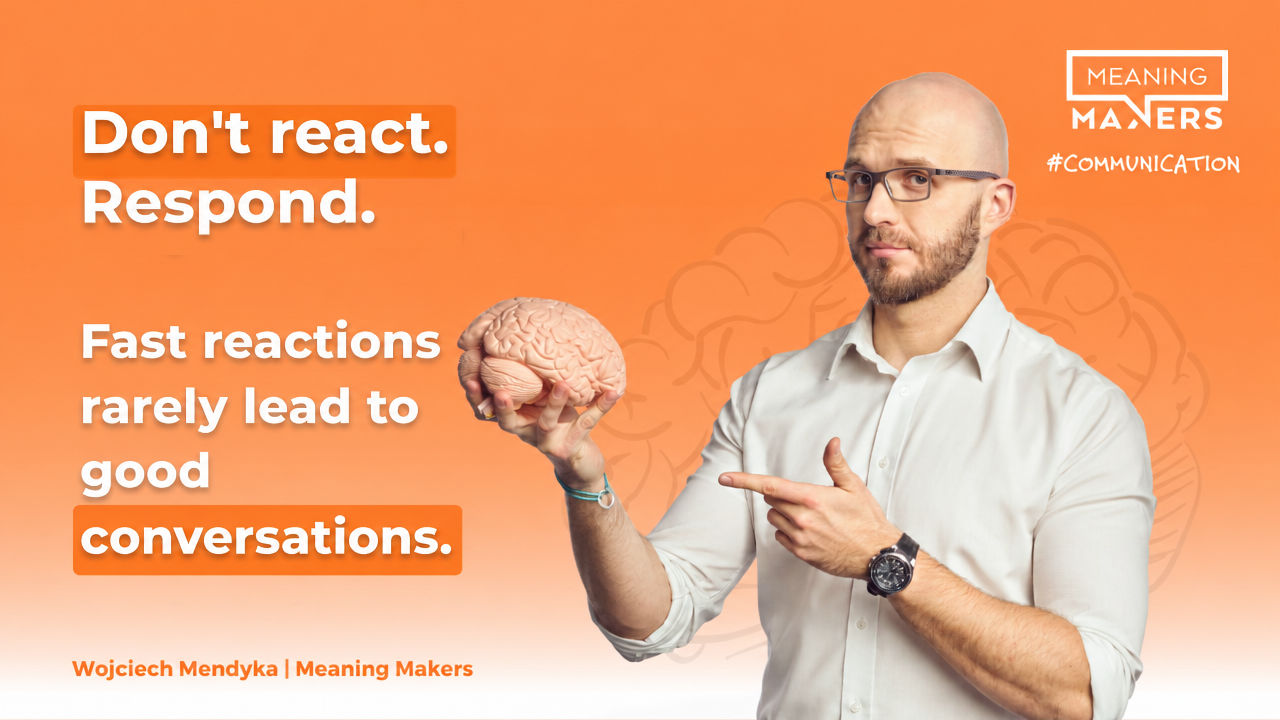
You know that feeling when the words are out of your mouth before you've had a chance to think? A second later you'd love to take them back, but it's too late. You didn't plan that reaction - it just happened. Your brain got there before you did.
I know it from my own experience. A few times in my life I've reacted too fast, and only later realised how much a moment on autopilot can cost. I'll tell you about some of those moments further down - the times when my own brain got there before I did.
The autopilot that runs the conversation
A lot of communication runs on autopilot. We answer instantly, finish other people's sentences and assume we know what they "really" meant. It can look like intelligence and confidence, but very often it's just habit. Brilliant from an evolutionary point of view, but in a conversation it can trip you up.
The brain is built to save energy. Anything we repeat becomes automatic. You don't think about how to brush your teeth, fasten your seatbelt or switch on the coffee machine. You just do it, without any conscious effort, which frees up your energy for other things. The trouble starts when the same "energy-saving" mode takes over the conversation.
The brain that guesses
The brain's job isn't to analyse. It's to predict. It scans what's around it and tries to guess what happens next. That's the mechanism that kept us alive for thousands of years. Back then, we were already running before the tiger showed up (assuming we'd spotted it, of course). In the 21st century, the same mechanism gives us misreadings and knee-jerk reactions. The brain doesn't wait for the facts. A tone of voice, a single word, a look on someone's face - and the brain has already decided what it means.
When we run communication workshops at Meaning Makers, we show people this simple truth: the brain doesn't wait for the other person to finish. While they're still talking, it's guessing what it's about to hear. And it's often wrong.
System 1 and System 2 - a double act that works (and gets it wrong)
Daniel Kahneman called these two modes of thinking System 1 and System 2. System 1 is fast, intuitive and automatic. System 2 is slow, logical and reflective. I usually put it more simply: the lazy autopilot and the tired thinker. You'll probably recognise yourself in both, especially after a long day at work.
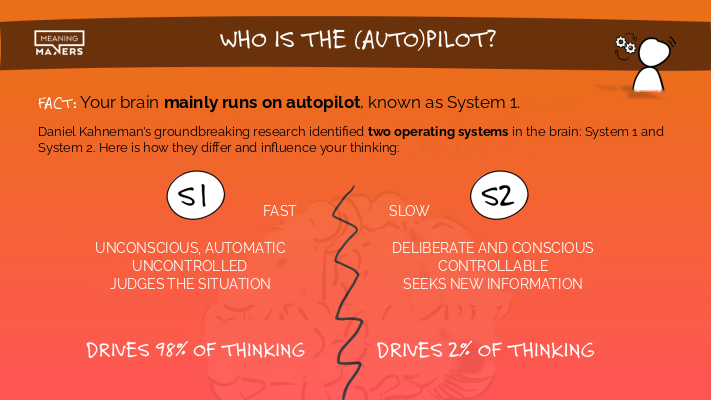
System 1 reacts in a split second. It's what catches the ball before you've even registered it's coming. It's what hits the brake before you've realised the car in front has stopped. It's what makes you finish someone's sentence before they've got to the last word. System 2 is slower, but smarter. It analyses, makes sense of things, weighs up the arguments. Unfortunately, it tires quickly. After a day of meetings, emails and decisions it's often running on empty. And that's when System 1 takes over again.
You look at someone and you just know they're "definitely having a go at you". Someone doesn't reply to your message and you're instantly annoyed. Or someone starts with "listen, but..." and you feel you have to defend yourself. That's all System 1.
98% on autopilot
Most people don't realise that around 98% of our thinking is automatic. Only 2% is conscious, reflective thought. These are estimates from research on cognitive processing (including John Bargh at Yale University, and Kahneman and Tversky), showing that most of our decisions, emotions and behaviour happen without us being aware of it.
Everything else just happens, outside our control. In other words, for most of the day you're being driven by a lazy but remarkably effective autopilot. And that's not a bad thing. As long as you know it's happening.
System 1 runs 98% of our thinking, System 2 just 2%. But although System 2 has the smaller share, it's the one that decides the quality of your communication. Because it's the one that can stop, think and ask a question instead of just reacting.
When the system overheats
You know the moment when, after a tough day, someone says one sentence and you completely overreact? That isn't bad manners, it's neurobiology. System 2 is worn out, so it stops analysing, and System 1 grabs the wheel. You answer in a tone you regret later. Then the next morning, after a good night's sleep, you think: "Why on earth did I say that?" Same person, different system in charge.
So it's worth remembering that communication isn't just an exchange of words. It's also about managing your energy. If you're tired, hungry or stressed, your System 2 is much less likely to show up for the conversation.
A story from my own life
More than once in my life I've reacted instead of responding. And I've almost always regretted it. I think a few of my relationships went through tension they didn't need, simply because I felt a sudden urge to react. At the time it felt as if I had to explain something, defend myself, get my own way. Now I know it wasn't really "me" - it was System 1 in survival mode.

It usually happened when I was simply worn out. Meaning Makers was growing, we had two small children at home, clients were calling non-stop and my calendar was bursting at the seams. Stress, pressure, not enough sleep - and one word was enough to set me off.
To the other person, my reactions often made no sense at all. Which only wound me up more - because I was feeling all the pressure and they weren't. Only looking back do I see that in many of those situations I could have reacted differently if I'd been in a different state - calmer, less tired, more present.
Today I know it wasn't bad intent, it was self-defence. System 1 was doing what it does best - reacting like an animal backed into a corner. And while I slipped up a few times because of it, there were many more times I managed to avoid it - precisely because I knew what was going on. The truth is, we all have a bit of that animal in us. Sometimes you manage to hold it back, sometimes you don't. But simply steering clear of situations where it can take over makes a huge difference.
How autopilot ruins communication
In Meaning Makers workshops, participants often get to see this list. We usually talk about which of these mistakes happen to us most often:
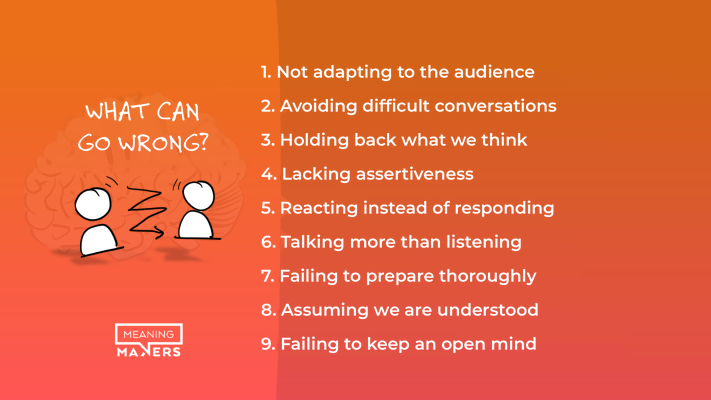
Not adapting your message to the audience. Avoiding difficult conversations. Holding back what we really think. Lack of assertiveness. Reacting instead of responding. Talking more than listening. Not preparing. Assuming you've been understood. Not keeping an open mind.
- Not adapting your message to the audience.
- Avoiding difficult conversations.
- Holding back what we really think.
- Lack of assertiveness.
- Reacting instead of responding.
- Talking more than listening.
- Not preparing.
- Assuming you've been understood.
- Not keeping an open mind.
(Which one happens to you most often?)
And this is where the conclusion always surprises people - they all come from the same place. It isn't a lack of skill. It's the autopilot at work.
You avoid a difficult conversation because System 1 says: "Not worth it, there'll be a row." You don't say what you think because the autopilot whispers: "Better not risk it." You go along with everyone else because quick agreement feels safe. System 1 loves peace and predictability, even when it's taking you in the wrong direction.
How to take back control from the autopilot
Before you can train your System 2, you have to notice what's going on. Awareness is the first step to control - you can't steer something you can't see. Only then can you get your voice back in the conversation before the autopilot speaks for you.
- Take a micro-pause. A second of silence isn't awkward - it's a safety buffer between System 1 and System 2. Harvard Business Review research ("The Power of a Pause", 2018) shows that leaders who pause briefly before answering come across as calmer and more rational. One second really does make a difference.
- Name the emotion before you respond. When you tell yourself "I'm angry" or "I'm hurt", you activate the prefrontal cortex - the part of the brain responsible for reflection. The emotion loses some of its grip and System 2 gets back in control. It works even in simple situations: instead of exploding, you can say, "I need a moment."
- Put off the decision. Not everything has to be sorted out right now. A bit of distance gives System 2 time to get back in the game. Sometimes a walk, stepping out of the room for a minute or sleeping on it is all it takes. It's a simple way to avoid a reaction you'll regret later. As I like to say - don't react in emotion mode, respond in energy mode.
- Practise curiosity instead of judgement. Instead of asking "Why did he do that?", ask "What might have been driving him?" Curiosity is the easiest way to switch off the autopilot. Because when the brain is asking, it isn't judging.
Autopilot isn't the enemy
Automatic behaviour is a gift. It's what lets you drive and hold a conversation at the same time. It's what lets you speak your native language without thinking about it. It's what lets you get things done smoothly and efficiently. But like any system, it needs supervision. System 1 is your lazy autopilot - brilliant, but impulsive. System 2 is your tired thinker - slow, but wise. The trick is learning to use one wisely to keep the other in check.
Sometimes I think of them as the engine and the driver. The engine can run on its own, but without a driver who thinks, it goes wherever is easiest - not necessarily where it's worth going.
Communication isn't just reacting
Most of our conversations aren't dialogues, just chains of reactions. One person's autopilot kicks in, the other answers with theirs, and you end up with emotional ping-pong. Only when you switch on System 2 do you start really listening. Communication doesn't happen when you speak. It happens when you understand what's really going on for the other person.
Try it today: for one day, notice how many times you react automatically. When someone cuts you off mid-sentence, when something gets on your nerves, when you say "sure, we'll do it" a bit too quickly. Then ask yourself: how many of those reactions were decisions, and how many were reflexes?
Because real change in communication doesn't start when you learn to speak better. It starts when you learn to stop.