

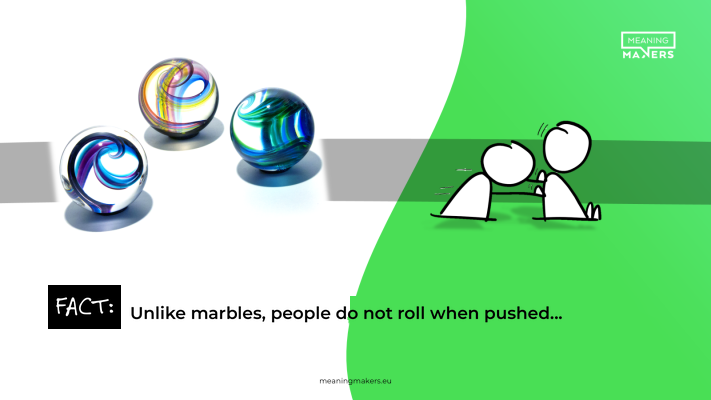
Do you know what marbles are? Those little glass balls you probably remember from your childhood. Small, shiny, often kept in a jar. And above all — they roll well.
What does this have to do with the approach to change? We’d like people to react to change just like those marbles — you give them a gentle push and they start rolling in the right direction. But it doesn’t work like that. Evolution has made sure it wouldn't be too easy. The result? People often roll in the opposite direction. Sometimes quickly, sometimes slowly, and sometimes they just stay where they are — in the status quo.
Imagine a Monday meeting. A slide reads: Transformation 3.0. Someone is finishing their coffee, someone else is replying on Teams. The leader says, “We’re starting another change.” There’s no visible enthusiasm. This isn't resistance to the idea. It’s fatigue. And fatigue is the quietest form of resistance.
Ewa, a manager at a large corporation, told me recently, “In our company, transformation is a daily reality. Change after change. People are tired before we even begin.” To be honest, for some time now I’ve been joking about this in training rooms myself: “So, any transformations going on at your place recently?” — and it always gets a laugh. The kind of laugh that’s tinged with tears.
It’s hardly surprising. According to Gartner, only 43% of people feel prepared to handle change, and their willingness to support transformation has dropped by 50% over the last seven years. Change has stopped being exciting. It has become just another chore.
Why we rebel
What we call “resistance to change” often has nothing to do with stubbornness or laziness. It’s reactance – an automatic brain response when we feel that someone is taking away our influence. The moment a message like “you must”, “you have to”, or “starting tomorrow, we are moving to a new model” appears, the brain activates the same system that responds to a threat.
Research by Jack Brehm, who first described the phenomenon of reactance in the 1960s, shows that the more pressure people feel, the greater their need to restore their autonomy. This isn't a rebellion against change, but a defence of one’s own agency.
From a neurobiological perspective, this works very predictably. When we feel that someone is limiting our choice, the amygdala – the fight-or-flight response centre – is activated. At this point, activity in the prefrontal cortex, the part of the brain responsible for logical thinking and rational decisions, decreases. This is why people often react emotionally during a change, even if they know “on paper” that the idea makes sense.
What’s more, research on motivation (Edward Deci and Richard Ryan, self-determination theory) shows that autonomy is one of the three basic human psychological needs – alongside competence and relatedness. When you take away people’s sense of influence, not only does their motivation drop, but so does their ability to learn and collaborate.
That’s why so often, when a leader says, “We need to implement this as quickly as possible,” the team reacts with silence, doubt, or irony. It’s not malice. It’s the brain in protection mode.
“I come in at 9:00...”
I remember a situation from years ago. My manager at the time came into the room one day and said, “From tomorrow, everyone comes to work at eight.” I always started at nine. I had simply been working that way for a long time. But something snapped in me then. Before I had time to think, I said, “No. I’m coming in at nine.”
It wasn’t about the hour. It was about the tone. About someone telling me how things were going to be. Today I see it was pure reactance – an automatic need to have my own way to regain control. It made no sense and only worsened the relationship. But that’s how the brain works when it feels it’s losing choice.
Reactance is, fundamentally, a survival mechanism. It made sense evolutionarily – it allowed us to defend our boundaries, decisions, and territory. The problem is that at work, the same reaction is triggered when what’s threatened is not our life, but… our sense of influence.
And this is where a paradox appears: the more a leader tries to persuade people with logical arguments, the more their brain “shuts down” to defend its own autonomy. That’s why effective change communication doesn’t start with data or arguments, but with rebuilding a sense of choice and influence.
People don’t fear change. They fear uncertainty
We said that change has become a chore – a chore that often lacks any visible meaning. Why this change? How does it connect with the previous one? With the one from a year ago? And why right now?
We know from research on human behaviour that if people don’t understand why a change is happening, they very quickly create their own explanation. And it’s rarely a positive one. It’s a bit like gossip — have you ever seen people gossip about something good? It happens, but rarely. Usually, it’s about something uncertain, potentially dangerous. And that’s exactly how the brain deals with change — when there is a lack of clarity, the brain creates a threat.
Often it’s not the change itself that triggers resistance, but the disorientation. As we show at Meaning Makers , people don’t run from change – they run from a lack of meaning. That’s why the first step isn’t to motivate, but to provide direction.
Three barriers built by reactance
Adam Grant, an organisational psychologist at the Wharton School, has for years studied how people react to change at work and why they often stick to their beliefs, even when the facts say otherwise. In his books – including Think Again and Originals – he shows that most of us prefer to defend our views rather than update them, because in the professional world, opinions are like an identity – they build our status and sense of competence. That is why, as Grant says, reactance has three classic forms.
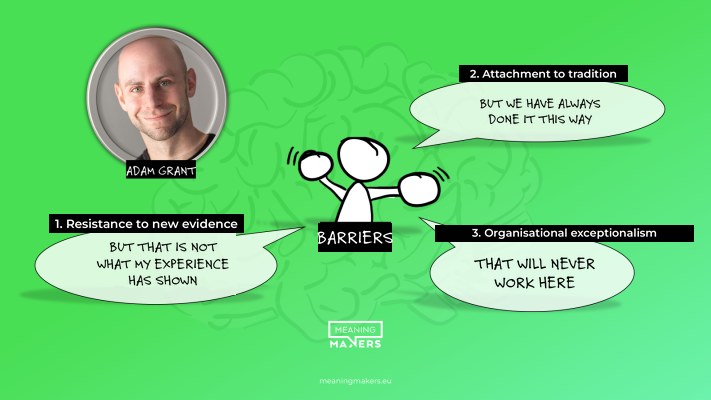
1. Resistance to new data - How does this work? For example, working from home vs. working from the office. Someone presents research showing that people collaborate better in the office, and someone else replies, “Well, I work better from home.”
It’s not about the data, but about the fact that admitting you’re wrong means changing your own belief. And that hits your sense of competence. People prefer to protect the consistency of their views rather than update them – even if it means holding on to outdated facts. That’s why simply “showing the data” rarely works in change. What’s needed is a conversation that allows people to reach the new conclusion on their own.
2. Attachment to tradition - People like what is familiar because it seems safe. Like in the study where most people prefer to receive PLN 100,000 today rather than PLN 120,000 in a year. Not because it’s logical – but because today feels more certain. This is the status quo effect, strongly linked to a sense of security.
David Rock’s SCARF model states it plainly: people feel safe when they have influence and know what to expect. In practice, this means the more unpredictable a change seems, the more strongly people will defend their old habits. That’s why a good leader doesn’t fight the past, but shows continuity – what is staying, not just what is ending.
3. A sense of exceptionalism I hear this sentence in almost every company: “That won’t work here because we’re different.” And of course – every company is different. But the brain works similarly in everyone. Reactance, the status quo bias, the need for influence – these are universal mechanisms.
Research by Dweck & Senn Delaney shows that teams with a fixed mindset have 2.5x higher turnover and a 30% slower innovation cycle. This is the real price of clinging to the old ways. The paradox is that the belief in one’s own exceptionalism often blocks learning – because if we are “different”, then we don’t have to change.
Grant says that “people more often act like lawyers defending their arguments than like scientists searching for new ones.”
Reactance is not a character trait, but a way the brain protects its sense of influence. Each of these three barriers – resistance to data, attachment to tradition, and a sense of exceptionalism – is a different form of the same need: to maintain control over meaning and identity. That is why implementing change effectively is not about breaking people down, but about rebuilding their influence.
How to lower barriers in practice
Before you introduce a change, try to anticipate where resistance will appear. It’s a bit like preparing for a good presentation – it’s not just about knowing what you want to say, but also anticipating the questions that might come up.
A good speaker doesn't just react when someone asks a question. They already know what might raise doubts and mention it themselves. As a result, the audience feels that someone truly understands their way of thinking.
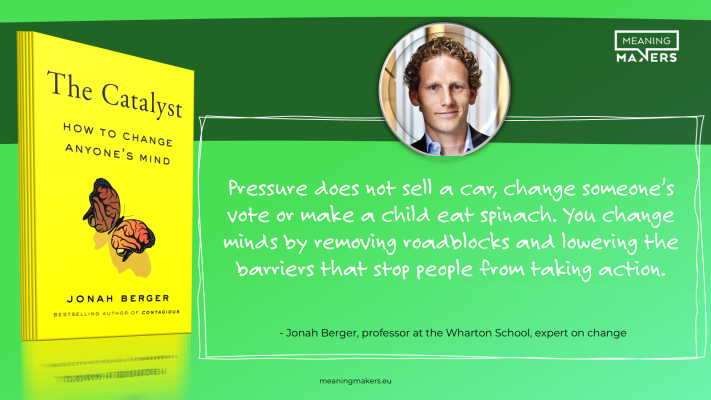
It’s the same with change. If a leader can name the concerns before the team does, people stop being defensive. They see that their emotions have been noticed. Reactance then loses its fuel before it even ignites.
Here’s what you can do when communicating your next change:
- Don’t tell people what to do – ask how they want to do it their way. Instead of: “From Monday, everyone will work in the new system,” say: “The new system goes live on Monday. How can we make the transition as simple as possible for you?” It’s a small difference, but it changes everything — people feel they have influence.
- Give a choice, even a small one. You can’t always give people full autonomy, but you can give them room for decision-making on the details. For example: “You have two ways to test the new process – which one would you prefer to start with?” A sense of choice reduces tension and increases engagement.
- Show examples from their world, not from books. I’ve noticed myself that giving examples from my Google training tour across 5 countries earlier this year certainly built my authority, but it wasn’t as effective as examples from the local scene. Don’t say: “This is how they did it at Google.” Say: “The team in Krakow had a similar problem – they got through it like this.” People trust what is close and familiar more quickly than what sounds like a theory.
- Don’t rush. Reactance burns out only in a calm environment. If the team reacts with resistance, don’t increase the pressure; just take a pause. Say: “I see this may raise concerns – what specifically is difficult for you?” Sometimes just listening works better than weeks of implementation.
You can use this approach right away in any conversation about change — from a new process to a team reorganisation. Instead of “implementing,” guide people through the change with them. You don’t need to have all the answers — you just need to ask the right question.
Change wisely, not by force
Deloitte research shows that teams that perceive change as a challenge have 35% higher adaptability and make 40% better decisions. This is the moment when an organisation stops reacting and starts acting with meaning.
Don’t try to force people to change. Help them do it their way. Don’t push – give space and choice. Instead of adding pressure, remove what’s blocking them. Because people aren’t afraid of change, but of losing influence and control. And when they feel they have influence, they start moving on their own.
P.S. If you’ve read this text to the end and are thinking: “Okay, Wojtek, but my change isn’t something where I can give people a choice. We just have to do it because it came from above” — then of course, you’re right. Such situations also happen. And I was talking about one of them with a client just yesterday. This is a completely different kind of challenge — it’s no longer about resistance to the new, but about violating the status quo and how to build a message that works even when people have no choice.
We will talk about these other aspects of change in future issues of Meaning Making .
Look for the green banner — like the one in this article. That’s where the conversation about Change begins.