

How much does it cost you when people don’t remember what you said?
And music? Think about why you remember specific songs for years. Not entire discographies. Not all tracks. Specific songs.
A good song is about something. It has a recurring theme.
If we know exactly how memorable music is designed, why do we leave memory to chance in presentations and meetings? And how much does it cost?
I’m not asking rhetorically. I’m asking very specifically. How many hours come back in the form of repeat meetings? How many emails start with “circling back to what we discussed”? How many times do you hear, “can you remind me what this was about, exactly?”
How many decisions were never made because people didn't remember what was supposed to push them towards that decision?
If people remember about 10% of the content after 48 hours, it means that 90% of your presentation has just vanished.
Three things in presentations. One we ignore
In my workshops on effective communication, I always ask one question.
What is both the most difficult and most important thing in a good presentation or meeting in 2026?
I usually give three options:
audience interest – they watch, read, listen, and aren’t on their phone; audience engagement – they respond, participate, and do something at the end; audience recall – they know what the meeting was about and remember the key takeaways.
- Audience interest – they watch, read, listen, and aren’t on their phone.
- Audience engagement – they respond, participate, and do something at the end.
- Audience recall – they know what the meeting was about and remember the key takeaways.
Since 2020, which is roughly the start of the pandemic, the distribution of votes has been almost always the same. Sometimes there's a minor anomaly, but in the vast majority of cases, the results are identical.
Engagement wins.
Why? Because its absence hurts the most. The feedback is immediate. You ask a question and are met with silence. No one answers. You know right away that something didn't work. You failed to engage people.
When the audience isn't listening, you also see it immediately. They are busy with other things, their minds are elsewhere. Regardless of the meeting format, a lack of interest makes itself known very quickly. That's why interest usually lands in second place.
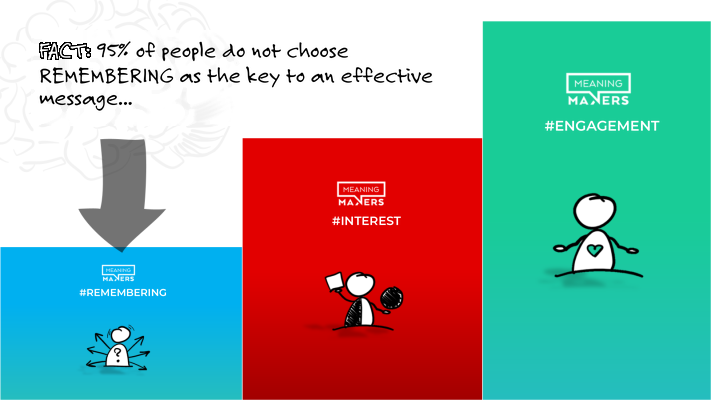
And what's always at the bottom of the priority list for the ambitious people who attend Meaning Makers workshops?
Recall.
Why? Because its absence doesn't hurt immediately. We don't run tests after meetings. We don't call 48 hours later to ask, “what do you remember?”. We don't get any immediate signal that something went wrong.
A lack of recall provides no feedback during the meeting, so it's very easy to ignore. We assume that “it'll be fine somehow”.
The problem is that what we don't feel during the meeting very often determines its real outcome later. Because recall doesn't affect how the meeting looks. It affects what happens after it.
It’s just like with music. You don’t go to a concert of a band whose songs you don’t remember. You don’t buy an album if not a single theme sticks in your head after listening.
It works exactly the same way with presentations and meetings.
10 percent after 48 hours
The research of Carmen Simon, who studies memory and decision-making, shows something simple but inconvenient.
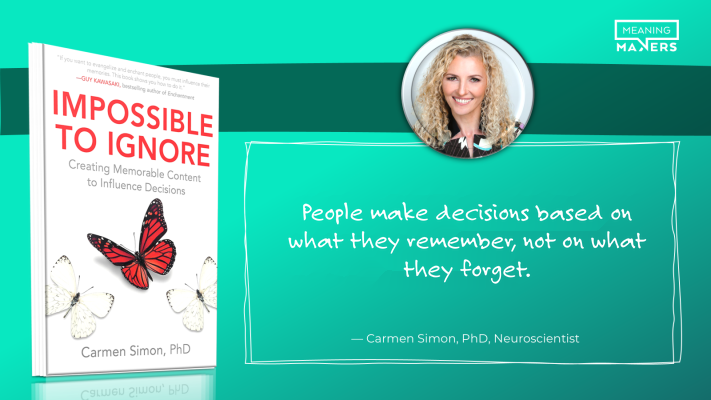
After 48 hours, people remember on average about 10% of what they heard.
This isn't a matter of the presentation's quality or the audience's level of competence. It's a normal mechanism of how memory works. The brain doesn't save information in its entirety. It selects it and deletes most of the content that doesn't seem useful for future decisions.
If your main idea, recommendation, or the difference between options wasn't remembered, then from a decision-making perspective, it doesn't exist. It doesn't compete with other arguments because it's simply not in the recipient's mind.
That's why the biggest mistake in a presentation isn't a lack of interest or engagement. The biggest mistake is assuming that memory will “work on its own”. That because something was said, it will be used later.
Memory doesn't automatically work in your favour. If you don't design for it, it will work randomly. And randomness is a very poor strategy for influence and decision-making.
Why recall doesn't happen by itself
This is where the first and very common illusion appears, especially for people who know their subject well.
“If I said it, they remembered it.”
This sounds logical because we confuse information exposure with its consolidation. We assume that if something was said or shown, it automatically has a chance of being remembered. Meanwhile, from the brain's perspective, these are two completely different processes.
Memory doesn't react to the mere appearance of information, but to signals that a given piece of content will be needed later.
From memory's perspective, most sentences in meetings have the same status: they are correct, sensible, but indistinguishable. And if something doesn't stand out, it doesn't get priority. The brain treats it as noise and does exactly what it was designed to do – it filters.
Simply “exposing” information to the public, therefore, achieves nothing. Without a clear signal that this is important, this will be useful later, this is worth returning to, the information disappears as quickly as it appeared.
This is a very convenient assumption for the presenter. And a very costly one in its consequences, because it gives the false sense that communication has occurred, whereas from the perspective of memory, nothing has been recorded.
No hierarchy = no memory
If the audience doesn't know what's most important, the brain has to figure it out for itself. It doesn't receive a signal on what to focus on and where to direct its energy. In such a situation, memorisation ceases to be controlled.
Either something random remains. Or nothing remains.
The lack of a clearly stated main idea leads to three very specific problems.
What gets remembered wasn't the most decisive point. People often remember an element that stood out, but wasn't necessarily key. From an influence perspective, a secondary point is remembered, and the core meaning is lost. Everyone remembers something different. When there is no single, clear axis, memory starts to work individually. After the same meeting, different people leave with a different picture of “what was agreed”. There is no common point of reference, so it's hard to move forward. Additional questions, clarifications, and the need for more conversations arise. The audience has to guess for themselves what was important. Instead of focusing their energy on understanding the decision or the next steps, people use it trying to reconstruct the content's hierarchy. This is extra cognitive effort that rarely pays off in practice. In a world overloaded with meetings and information, the brain very often chooses the simpler solution. It gives up.
- What gets remembered wasn't the most decisive point. People often remember an element that stood out, but wasn't necessarily key. From an influence perspective, a secondary point is remembered, and the core meaning is lost.
- Everyone remembers something different. When there is no single, clear axis, memory starts to work individually. After the same meeting, different people leave with a different picture of “what was agreed”. There is no common point of reference, so it's hard to move forward. Additional questions, clarifications, and the need for more conversations arise.
- The audience has to guess for themselves what was important. Instead of focusing their energy on understanding the decision or the next steps, people use it trying to reconstruct the content's hierarchy. This is extra cognitive effort that rarely pays off in practice. In a world overloaded with meetings and information, the brain very often chooses the simpler solution. It gives up.
As a result, recall stops being a tool of influence and becomes a lottery. What remains in the mind is not the result of your intention, but of chance. And chance very rarely leads to the decision you care about.
Memory is not a recording. It is a reconstruction.
And here we come to the most frequently overlooked consequence of the previous mistakes.
Once memory has lost something, it doesn't leave an empty space. It tries to build a coherent whole from what remains. It doesn't “replay” the meeting. It reconstructs it.
This means that after a few days, people don't recall the presentation in its entirety. They assemble its meaning from the fragments they remembered. They fill in the rest themselves.
And this filling in is not neutral.
Gaps in memory are filled with prior experiences, beliefs, and assumptions. Everyone does it a little differently. That's why two people can have different versions of “what was actually agreed” in their heads after the same meeting.
The less clearly the main idea was communicated, the greater the freedom in this reconstruction. When there's no single axis to refer to, memory begins to organise meaning on its own terms.
And at this point, we're no longer just talking about forgetting. We're starting to talk about a divergence of meaning. What was meant to lead to one decision starts to lead to several different interpretations.
Therefore, a lack of recall is not just the risk that something will disappear. It's the risk that something other than what you intended will be remembered.
Why we remember music for years, but meetings vanish after two days
For me, memory has always been linked to music.
If I hear a track from Korn's album Follow the Leader today, I don't have to wonder where I was. I'm in high school. I see a specific room, specific people, a specific moment in my life.
If The Prodigy's The Fat of the Land is playing, I'm back in the sixth grade of primary school. Summer holidays. A different rhythm to the day. Different energy. A different way of thinking about the world.
And if I hear the intro to the cartoon Puffin Rock today, I don't go back a dozen years. I go back a few. It's evening. Small children. A cramped flat. Exhaustion after a full day of work. And at the same time, a feeling that something important is happening – even if I didn't have a name for it then.
The most interesting thing is that I don't “recall” these moments. They come back on their own. A few seconds of sound is all it takes.

And that's exactly how memory works. It doesn't record content in its entirety. It records what was connected to something else. To an emotion, a meaning, a breakthrough. The rest disappears.
And when I think about presentations and meetings that were “fine” but left nothing behind, I less and less often ask: was it interesting?
More and more often, I ask: was there any moment in it that could come back to someone in a few days?
And this mechanism isn't unique. It's clearly visible in workshops.
What really sticks in the memory
There's one exercise I almost always do in my sessions.
I ask participants to list 10 things they remember best from their entire lives. No order, no thinking about whether it makes sense. Just whatever first comes to mind.
The result is very consistent.
People rarely write down facts, information, or sequences of events. Instead, specific moments appear. Connected with emotions, with something groundbreaking, or with a “first time”. First job. First failure. First major success.
These are not random memories. They share a common feature. Something happened in them. Something had meaning.
This is exactly what Chip Heath and Dan Heath describe in their book The Power of Moments. They show that memory is strengthened not by the content itself, but by moments that carry meaning. Moments in which emotion, a sense of breakthrough, understanding, or connection with others appears.
That's why memory doesn't work neutrally. It doesn't record everything equally. It leaves what it deems important, new, or worth saving for the future.
And this is exactly how memory works after presentations and meetings, too.
Four principles that increase memorability
Since recall doesn't happen on its own, you have to consciously design it. Just like you design good music.
A good song isn't a random collection of sounds. It has structure, a theme, moments, and repetition.
These four principles don't guarantee that people will remember everything. They guarantee something else – that they will remember what is truly important to you.
1. First, decide what should stick in their minds
A good song is about something. Not about everything at once.
It has a recurring theme that ties together the lyrics, melody, and emotions. When you listen to it, even if you don't catch every word, you intuitively know “what it's about”. And you interpret the rest based on that theme.
The audience's brain is constantly filtering information. If it doesn't get a clear signal about what's most important, it won't “stop” on anything specific. Then recall becomes random.
That's why the presenter's first task isn't to talk or explain. It's to make a decision about what exactly should remain after the meeting.
One main idea. One sentence that still makes sense when someone recalls it two days later. One decision or course of action that follows from that sentence.
If you don't do this, the audience will try to do it for you. With varying results.
What does this look like in a business meeting?
Instead of starting by describing the topic or the scope of the presentation, you state the point of the meeting directly.
Not: “I want to tell you about the new offer and a few changes to the process.”
But: “If you remember one thing today, make it this – this model cuts implementation time in half.”
And just like in a song, you return to this sentence during and at the end of your presentation. Not because people are inattentive. But because memory needs a theme around which everything else can be arranged.
2. Design a moment, not just content
In good music, there's always a moment you wait for. A solo. A breakdown. A change in rhythm. A break in the structure and a powerful impact.
Sometimes the whole song is just a journey to that one fragment. And interestingly, sometimes the track itself is just “okay”, but that one moment makes you want to keep listening.
It's exactly the same with presentations.
People don't remember slides or strings of arguments. They remember moments when something clicked for them.
A moment is not a flashy gimmick or a “show”. It's a point in time when the recipient stops just listening and starts to understand how it relates to their situation.
If a presentation is a continuous stream of information, the brain has nowhere to stop. Everything just flows by, until eventually nothing is left.
What does this look like in a business meeting?
Instead of going through successive slides of data, you consciously pause in one place.
It could be:
a single contrast; a question that makes them think; a short story from a real project
- a single contrast
- a question that makes them think
- a short story from a real project
For example: “Before I show you the numbers, I want to tell you about one situation from our last implementation, because it best illustrates where the problem lies.”
Just as you wait for the breakdown in music, in a presentation you give the brain an anchor point. And very often, it's this moment that sticks in the memory, even if the rest fades over time.
3. Use novelty and surprise
Monotonous music has its uses. Mostly for putting people to sleep.
If a track is meant to excite, move, or be remembered, something new has to happen in it. A change of pace. An unusual sound. An unexpected turn.
The brain reacts to novelty, because novelty signals: “this might be important”. It works identically in presentations.
The brain very quickly filters out what is predictable. If a presentation sounds exactly as the audience expects, memory stops working.
Novelty doesn't mean fireworks or revolutionary theses. Most often, it's about changing the angle of view. Something that makes a familiar topic suddenly look different.
It is novelty that signals to the brain that it's worth stopping and retaining something.
What does this look like in a business meeting?
Instead of the standard introduction: “The market is changing, customers are increasingly demanding…” You start with something that breaks the routine of thinking:
a number that contradicts intuition; a comparison that frames the topic differently; a question with no obvious answer
- a number that contradicts intuition
- a comparison that frames the topic differently
- a question with no obvious answer
For example: “Most companies lose customers not because their product is worse, but because customers don't remember what makes it different.”
Just as a change in music wakes you up, in a presentation a new perspective activates the memory.
4. Consciously repeat what needs to stick
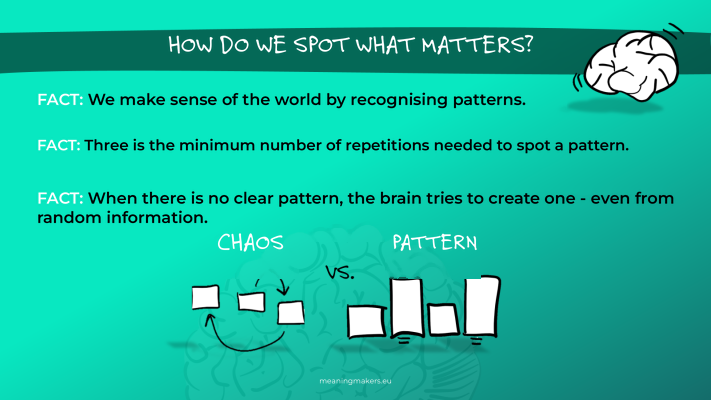
The classic verse-chorus-verse musical structure didn't come from nowhere. That's why the chorus “gets into your head” faster than the verses.
It's the same with memory in communication. One of the most common illusions in communication is: “I said it once, so that's enough.”
It's not enough. Memory needs repetition, preferably spaced out over time and presented in different forms. Repetition doesn't weaken the message. A lack of repetition dilutes it.
What does this look like in a business meeting?
The same idea appears:
at the beginning, to announce the point of the meeting; in the middle, as an example or consequence; at the end, as a summary and conclusion
- at the beginning, to announce the point of the meeting
- in the middle, as an example or consequence
- at the end, as a summary and conclusion
Not in the same words, but with the same meaning.
This way, even if an audience member “tunes out” for a moment, they have several opportunities to catch what's most important. This isn't padding. It's consciously reinforcing the memory trace.
Why all this matters
These four principles boil down to one conclusion.
If you don't decide what and how it should be remembered, the recipient's brain will do it for you. Randomly, fragmentarily, and often against your intention.
And in communication that is meant to lead to a decision, chance is a very poor strategy.
If they didn't remember, you'll pay for it later
A lack of recall doesn't just end with “oh well”. It simply postpones the cost.
It comes back when:
someone asks the same question again; you have to organise another meeting; you send an email explaining exactly what was already said; a decision that was supposed to be made is postponed “for clarification”
- someone asks the same question again
- you have to organise another meeting
- you send an email explaining exactly what was already said
- a decision that was supposed to be made is postponed “for clarification”
These are not random situations. They are a direct result of the fact that after the meeting, what was supposed to stick in the audience's minds did not.
In sales, this mechanism is even more powerful.
If customers don't remember how you're different, why your solution makes sense, and what specifically it changes in their situation, then in practice all suppliers start to look similar. Not because they are the same, but because the differences were not remembered.
And when the differences disappear from memory, the conversation very quickly turns to the only parameter that is easy to compare.
Price.
And that is exactly the moment when a lack of recall stops being a communication problem and starts being a real business cost.
In conclusion
Recall is not an add-on to a presentation. It is its foundation.
Except it's invisible. It doesn't hurt at the time. It gives no immediate feedback.
But if your content isn't built for memorability, it's very possible that it's built for forgetting.
In music, monotony makes sense – when you want to send someone to sleep. But if you want to move them, there has to be a theme, a moment, and a return. Without that, everything sounds “correct”... and disappears.
One final question – and I think you know what it is...
If your audience were to remember one sentence after your meeting – what sentence would that be?
If you don't know the answer to that question – it's time to act.