
Sometimes you don’t need anything new to capture people’s attention in a meeting. All it takes is to present a familiar topic differently, so they experience a moment of conscious incompetence. But do you know how to do that?
The brain’s job is to predict. For thousands of years, this very skill has allowed us to survive. When something new appeared on the horizon - a sound, a shadow, a scent - we had to decide in an instant whether it was a threat or an opportunity. Novelty could mean a jaguar, but it could also mean a source of water. That’s why the brain still operates the same way today: it scans its surroundings, compares what it sees with past experiences, and tries to guess what will happen next.
You can’t fight evolution
Your brain didn’t evolve to listen to a status update. When it predicts correctly, it feels safe. But when everything is predictable, it concludes that nothing interesting is happening. And it stops engaging.
I think this is how meetings die today. Not because people have too little time. Not because calendars are overflowing. But simply because the brain has stopped being surprised by anything.
This has very specific consequences, because when the brain disengages, it doesn’t just “not listen” - it stops updating its models of the world. This means one thing: it doesn’t change its mind, it doesn’t make decisions, it doesn’t move forward even a single step.
The meeting can continue. The slides can change. The discussion can seem perfectly fine. But from the brain’s perspective, nothing has happened.
That’s why so many meetings end with phrases like: “let’s come back to this”, “let’s think it over”, “let’s touch base later”. It’s not about a lack of responsibility. It’s the result of the brain never deciding that moment was worth the energy.
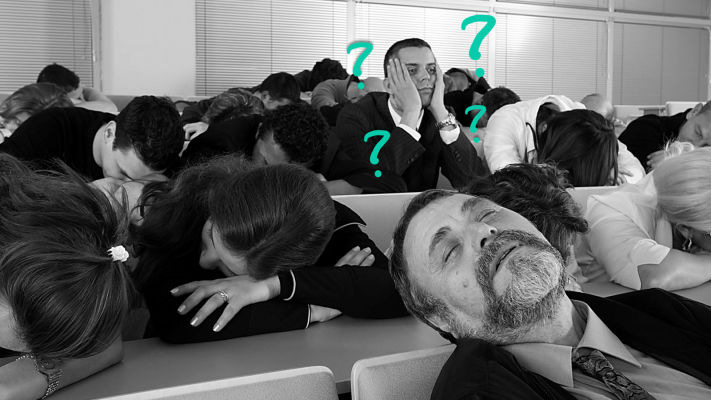
We’ve all sat through hundreds of meetings: the same introductions, the same “agenda -> status -> summary” structure. The same tone, the same order of speakers. The brain recognises the pattern in a few seconds and says, “I know this. I know how it ends,” and switches off. People start checking their email and moving their mouse around. Not out of a lack of respect, but purely out of biology.
The brain does this not because it’s lazy - but because it’s trying to save energy. If it recognises a pattern, it immediately switches into energy-saving mode. And a predictable meeting is a signal to the brain: “Nothing here is going to surprise me. There’s no point investing any more energy.”
This is important, because the brain is, above all, an energy manager. Every second of attention comes at an energy cost. If something looks familiar, predictable and safe, the brain chooses the cheapest path: autopilot.
From this perspective, a predictable meeting is like a familiar route home. You don’t need to look. You don’t need to think. You don’t need to be present.
The problem is, new decisions aren’t made on old paths. If you want change, engagement or a genuine “yes”, you first have to make the brain register the situation as new and worth paying attention to.
And I see the same thing in training rooms. I walk into a meeting with a sales team, ask them to think back to the last three presentations they showed clients... and in 90% of cases, the first few slides look identical. Logo. Agenda. About us. Our successes - the obligatory world-map slide showing how global they are. A nice slide. But what if EVERYONE has it?
Meetings like films with no plot twists
Speaking of respect - for cinema this time. Years ago, when I used to watch films with my father, he had a simple rule: if nothing happened in the first few minutes - no twist, no surprise - he’d say: “This is a bit slow to get going. Shall we change the channel?” (He’d also often say, “this film is a bit dark” when the scene was set at night... eh.)
I love this film analogy. The brain treats meetings exactly like film scenes - if nothing surprises it in the first few minutes, it assumes there’s nothing worth waiting for. And when the brain predicts what’s coming next, it sees no point in investing energy in being present. If nothing surprises it, it shifts its attention elsewhere - even if the body is still sitting at the table. At least meetings, unlike some films, are usually bright enough. Things get darker later... when someone asks: “Can you send me those slides?”
This isn’t a metaphor or a journalistic oversimplification. It’s a well-described biological mechanism that operates faster than conscious, logical assessment.
Before you’ve even had a chance to say much, your audience’s brains have already decided whether you’re worth listening to.
What does neuroscience say?
Neurobiologically, it’s simple: our novelty-detection network operates faster than conscious thought. If it doesn’t detect anything new in the first few seconds, it automatically lowers dopamine levels - and it’s dopamine that determines whether we are engaged or just “present”. You won’t win that battle with more words or more slides.
But don’t worry - this isn’t about turning everything upside down and making your “film” into a full-blown thriller. You don’t have to be a showman or introduce chaos into the meeting. It’s enough to break the pattern - a subtle contrast, a small twist, a different perspective.
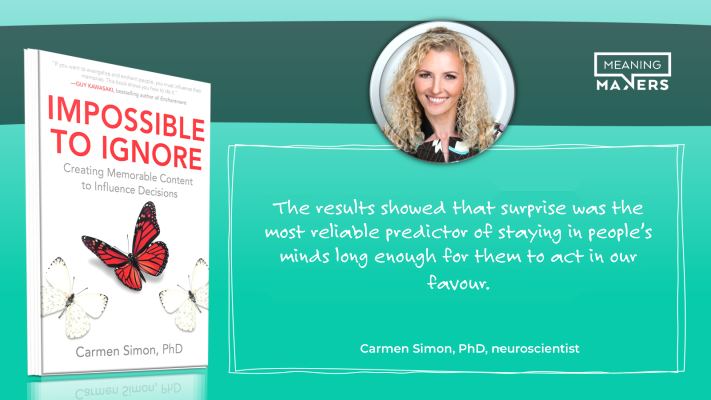
As neuroscientist Carmen Simon says, “Surprise is the most reliable predictor that people will remember you long enough for it to work in your favour.”
Studies show that even a small surprise - a small twist, a different question, an unusual opening - can boost attention for several minutes. In a world where people check their phones every 5-7 minutes, that’s a greater advantage than any slide can offer.
This works because surprise triggers what’s known as an information gap - the moment you realise there’s something you don’t know. That’s when curiosity kicks in, and with it, dopamine, which helps your attention stick.
So it’s not about novelty for its own sake. It’s about saying something familiar in a way that sparks that little reaction: “Oh, that’s interesting... I’ve never thought about it like that.”
That’s precisely why the surprise doesn’t have to be big. It’s not about fireworks, anecdotes or “openers” that distract from the topic. It’s about a small violation of expectations that tells the brain: “Pay attention, there might be something new here.”
It could be a different question. A different order. A single sentence that doesn’t sound quite how you’d expect.
The brain doesn’t need a revolution. It needs a signal that its prediction has just failed.
Four ways to surprise the brain
It’s in moments like these that four simple methods I’ve tested in hundreds of workshops and meetings come in handy. These aren’t “presentation tricks” or flashy openers. They are four different ways of violating the brain’s predictions - each one interrupting a different automatic pattern the brain relies on.
Sometimes one of them is enough. Sometimes a combination. But the goal is always the same: to pull the brain out of “I already know this” mode and invite it back to thinking.
- The Overlooked - show something that people usually overlook. We all have blind spots; you just need to point them out. Example: “Before we move on to the sales plans, I want you to notice that for the last three months, it hasn’t been the numbers, but the way we talk to clients that has made the biggest difference in our results.” This technique works because the brain suddenly realises it has missed something important, which automatically increases alertness and attention.
- A New Angle - look at a familiar topic from a slightly different angle. A change in context can completely alter its meaning. Example: “We all talk about the drop in efficiency, but maybe the problem isn’t with the people - maybe it’s the way we plan our meetings?” Here, the surprise comes from forcing the brain to reframe the problem.
- Controversy - pose a question or make a claim that slightly challenges the status quo. Don’t be provocative - just show that things could be seen differently. Example: “What if longer meetings aren’t the problem? Perhaps the problem is that we’re trying to cram decisions into too short a time frame?” Controversy works because it introduces cognitive dissonance - and the brain hates unresolved tension.
- The Counterintuitive Take - say something that runs against intuition. A twist like this immediately knocks people off autopilot. Example: “The more information we provide in a meeting, the less people remember. It’s not a lack of data, but an excess of it that weakens attention.” In this case, the brain has to pause for a moment, because what it’s hearing doesn’t fit with its existing mental shortcut.
Each of these methods creates a small dose of uncertainty. And uncertainty, in the right dose, doesn’t paralyse. It activates thinking, curiosity and a willingness to shift perspective.
How to apply this in your meeting tomorrow
How can you apply this tomorrow? Start your meeting with a single sentence that gently knocks people out of their usual rhythm. “Today, we’re not going to start with the numbers,” “I’m going to start with something no one usually talks about,” “I want to show you something that recently changed my thinking.” One or two sentences like this do the job - they create an information gap, capture attention and reset the audience’s focus.
An opening sentence like this works because it sets a tone of curiosity. The brain loves solving puzzles. If you give it even a subtle signal that something non-obvious is about to happen, it will stay with you. Even if only for the first few minutes - and that’s often enough to earn their full engagement.
One important caveat. Surprise doesn’t work if it’s detached from the meeting’s purpose. The brain is very quick to distinguish between “something interesting” and “something random”.
That’s why the best surprises always serve a purpose. They help you see a problem differently. They add new context. They create space for a decision.
If the surprise doesn’t lead anywhere, it will just become noise. If it leads somewhere meaningful, it can become a turning point.
Your new core skill: the first plot twist
So if you want your meetings to truly come alive, don’t start with the “agenda”. Start with a moment that surprises. With something that sparks curiosity, reveals a gap and breaks predictability.
This isn’t a matter of the presenter’s style or personality. It’s a consequence of how the brain works. The same mechanism that, thousands of years ago, made us react to a shadow in the grass or an unusual sound in the forest, today decides whether people will stay mentally present in your meeting - or drift away after the first few minutes.
In a world overflowing with information, predictability kills attention faster than boredom - that’s why the first plot twist is the most important communication skill today. Not a new slide. Not a better agenda. Just the ability to say something familiar in a way the brain doesn’t expect.
Because if you don’t surprise your audience’s brains, they’ll surprise you instead. Exactly when you need their attention most.
Over to you
We all know the feeling: the meeting is still going, but your brain checked out a while ago. I’m curious - what do you do to keep participants’ attention (or your own) during meetings? Do you have any proven tricks, rituals or techniques that help you stay present?