
Sometimes a sentence comes my way that stays in my head for a long time. A few days ago, I saw a quote that went like this: "in the future, your career will be decided by your psychological resilience."
Sounds reasonable. Except if you're a leader, there's one important element missing here.
It's not that an employee's psychological resilience depends solely on them. In leadership, it's the leader who shapes the environment where this resilience can be maintained or fall apart. You set the context in which people work. You create the conditions that either allow someone to think or force them to defend themselves.
And this is where the conversation about psychological safety begins. About one of the most underestimated, yet one of the most practical, elements of teamwork. Because if there's no safety, there's no thinking. And thinking is what we pay people for today.
Why don't zebras get stomach ulcers?
Not because their life is easy. Life-threatening danger is a daily reality for them. And yet, a zebra doesn't carry stress all day long. If it escapes a lion, its body returns to equilibrium in a few minutes. It's a matter of the responsive state vs. the reactive state. In the responsive state, the body is in balance, regenerating. In the reactive state, adrenaline and cortisol take over and focus the body on just one thing - survival.
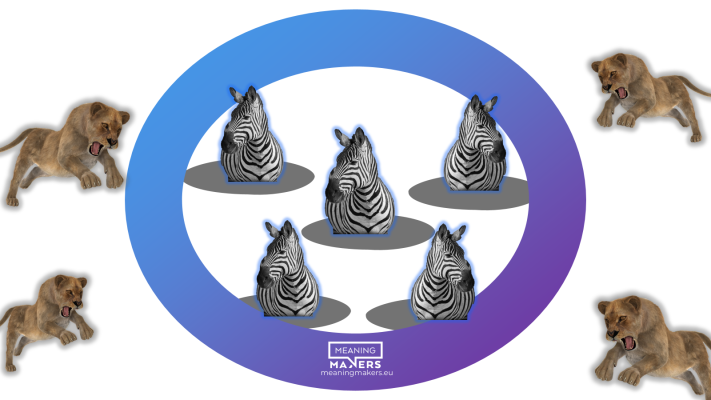
A significant fact in this story from Animal Planet is that you don't really see zebras "lending a hoof" when one of them falls. What do they do? They keep running. In the animal kingdom, this is how selfishness driven by the will to survive manifests.
And people? A human can carry stress for a whole day, week, or month. And the worst part is that most of this stress doesn't come from a real threat, but from a psychological threat.
Was I judged fairly? Was I allowed to speak? Do I know what's about to happen?
These aren't questions on the scale of 'am I about to be devoured by a pride of lions,' but the brain treats them just as seriously.
And this is a space where the leader has an enormous impact.
Because you can work in a fast-paced, demanding environment and still feel safe. You can also work in a calm setting and feel tense all the time. The difference is made by the signals from the people around you - and most of all, from the leader. That's how it was once, in a tribe on the savanna. And that's how it is today, in an office building in Mokotów.
And in that office building, people can either trample each other like zebras or function as a team.
What do you pay people for (and what do they pay you for)?
Most modern jobs require high-quality thinking. Not executing orders. Not clicking according to instructions. Thinking.
But the brain can't think if it has to defend itself at the same time.
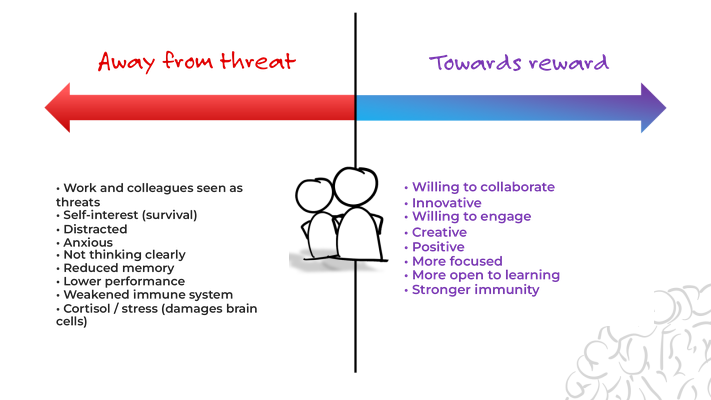
In a state of threat:
- the limbic system is activated,
- cortisol takes control,
- fight, flight, or freeze appears,
- the neocortex switches off like a light.
We see the effects every day.
Someone sits at their computer after a tough conversation with their boss and is unable to do even a basic task. Someone else loses their energy for the rest of the day after an unfair comment. A single rumor about changes can kill a team's productivity for a week.
A psychological threat interrupts thinking like a ball suddenly flying into the middle of the frame.
And it happens all the time. Through a moment of silence from a superior. Through the tone of a question. Through informational chaos. Through a loss of autonomy. Through even a small sense of injustice.
People genuinely want to do a good job. It's just that sometimes their brain is working on something else - a survival plan.
My fight for autonomy
Autonomy is one of the pillars of psychological safety. I've always had a strong need for it. I only understood this over time, but it influenced my decisions much more strongly than I wanted to admit.
When I lived in Wrocław, and my partner was in Warsaw, we flew to see each other for three years. The company wanted me to move to the capital, but I knew that meant being in the office every day (well, they wouldn't have let it slide). And that would have taken away the autonomy on which my way of working was based.
It was only after I left the company that we could live together. And to this day, I consider it one of the best decisions. Both of them.
Was it rational? Probably not for those around me. But for my brain, absolutely.
When I lived in Dublin a looong time ago, I called in sick a few times. Not because I was ill. I was psychologically overwhelmed. My nervous system was in such a state that I was physically unable to go into the office. It was a defense mechanism. The brain can say its 'no' before you understand it yourself.
And one more thing. I recently made a few decisions in my company to increase my autonomy. They weren't easy. They required cutting myself off from things that had been holding me back for a long time. But now, after two months, I can say one thing: it was the best decision in years. My nervous system is working more stably. I have more space for thinking and creating. And I see in myself the same thing I see in people on teams: when autonomy is taken care of, a person comes back to life.
And especially someone for whom this particular dimension is key. For you, or for your team, it might be something else. What? Read on.
Safety builds culture, and culture builds results
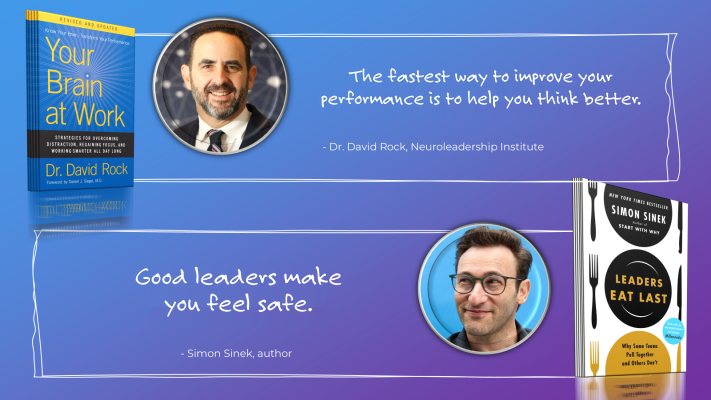
David Rock once said, "you're paid to think, so the fastest way to improve your performance is to help you think better." And if you want people to think, they have to feel safe. This isn't a metaphor. It's an operating manual for the nervous system.
In a state of threat, a person:
- won't take risks,
- won't be creative,
- won't tell the truth,
- won't take responsibility.
And these are the four foundations of any healthy organizational culture. If most of the team is operating in a defensive mode, the culture starts to look like a recipe for poor decisions, hiding problems, a lack of initiative, and quiet withdrawal. People do the bare minimum because their brain won't allow for more.
In a state of safety, all these functions return. A person starts to think more broadly, speak more honestly, propose more boldly, and take responsibility naturally. That's why psychological safety isn't a soft topic. It's the hard infrastructure for results. It's the operating system of every company, just one that's often invisible in Excel.
Culture is key here, because it's the culture that tells people whether to operate in fight mode or thinking mode. In cultures of tension, risk avoidance and playing for survival dominate. In cultures of safety, courage, truth, and real engagement grow.
The best tool for understanding how to build this culture every day is the SCARF model.
How to build a psychologically safe environment?
Leader, it won't happen on its own. You have good intentions, but sometimes bad instincts. It's not your fault. Good intentions can clip wings if we don't understand how the brain works.
Here are five areas based on David Rock's SCARF model.
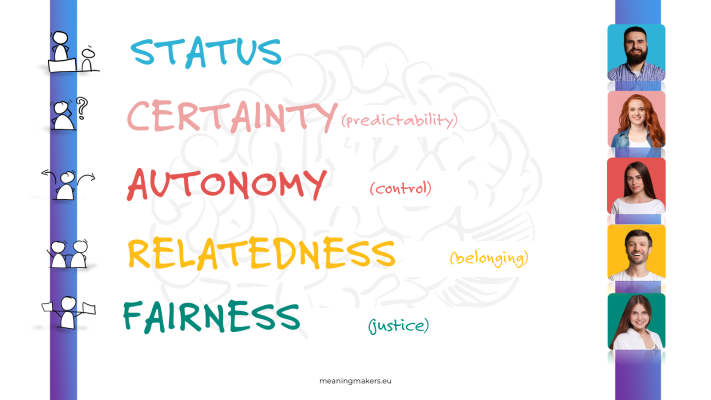
1. STATUS
Status is about how a person feels around you. Whether their competence is respected. Whether they won't be belittled or embarrassed. It's the most sensitive element of communication. A single comment can shut a person down for the whole day. Evolutionarily, status told us where we were in the tribe's hierarchy and whether we were safe or threatened.
What destroys it: comments like that's obvious or how could you not know that.
What strengthens it: the question tell me how you approached that.
2. CERTAINTY
Certainty is the sense of predictability. The brain prefers bad news to no news. A lack of certainty triggers the alarm system, even if objectively nothing bad is happening. From an evolutionary perspective, uncertainty equaled threat, because losing your bearings meant risking survival.
What destroys it: a leader's silence during times of change or withholding information because we don't have the full picture.
What strengthens it: the message I don't know yet, but I'll tell you when I do.
3. AUTONOMY
Autonomy is the sense of having influence over how I work. We don't need complete freedom. We need a minimum level of agency. Autonomy gives energy. The lack of it drains it. In our evolution, control over our own actions increased the chances of survival, which is why the brain defends autonomy like territory.
What destroys it: micromanagement and imposing the way a task must be done.
What strengthens it: the question how would you solve this.
4. RELATEDNESS
Relatedness is information for the brain: are you with me or against me. Can I trust you. Are we on the same side. For the brain, a lack of connection once meant being outside the tribe, and that was equivalent to a life-threatening situation.
What destroys it: a cold dive into tasks without any person-to-person contact.
What strengthens it: a moment of normality at the start of a conversation, even a brief how's your day going.
5. FAIRNESS
Fairness is the foundation of trust. The brain detects inequality instantly and treats it as a threat. In a tribe, unfairness meant the risk of being exploited or excluded, which is why we react to it so strongly today. Even a small injustice can switch off engagement for a long time.
What destroys it: different standards for different people and unjustified exceptions.
What strengthens it: a brief justification for a decision, I'm doing this because....
Why it works
Not because people are sensitive. But because the brain is reactive.
In a state of threat, it shuts down functions that are crucial in modern work. In a state of safety, it gives everything back.
That's why psychological safety is the currency of the future. It's not an add-on. It's not a bonus. It's the foundation.
A good leader creates an environment where a person doesn't have to defend themselves. Where they don't analyze every word. Where they can simply think.
It starts with you
The psychological safety of others begins with your own. I know this from personal experience, because I repeatedly messed up as a leader not because I wanted to, but because I myself felt threatened. I didn't have space for my own five SCARF dimensions, and I passed that on.
If I lacked certainty, I gave less of it to others. If my autonomy was limited, I tried to regain control in other areas. If I felt judged, I was quicker to judge.
These were instincts, not intentions.
The team sees it immediately. People's nervous systems react to their leader's nervous system faster than to their words. A tone of voice, a pace of work, a single glance is all it takes. And suddenly the whole team is operating in your state, not their own.
That's why working on psychological safety starts from within. When you are calm inside - you give calm. When you have tension - you transfer tension. When you have space for autonomy - you give autonomy to others.
A leader is like an amplifier. What's inside them comes back through people's behavior.
That's why a leader's most important decision is to take care of their own SCARF. Not to be nice. But so that others can think.
In conclusion
Leadership always begins with one choice. Do you want to build a culture where people can think, or a culture where they have to defend themselves. Because it's never fifty-fifty. The brain chooses one mode. And the team always operates in the leader's mode.
You can have the best strategy, the best tools, and the best processes. If people are in defensive mode, all of it will run at half-speed anyway. If they're in thinking mode, even a difficult environment will start to yield good decisions, better collaboration, and real accountability.
Psychological safety isn't soft. It's the condition that allows a person to even do the job you pay them for. And the condition for you to be a leader, not a firefighter for emotional blazes.
So instead of asking how to increase the team's engagement, accountability, or creativity, ask yourself a different, much simpler question. One that really makes a difference.
What will I do today to build my team's safety.
A final question
Each of us has a different sensitive spot. Some react most strongly to a loss of autonomy. Others can be knocked off their rhythm by a lack of certainty. For someone else, status or relatedness will be key. And sometimes it's the sense of fairness that determines whether we can kill it at work, or whether our thoughts wander and we start operating in defensive mode. I'm curious what it's like for you - which element of the SCARF model most affects your sense of safety, and when do you feel you're working at full throttle, versus when something takes that away from you.