
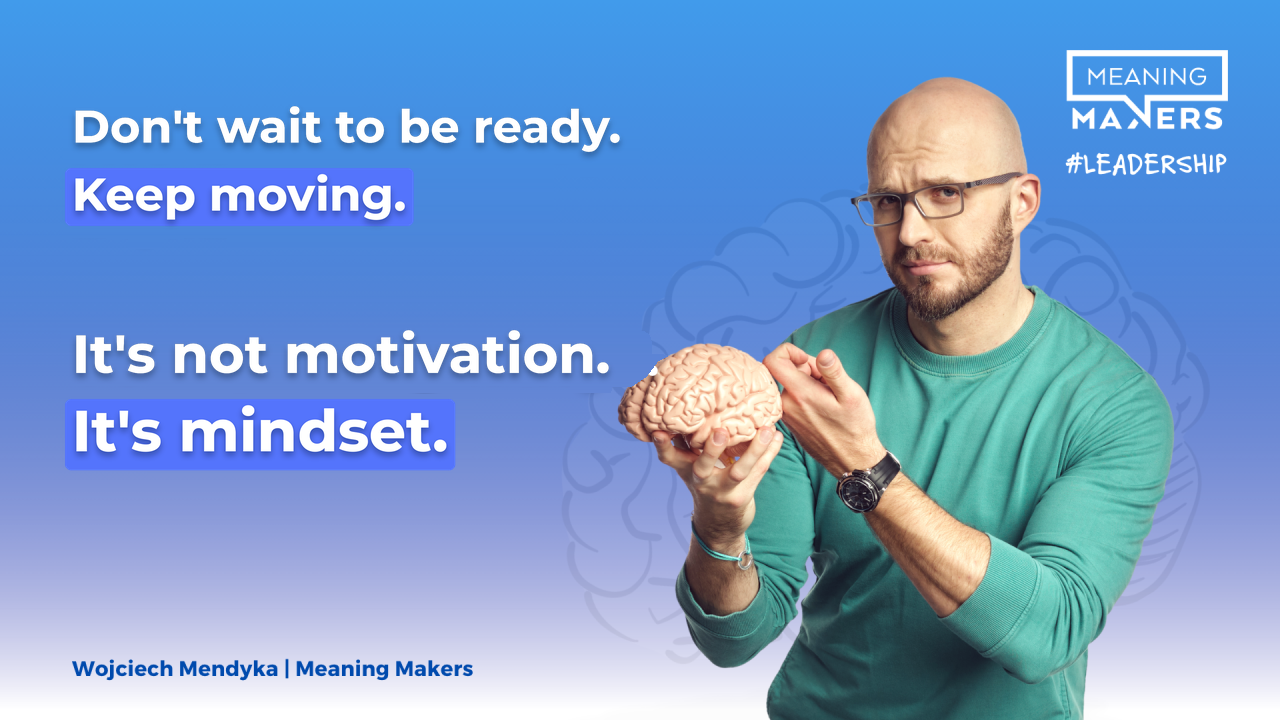
Everyone talks about growth, but hardly anyone talks about how it actually works. Because growth doesn’t start with feeling ready - it starts with deciding to move anyway.
Recently, my son came home from school and proudly announced that he’s the fastest reader in his class. (I know, I know - humble brag.) My first impulse was to say: “You’re so clever - so talented!” (Well, it’s the genes - you understand.) My instinct was pushing me to praise him for the result and for something that sounds like a fixed trait - intelligence, talent, an innate ability.
But I stopped myself. I knew that words like these don’t help a child grow - they switch them into “I have to prove myself” (PROVE) mode. A mode in which every failure that follows threatens their sense of self-worth. From then on, my son would feel that he has to keep proving to his dad that he’s clever and talented.
And from an evolutionary point of view - would he really want to take risks and try new, uncertain challenges where he might fail?
What do you really reward people for?
Carol Dweck’s research shows that children praised for their intelligence or talent are a full 92% more likely to avoid challenges later on. Not because they’re lazy, but because they’re afraid of losing the “clever” label.
Remember this from school? There was always that one person with top marks in everything, hand always up, perfectly prepared. This isn’t research, just my own experience, but those children rarely went on to start companies or head into the unknown. Maybe precisely because they spent years learning to avoid situations where someone might see they weren’t perfect.
That’s why, instead of saying “you’re clever”, I told my son: “you read quickly because you’ve practised a lot.” It’s a small difference in language, but a huge difference in how the brain builds habits.
A “growth mindset” (popularised by Carol Dweck, mentioned above) begins exactly where the need to keep proving yourself ends.
As adults, we forget this. The whole world around us runs on results - KPIs, targets, quarterly reviews. Everything measures what you’ve achieved, not what you’ve learned. No wonder most people learn to prove their worth instead of developing it.
And what about you or your organisation - what do you really reward people for? If you’re like most companies, the answer might be… a little uncomfortable.
“PROVE” vs “IMPROVE”
Each of us has two modes in our head: PROVE and IMPROVE.
In PROVE mode, you want to prove something - that you’re good, ready, competent enough. You try to control everything and avoid mistakes and risk. Every slip-up is a blow to your self-worth.
In IMPROVE mode, you don’t have to prove anything. You focus on getting better. You step into new situations, learn as you go, and watch with curiosity to see what happens.
Ask yourself one question: which of these behaviours does your brain naturally reward?
The answer is simple - PROVE. Because from a survival perspective, it’s safer. The brain is built to keep us safe, not to help us grow. It prefers predictability, because every change means potential risk.
And that’s exactly why a growth mindset doesn’t come naturally. It’s not an instinct - it’s a choice.
How the brain reacts to change
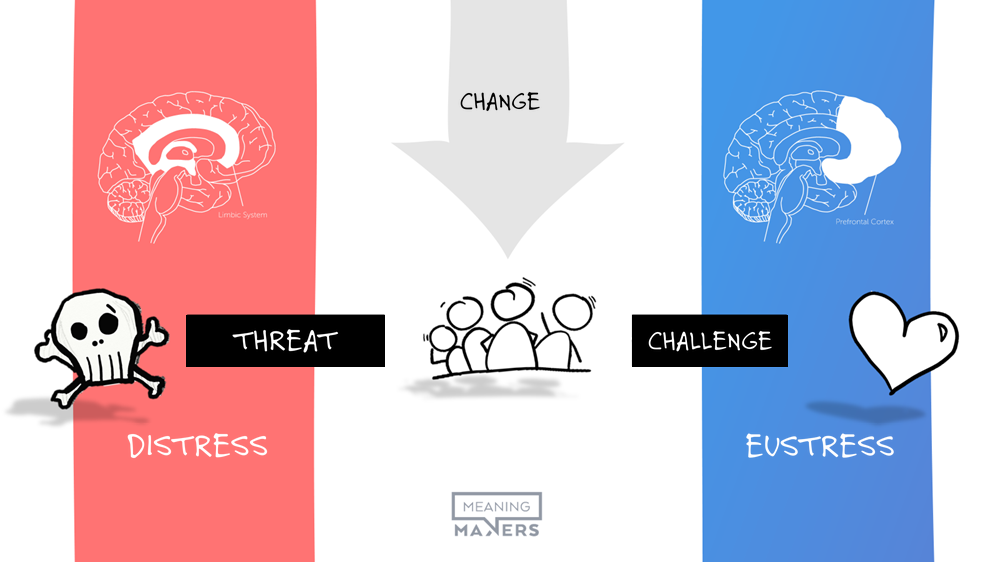
Every change - a new project, a new boss, a new way of working - sets off an alarm in the brain. The amygdala sends a “watch out” signal, and the rational part of the brain gets less energy. Instead of thinking things through, we start reacting.
But not all stress works the same way.
Every change triggers stress - but whether we treat it as a threat or a challenge decides which part of the brain takes over.
When we see change as a threat, the limbic system kicks in - the centre of emotions and defensive reactions. This is what’s known as distress: stress that blocks us. In this state, energy goes into protecting ourselves, not learning. We focus on survival, think short-term and avoid risk.
But when the brain reads change as a challenge, the prefrontal cortex takes the lead - the area responsible for planning, analysis and creativity. This is eustress - stress that mobilises us, opens us up and spurs us into action. It’s still stress, but the kind that pushes us forward instead of holding us back.
And this is exactly where a growth mindset comes in. Because it’s what lets you switch from threat to challenge. From an emotional reaction to a rational one. From defensiveness to curiosity.
Look at the word mind-set itself. It’s all in there - it’s about the stance you take towards reality. You can set yourself to PROVE mode or to IMPROVE mode.
The first time, I did it by accident
In 2007, I was living in Dublin and working for a large corporation. We were wrapping up a big project, and in those days I spent my time counting the minutes until 5 p.m.
My manager (hi Graham, wherever you are) said he wouldn’t be flying out to the client to do the so-called hand-over. Something had come up - he couldn’t go. There were twelve people in the room. Silence.
And then I did something I still don’t fully understand. I said: “It’s a shame that no one will go.”
Suddenly, every surprised pair of eyes in the room turned to me… You see, back then, speaking up in meetings wasn’t exactly my thing.
The manager looked at me and asked: “Would you like to go?”
Before I had time to panic about what I’d just done, I blurted out again: “Will they pay for my expenses?” Clearly a seasoned business traveller even then. He smiled and said of course.
I said yes. I flew. It went really well. Not because I did anything exceptional, but because everyone else had frozen, and I took a step forward.

Looking back, I know that moment completely changed the course of my life. That hand-over was really my first training session - although I had no idea at the time.
Ever since, I’ve kept a simple rule in my head: put your hand up first, then work out how you’ll do it. Say yes - and figure it out.
A rerun from Munich
Twenty years later, the same rule came back to me out of the blue. On a Friday afternoon I got a call: the person running a sales session in Berlin for a global team had pulled out, and they needed a replacement. Flight on Sunday, session on Monday.
First thought: “I’ll never make it.” Second thought: “Do it. You’ll figure it out anyway.”
So I said “yes”. And I flew.
Sitting in my hotel in Munich that morning, an hour before the start, I could feel the stress - the good kind, eustress - but also a sense of calm. I knew it would work. And it did - it went brilliantly.
It reminded me of something important: a growth mindset isn’t a theory. It’s a practice. It means saying yes before you feel ready - and figuring it out as you go.
Stuck or gaining momentum?
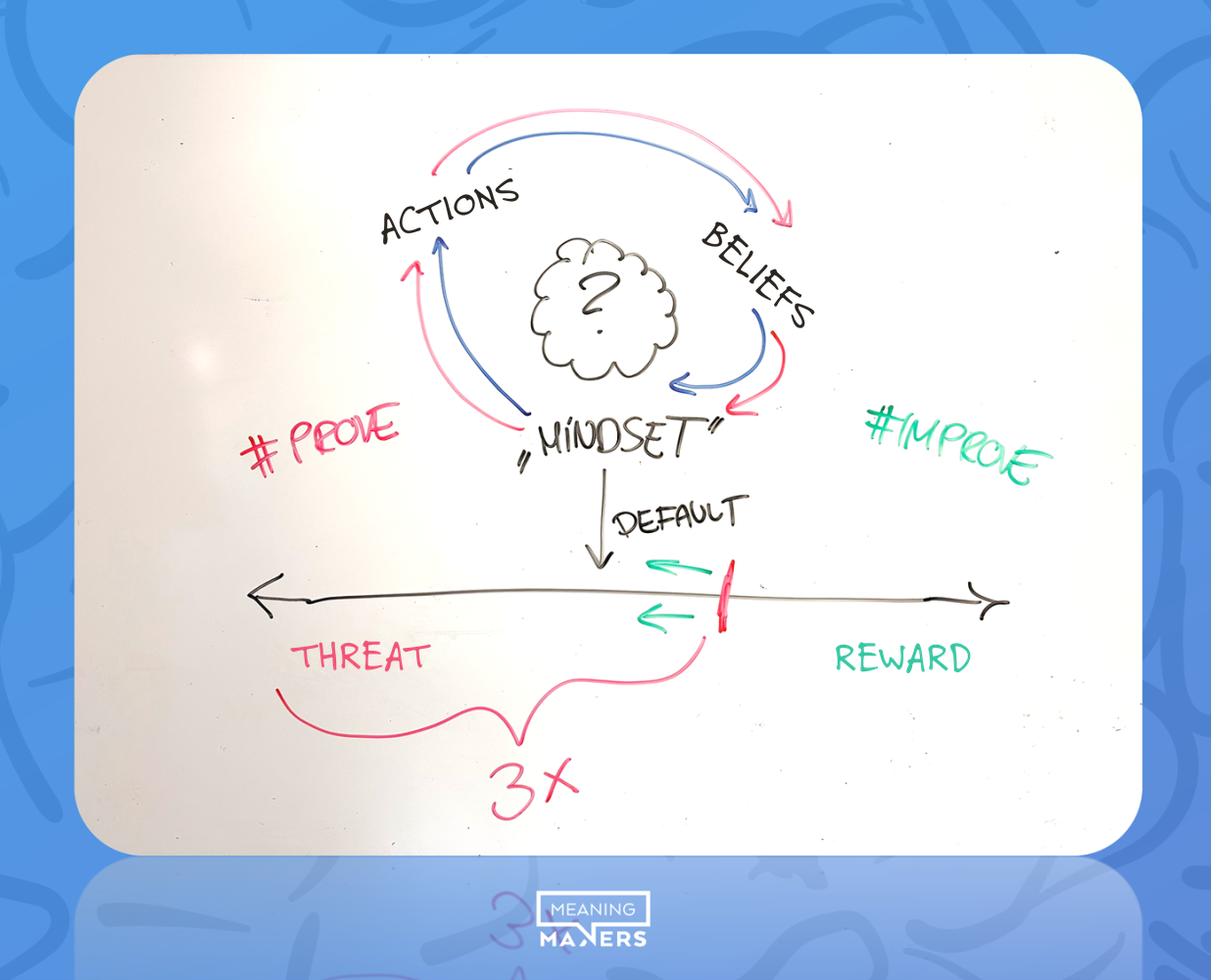
The Doom Loop is a spiral that starts with the thought: “I’m not good enough.” Then come stress, avoiding risk and the confirmation: “See? Better not to try.”
The Momentum Loop works the other way round. Every attempt - even a failed one - builds momentum. With each attempt, the brain learns that taking action is safe.
Take presentations, for example. Someone believes they’re not a good speaker, so they go on the defensive. They avoid presenting, or they go into presentations tense and nervous. The result? A weak presentation - and proof that “I can’t do it.”
In the Momentum Loop, the opposite happens. Someone believes they can learn to speak better. They try. They make mistakes. They improve. They get positive feedback. And their belief grows stronger.
That’s how a spiral of growth forms - not of perfection, but of movement. And today I think the whole idea of Meaning Makers grew out of exactly that spiral: try, believe you can do it better, act - and repeat.
And yes, it all started with a single presentation.
Three habits of leaders with a growth mindset
1. Value progress, not perfection. Change your language. Instead of “great result”, say “I can see you’ve put a lot of work into this”. A single sentence can change how a team sees effort. In one company, a manager started every Monday with the question: “What did we learn last week?” A month later, the team was reporting mistakes as openly as successes.
2. Experiment together with your team. You don’t have to have all the answers. Sometimes it’s better to say “I don’t know, let’s try” than “let’s do it the way we always have”. A leader who shows they’re willing to try things becomes someone people feel safe around. People aren’t afraid to come forward with ideas, because they can see that a mistake isn’t a failure - it’s a lesson.
3. Share what you’re learning. Not just the successes. Talk about the mistakes that taught you something, too. One leader I worked with started every Friday with a five-minute “learning wrap-up” - a quick reflection on one mistake and one lesson. How do you think that shaped the team’s culture?
These three things sound simple, but they can transform a culture. Because momentum doesn’t come from motivation, it comes from movement.
Growth Mindset in practice: how companies do it
Microsoft shifted from a know-it-all culture to a learn-it-all one. Adobe made a similar move, replacing annual reviews with regular check-ins. A small change in the system - a huge change in the culture.
It’s not about relentless optimism. It’s about staying in motion.
The newsletter you’re reading right now is an example, too. I thought about starting it for a long time, but kept putting it off for the same reasons that stop most of us: “I’m not ready yet”, “I don’t have time”, “I don’t know if it’ll work.”
In the end, I did what I keep telling others to do: say yes - and figure it out.
So if this piece has stirred something in you, maybe now is the moment to make the switch too. From PROVE to IMPROVE.
Or maybe you already have? Let me know - I’m curious what “staying in motion” means to you.